

Medical device development costs are shaped by the questions a team must answer, the iterations needed to answer them and the evidence required before manufacturing release. A prototype’s invoice is only one part of that budget. Test fixtures, inspection, assembly work, tooling changes and samples for specialist evaluations can materially change the total.
There is no defensible universal price for developing a medical device. A simple mechanical accessory and a complex active device have different requirements and pathways. This guide focuses on the physical manufacturing budget that a component supplier can help define, not a total clinical, software or regulatory program estimate.
Build a Learning Budget Instead of a Parts Budget

Write down the decisions the next development stage must support. Examples include selecting a grip shape, proving a latch force, comparing a seal geometry or checking a housing’s thermal path. Associate each decision with an appropriate sample and a measurable endpoint.
A parts-only budget can encourage the wrong optimization. A cheap sample that cannot answer its assigned question wastes expenditure, while a more representative sample can be justified if it prevents an expensive later tool change. The relevant comparison is the cost of obtaining useful evidence, not simply the lowest piece price.
Use the parent medical device manufacturing cost article for the broader manufacturing economics. Here, the focus is development expenditure before the stable production unit cost can be established.
| Development question | Possible sample route | Budget items beyond the sample |
|---|---|---|
| Does the grip suit the intended task? | Early printed or fabricated physical models | Evaluation setup and documented feedback |
| Does a metal interface carry the load? | Representative machined components | Fixture, assembly and measurement |
| Does a molded latch behave as intended? | Appropriate molded development parts | Tooling, trial adjustments and testing |
| Does a coating alter the fit? | Finished representative components | Coating setup and post-finish inspection |
| Can the assembly be built repeatably? | Pilot assemblies | Workholding, instructions and inspection records |
Do not treat every route in the table as interchangeable. Select the process according to what it must represent and record its limitations before the result influences a release decision.
Use Three Cost Ledgers
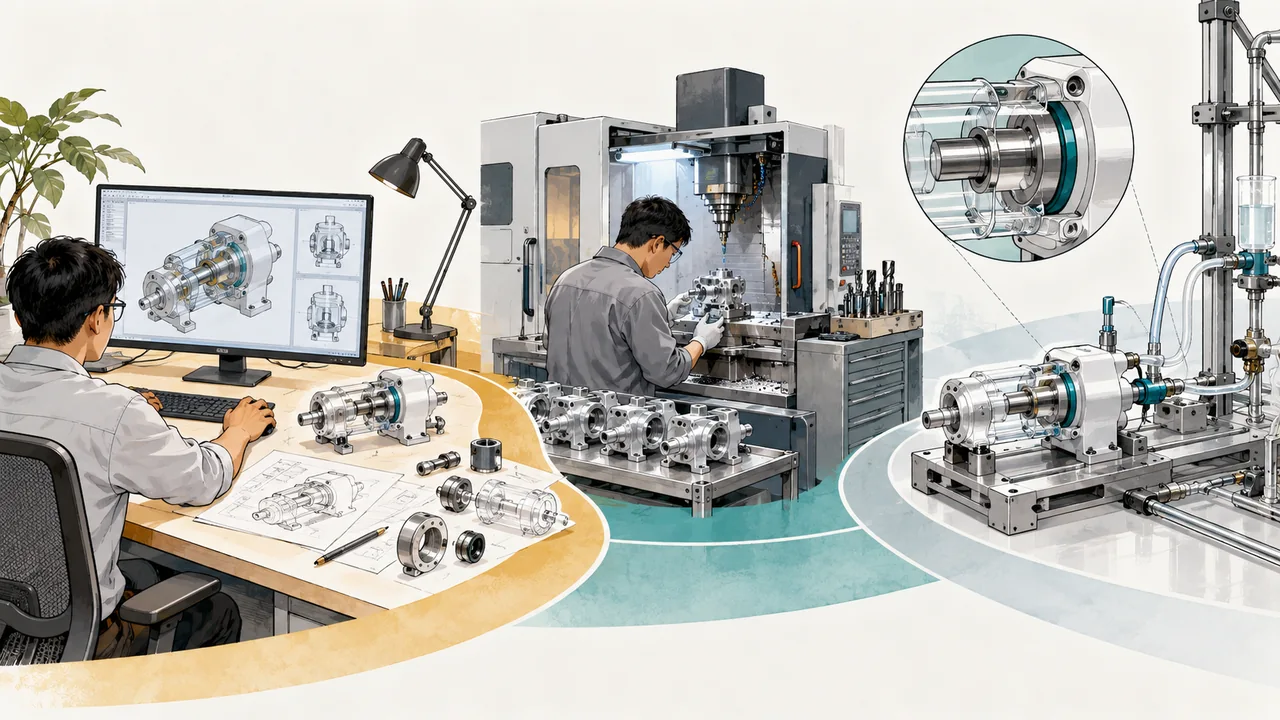
The first ledger is fabrication: materials, programming, printing, machining, tooling and finishing. The second is evidence: test articles, inspection, fixtures and external specialist work. The third is iteration: design revisions, repeated builds and changes to tools or processes.
Separating these ledgers improves quotation comparisons. A proposal that includes extensive inspection may appear more expensive than one offering parts alone, yet the apparent saving disappears when the same inspection is ordered later. Compare scope before comparing totals.
Record recurring and nonrecurring charges separately. Programming or a custom fixture may be reused across builds; a material or finishing charge may recur. Reuse is valuable only when the next revision still fits the approved program, fixture or tooling assumptions.
An Illustrative Budget Calculation
Assume, purely for planning, that three development builds each cost $1,200 and a reusable test fixture costs $1,500. The direct subtotal is $5,100 before other work. If a design revision requires a $700 fixture modification, the subtotal becomes $5,800. These are hypothetical numbers, not market averages or Jucheng prices; the example shows why the fixture and iteration cannot be hidden inside a per-part comparison.
The project should also identify exclusions and uncertainty. Specialist tests, additional sample quantities, shipment and failed iterations may require separate allowances. Avoid presenting a contingency percentage as a universal rule when the remaining risks differ substantially between projects.
Delay Irreversible Decisions, Not Necessary Learning

Early 3D-Druck can help compare forms or assembly arrangements without a production mold. It is less useful when the key question depends on molded material behavior or a production surface. Do not keep using a convenient route after the development question has changed.
Move to representative materials and processes when their differences become decision-critical. A machined polymer housing can support a fit trial but may not answer a snap’s behavior at a molding weld line. A printed metal model may not represent a machined sealing surface without the intended finishing.
Tooling decisions need a gate. Before committing, review stable interfaces, material choice, parting and gate locations, measurement access and the tests already completed. Identify remaining uncertainty and whether the proposed tool can accommodate the likely change.
Schnellwerkzeuge may support selected development questions. Its value depends on the planned learning and representativeness; it is not automatically a low-risk substitute for production tooling. Clarify expected trial quantities, modification provisions and what the tool does not establish.
Fixtures and Samples Are Often the Missing Line Items

A repeatable test needs a repeatable load and reference. A custom fixture may be necessary to grip a flexible part, apply a controlled insertion force or constrain an assembly in its actual operating orientation. Planning it late can delay the evidence even when all prototype parts are ready.
Inspection can also require development. Access to a hidden dimension, optical measurement of a transparent part or a method for a soft seal may need suitable workholding and a documented procedure. Agree these requirements with the supplier rather than assuming every dimension can be checked with a general-purpose tool.
Plan sample quantities with the responsible evaluators. Some evaluations consume or alter samples; other samples may need to be retained for comparison. The team should not promise a universal quantity without understanding the tests, variants and repeat work involved.
Document sample genealogy. A test result loses value if no one can identify the drawing revision, material and finishing state of the sample. The cost of recording that history during manufacture is usually easier to control than the effort of reconstructing it after several iterations.
Make the Next Quotation Answer the Right Question

Provide CAD, controlled drawings, the exact sample role, quantity assumptions and relevant acceptance requirements. Identify which interfaces are stable and which are still being explored. Ask the supplier to distinguish fabrication, tooling, inspection and any proposed development work.
Die medical device prototyping article supports process selection for physical samples. Use it alongside a test plan so the chosen fabrication route matches the evidence needed, not simply the appearance of the finished concept.
For a Jucheng inquiry, request a manufacturing review that explains options and limitations. Confirm project-specific scope, records and specialist responsibilities. A component manufacturing quote should not be interpreted as the total cost of clinical development or device approval.
Should We Budget for One Successful Build?
Only if the evidence and remaining uncertainty justify that assumption. Identify credible iterations and their cost drivers rather than hoping the first build will settle every question. A staged plan can release spending as the design becomes better understood.
Does the Lowest Prototype Price Reduce Development Cost?
Not always. The lowest-priced route may require replacement samples, extra finishing or repeated tests because it is unrepresentative. Compare the cost of answering the development question reliably and the consequences of a wrong decision.
When Can the Production Unit Price Be Trusted?
It becomes more useful when material, geometry, quantities, tooling, finishing and acceptance scope are defined. Early estimates should state their assumptions and be updated as those inputs change, rather than being treated as fixed production commitments.