


Die Fertigung für die Lebensmittel- und Pharmaindustrie ist eine Disziplin, die dadurch definiert wird, was man dem Bauteil nicht hinzufügt. Während Standard-Industriepolymere auf mechanische Festigkeit ausgelegt sind, ist die, FDA-zertifizierte PTFE-Bearbeitung auf absolute biologische Neutralität ausgelegt. In diesen Hochrisikosektoren kann ein einziges mikroskopisches Partikel Mineralöl oder eine Spur von Metallstaub, die in einer Dichtung eingebettet ist, zu einem millionenschweren Produktrückruf oder einem beeinträchtigten medizinischen Gerät führen. PTFE ist aufgrund seiner extremen chemischen Beständigkeit von Natur aus der ideale Kandidat für diese Umgebungen, aber die Reinheit des Materials ist nur so gut wie die Einrichtung, die es formt.
Bei Jucheng Precision sind wir uns bewusst, dass PTFE-Teflon-CNC-Bearbeitung für Lebensmittelkontaktanwendungen erfordert eine grundlegende Quarantäne des Fertigungsprozesses. Es reicht nicht aus, einfach das richtige Harz zu kaufen; der Hersteller muss vom Moment des Wareneingangs bis zum Moment der vakuumversiegelten Verpackung für den Versand der Hüter dieser Reinheit sein. Ob Sie Komponenten für eine Hochgeschwindigkeits-Abfüllanlage oder ein Diagnosegerät entwickeln, das Verständnis der technischen Grenzen von "FDA-zertifiziert" ist unerlässlich. Dieser Leitfaden erläutert die strengen Kontaminationskontrollprotokolle, die JUCHENG anwendet, um sicherzustellen, dass jedes Teflon-Bauteil die strengsten globalen Sicherheitsvorschriften erfüllt.
Reinheit in der Bearbeitung ist eine Frage der dokumentierten Integrität. Es erfordert eine Einrichtung, die den Unterschied zwischen einer Industriedichtung und einer lebensmittelechten Dichtung versteht. Lassen Sie uns die molekularen und operativen Strategien untersuchen, die professionelle FDA-konforme Fertigung definieren.
Der Virgin-Standard: Warum Füllstoffe verboten sind
Kontaminationskontrolle: Das Protokoll für saubere Maschinen
Die Trocken-zuerst-Strategie: Verhinderung von chemischer Auslaugung
Hygienische Oberflächenintegrität: Verhinderung von Bakterienwachstum
Lebenszyklus-Rückverfolgbarkeit: Der Papierpfad der Sicherheit
Der Virgin-Standard: Warum Füllstoffe verboten sind
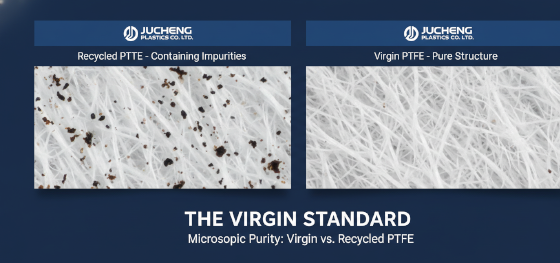
Der erste Schritt in FDA-zertifizierte PTFE-Bearbeitung ist die Verifizierung der Rohmaterial-"DNA". Standard-Industrie-PTFE wird oft mit Füllstoffen modifiziert – Glasfasern, Kohlenstoff, Bronze oder Molybdändisulfid – um seine mechanische Steifigkeit oder Verschleißfestigkeit zu verbessern. Während diese Additive hervorragend für Industriepumpen geeignet sind, sind sie in Lebensmittelkontaktanwendungen strengstens verboten. Füllstoffe können im Laufe der Zeit aus dem Material auslaugen und das Lebensmittel- oder Pharmaprodukt kontaminieren. Darüber hinaus kann recyceltes oder "Repro"-PTFE Spuren gefährlicher Chemikalien aus seinem vorherigen Lebenszyklus enthalten.
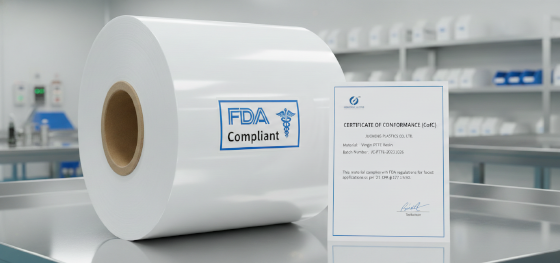
Bei Jucheng Precision verwenden wir ausschließlich 100% Virgin-PTFE für alle FDA-konformen Projekte. Virgin-PTFE wird direkt aus dem Primärharz ohne zugesetzten Abfall oder Füllstoffe hergestellt. Es ist von Natur aus "wasserweiß" im Aussehen und besitzt das höchste Maß an chemischer Reinheit. Wir verifizieren das Material durch umfassende Werksprüfzeugnisse (MTRs) und Konformitätszertifikate (CofC), die ausdrücklich bestätigen, dass das Harz die Anforderungen der FDA 21 CFR 177.1550 erfüllt. Diese technische Basislinie stellt sicher, dass das Material nicht nur ungiftig ist, sondern auch die extreme Hydrophobie (Wasserabweisung) besitzt, die erforderlich ist, um die Absorption von Aromen, Gerüchen oder Bakterien zu verhindern. Durch den Start mit einer reinen Basis eliminieren wir das primäre Risiko der chemischen Migration in Ihrer Verarbeitungsausrüstung.
Kontaminationskontrolle: Das Protokoll für saubere Maschinen
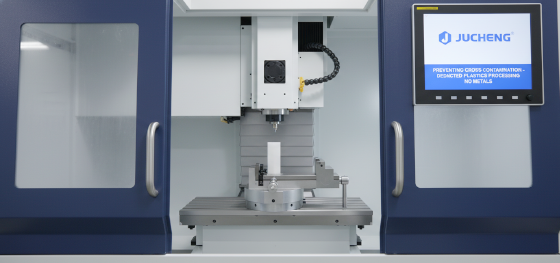
The most common failure in PTFE-Teflon-CNC-Bearbeitung for high-purity sectors is not the choice of material, but the environment of the shop floor. Most CNC machines are saturated with sulfur-based oils and metallic dust from previous jobs. PTFE is a soft material; as the cutting tool moves, it can easily press microscopic shards of steel or copper into the surface of the plastic. This cross-contamination is often invisible to the naked eye but will be detected during a medical audit or food safety inspection.
JUCHENG operates under a "Quarantine Protocol" for all FDA-zertifizierte PTFE-Bearbeitung runs. Before an FDA project begins, the machine enclosure is stripped, deep-cleaned, and inspected for any residual metal fines. We utilize dedicated workholding fixtures—often made from high-density polyethylene or the PTFE material itself—to ensure that no metal-to-plastic contact occurs on critical surfaces. Our tools are segregated; we never use a drill bit on an FDA part if it has previously cut metal. This obsessive level of isolation ensures that the "virgin" state of the material is maintained throughout the entire manufacturing cycle, providing you with parts that are chemically as pure as the resin they were born from.
Die Trocken-zuerst-Strategie: Verhinderung von chemischer Auslaugung
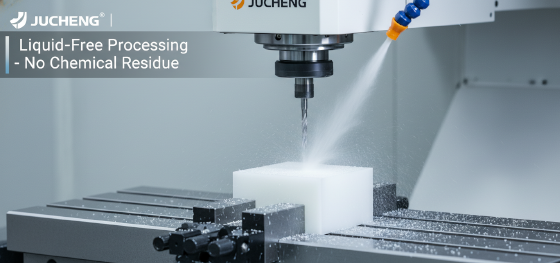
Standard CNC coolants are a primary source of contamination. Even "water-soluble" oils contain biocides and chemical stabilizers that can penetrate the surface of PTFE. Because PTFE is slightly porous at the microscopic level, these chemicals can become trapped within the part, only to "leak" out later when the part is exposed to steam or hot cleaning fluids in a food plant. For FDA-zertifizierte PTFE-Bearbeitung, the only safe strategy is to eliminate liquid coolants entirely.
At Jucheng Precision, we utilize high-pressure, filtered cold air guns to manage thermal energy. The air is filtered to remove all traces of compressor oil and moisture. This air blast serves two critical functions: it keeps the tool tip below the material's softening point and physically clears the "waxy" PTFE chips away from the hole or pocket before they can be re-cut. Dry machining is technically more difficult—it requires perfectly sharp tooling and carefully managed feed rates to prevent the material from melting—but it is the only way to guarantee a chemically inert final product. By removing the risk of liquid absorption, we ensure that your seals and valve seats won't compromise the sterility of your pharmaceutical or food-grade production lines.
Hygienische Oberflächenintegrität: Verhinderung von Bakterienwachstum
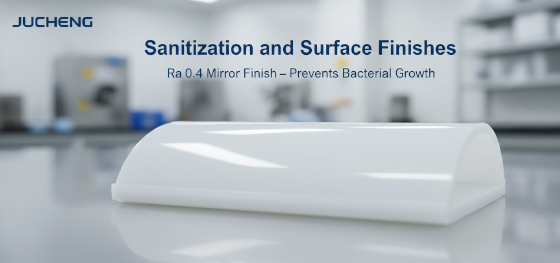
In food and medical equipment, the "roughness" of a part is a safety parameter. Microscopic valleys and tool marks are the perfect breeding ground for bacteria (biofilms). If a surface is too rough, standard CIP (Clean-In-Place) procedures won't be able to reach the microbes hiding in those grooves. Therefore, achieving a superior surface finish is a mandatory requirement for FDA-zertifizierte PTFE-Bearbeitung.
JUCHENG engineers optimize our tool paths to achieve Ra 0.8 µm or better directly off the mill. We avoid traditional hand-sanding or polishing with abrasive pads, as these can embed grit into the soft PTFE surface. Instead, we utilize high-speed diamond-polished carbide tools that slice the plastic fibers so cleanly they leave a mirror-like finish. We also pay close attention to the geometry of internal corners. We design all pockets and transitions with generous radii—avoiding sharp 90-degree internal corners where food particles could get trapped. This focus on "Hygienic Design" ensures that your components are as easy to sanitize as they are precise, helping you meet the most stringent USDA and FDA sanitation requirements.
Lebenszyklus-Rückverfolgbarkeit: Der Papierpfad der Sicherheit
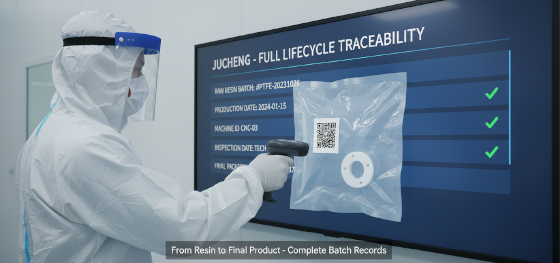
The final hallmark of a professional FDA supplier is the ability to prove everything. In a regulatory audit, if a process isn't documented, it didn't happen. Jucheng Precision provides a comprehensive "Quality Data Package" with every FDA project. This includes the primary Mill Certificate from the resin manufacturer, our internal machining log, and a certificate of conformance signed by our quality manager.
We maintain full "Heat Number" traceability. This means if a batch of resin is ever found to have a defect, we can tell you exactly which parts were made from that batch and when they were shipped. This transparency is essential for global brands in the beverage, dairy, and medical device sectors. Our PTFE-Teflon-CNC-Bearbeitung workflow is designed to pass the most rigorous customer audits, providing you with the peace of mind that your supply chain is secure and compliant. When you choose Jucheng Precision, you aren't just buying a component; you are buying the engineered assurance of food-grade purity. Contact our team today for a full technical review of your next FDA-compliant project.

