


Die Bearbeitung von Polytetrafluorethylen, dem Material, das bekanntermaßen als Teflon bekannt ist, ist eine Übung im Umgang mit einer "festen Flüssigkeit". Für Ingenieure ist PTFE ein Wunderwerk der chemischen Trägheit und geringen Reibung. Für den Zerspaner ist es jedoch ein dimensionsinstabiler Geist, der sich jeder konventionellen Fertigungsregel widersetzt. Der Kampf um die Einhaltung konsistenter PTFE-Toleranzen bei der Zerspanung ist der Hauptgrund, warum viele Werkstätten sich weigern, komplexe Teflon-Bauteile anzubieten. Das Material ist so weich, dass es sich unter dem Gewicht einer Mikrometerschraube verformt, und es besitzt eine Wärmeausdehnungsrate, die ein "bestandenes" Teil in ein "Versagen" verwandeln kann, nur indem man es von einer kalten Werkstatt zu einer warmen Montagelinie bringt.
Bei Jucheng Precision behandeln wir Teflon nicht wie einen Standardkunststoff. Wir behandeln es als eine temperaturempfindliche technische Herausforderung. Der Erfolg bei PTFE-Teflon-CNC-Bearbeitung erfordert eine Beherrschung der Thermodynamik und spezielle Spannmittel, die den meisten Generalisten-Werkstätten fehlen. Ob Sie nun Hochspannungsisolatoren oder chemisch beständige Dichtungen für die Halbleiterindustrie konstruieren, das Verständnis der Kräfte, die Ihre Maße zum Driften bringen, ist der einzige Weg, um sicherzustellen, dass Ihr Produkt im Feld überlebt. Dieser Leitfaden untersucht die technische Strenge, die JUCHENG anwendet, um das "Instabile" zu stabilisieren und Toleranzen zu liefern, die andere für dieses rutschige Polymer für unmöglich halten.
Präzision bei PTFE entsteht nicht an der Maschinenspindel; sie entsteht im Messlabor und im Klimakontrollsystem. Sich von der Denkweise "gut genug" zu verabschieden, ist unerlässlich, wenn Ihre Baugruppe von einer perfekten Abdichtung abhängt. Lassen Sie uns in die technischen Strategien eintauchen, die weltklasse Teflon-Fertigung definieren.
Inhalt:
Das Weichheitsparadoxon: Messen ohne Verformen
Thermodynamische Verschiebung: Der 19-Grad-Übergang
Das Schärfegebot: Das Rutschige schneiden
Das Unspannbare spannen: Spannungsfreie Werkstückhaltung
JUCHENGs Messtechnik: Verifikation in der Kälte
Das Weichheitsparadoxon: Messen ohne Verformen
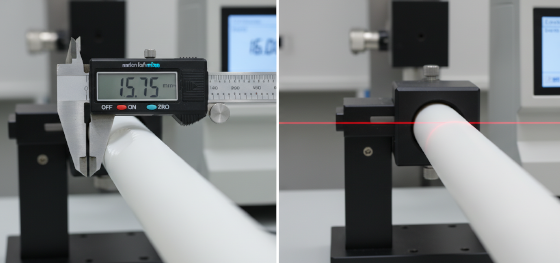
Das erste Hindernis für enge PTFE-Toleranzen bei der Zerspanung ist der Messvorgang selbst. PTFE hat einen sehr niedrigen Elastizitätsmodul, was bedeutet, dass es unglaublich leicht zu komprimieren ist. Wenn ein Qualitätsprüfer eine Standard-Handmikrometerschraube verwendet und auch nur ein leichtes "Gefühl" auf die Trommel ausübt, kann der Druck des Werkzeugs das Material tatsächlich um 0,02 mm oder mehr komprimieren. Der Prüfer denkt, das Teil sei untermaßig, während er in Wirklichkeit die Abmessung beim Messen physisch verändert. Dies erzeugt eine falsche Datenschleife, die die Produktionskonsistenz ruiniert.
Jucheng Precision solves this "Softness Paradox" by utilizing non-contact metrology for all high-precision Teflon projects. We employ high-resolution optical comparators and vision systems that use light, rather than physical probes, to verify dimensions. When physical contact is unavoidable, we utilize "low-force" digital indicators calibrated specifically for polymers. By eliminating the operator's "touch" from the equation, we provide an objective, accurate baseline for our PTFE-Teflon-CNC-Bearbeitung. We understand that you cannot reach a tolerance you cannot accurately measure, and our investment in non-contact inspection is the first step in guaranteeing the integrity of your seals and gaskets.
Thermodynamische Verschiebung: Der 19-Grad-Übergang
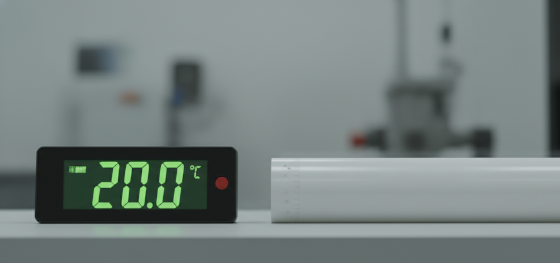
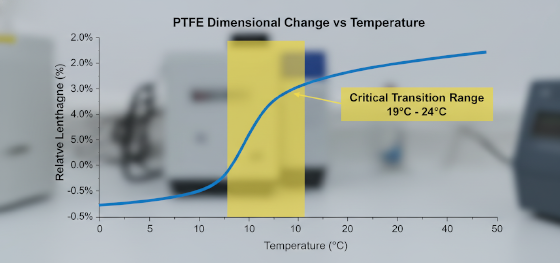
PTFE behaves unlike almost any other plastic due to a unique phase transition that occurs near room temperature. Between 19°C and 24°C (66°F to 75°F), the crystalline structure of PTFE undergoes a dramatic shift, resulting in a volume change of approximately 1%. This might seem small, but in a part requiring a +/- 0.05mm tolerance, this 1% expansion is a disaster. If a part is machined at 18°C and then installed in a facility at 25°C, it will no longer fit. This thermal instability is the primary culprit behind the "drifting dimensions" that plague most PTFE-Teflon-CNC-Bearbeitung suppliers.
To combat this, Jucheng Precision operates a strictly climate-controlled manufacturing environment. We stabilize our entire production floor and inspection lab at a constant temperature, avoiding the critical 19°C-24°C transition zone during the machining process. More importantly, we perform "Thermal Mapping" for our clients. If we know the part will operate in a high-heat chemical reactor, we calculate the expansion and machine the part "undersized" at room temperature so that it expands in the correct tolerance during service. This proactive thermodynamic approach ensures that the PTFE-Toleranzen bei der Zerspanung we deliver are functional in the real world, not just on a cold inspection table. We don't fight the expansion; we engineer for it.
Das Schärfegebot: Das Rutschige schneiden
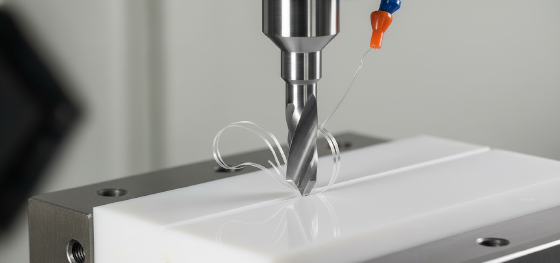
PTFE is notoriously slippery, which means a dull tool won't cut the material—it will simply skate over it, creating frictional heat and localized stress. If a tool "pushes" the plastic rather than shearing it, the material will experience "elastic recovery." The part will look correct while the tool is engaged, but once the pressure is released, the material will spring back, causing a hole to shrink or a diameter to swell. This behavior makes achieving consistent PTFE-Toleranzen bei der Zerspanung impossible with standard metalworking tools.
At Jucheng Precision, we follow the "Sharpness Mandate." We utilize specialized carbide tooling with extremely high positive rake angles and polished flutes. These tools are designed to act like a razor blade, slicing through the PTFE chains with virtually zero cutting force. By reducing the force, we reduce the heat and the deformation. We also utilize high-helix flutes to ensure that the light, "waxy" chips are evacuated instantly. If PTFE chips are re-cut, they smear and fuse back onto the part, destroying the surface finish and the tolerance. Our commitment to using only virgin, high-grade cutting edges for every precision Teflon run is what enables us to achieve Ra 0.8 finishes and tight tolerances that other shops consider "metal-only" territory.
Das Unspannbare spannen: Spannungsfreie Werkstückhaltung
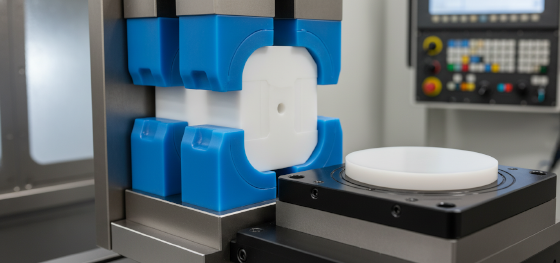
How do you hold a material that is designed to be a lubricant? Clamping is the most common source of error in PTFE-Teflon-CNC-Bearbeitung. If you tighten a standard vice on a PTFE block, you will crush it. The material will cold-flow around the jaws, and once you release the pressure, the part will warp into a completely different shape. The stress induced by traditional clamping is a silent killer of PTFE-Toleranzen bei der Zerspanung.
JUCHENG engineers utilize "Stress-Free Workholding" techniques to protect the material. We design custom "Soft Jaws" that wrap 360 degrees around a part, distributing the clamping force across the maximum possible surface area to prevent localized deformation. For thin-walled parts or large plates, we utilize high-flow vacuum tables or specialized adhesive fixtures that hold the material without any compressive force at all. By minimizing the internal stress during the machining cycle, we ensure that the part doesn't "relax" into a non-conforming shape after it is removed from the machine. This attention to the physics of fixturing is what allows us to produce large-diameter Teflon seals that remain perfectly round and flat.
JUCHENGs Messtechnik: Verifikation in der Kälte
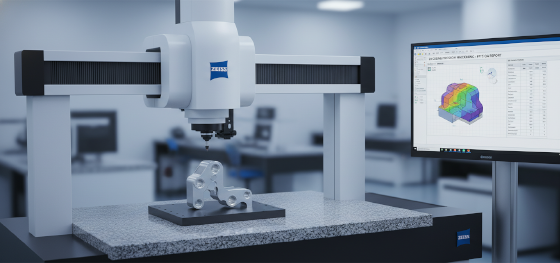
The final hallmark of a professional plastic manufacturer is the ability to prove the work. In the world of high-end semiconductor and pharmaceutical equipment, an unverified tolerance is a liability. Jucheng Precision recognizes that PTFE-Toleranzen bei der Zerspanung must be backed by a transparent and rigorous validation process. Every high-precision Teflon component we manufacture undergoes a stabilized inspection cycle.
We utilize multi-sensor CMMs that combine optical imaging with low-force touch probes to generate a complete dimensional map of your part. We provide our clients with detailed inspection reports that include thermal data, ensuring you know exactly at what temperature the part was measured. This level of transparency is essential for global supply chains where parts might be machined in Asia and assembled in Europe. When you partner with JUCHENG, you aren't just buying a piece of Teflon; you are buying the engineered certainty that your components will perform under pressure, in harsh chemicals, and across varying temperatures. Don't risk your critical seals with a shop that doesn't understand the complex thermodynamic soul of PTFE. Contact Jucheng Precision today for a full DFM review and experience the precision that specialized PTFE-Teflon-CNC-Bearbeitung can bring to your next project.

