

Konstruktion für die Passung: Wie viel Toleranz für 3D-Druck-Baugruppen hinzufügen
Aufrufe: 8 Autor: Allen Xiao Veröffentlichungszeit: 2026-02-19


Nichts tötet einen technischen Prototyp schneller als eine hochpräzise Baugruppe, die sich weigert, zusammenzubauen. Im reibungslosen Vakuum der CAD-Software passt ein 10,00-mm-Stift perfekt in ein 10,00-mm-Loch. Doch sobald das Design die physische Baukammer betritt, übernehmen die Gesetze der Wärmeausdehnung und des Materialverhaltens. Wenn Sie nicht berechnet haben, wie viel Toleranz für 3D-Druck hinzugefügt werden muss, wetten Sie im Wesentlichen mit Ihrem Produktionsbudget. Die meisten Ingenieure nehmen an, dass die Teile automatisch passen, wenn die Maschine auf ±0,1 mm genau ist. Die Realität ist, dass "Genauigkeit" und "Passung" zwei verschiedene Sprachen sind. Die Erzielung eines funktionierenden Gleitmechanismus oder einer sicheren Presspassung erfordert einen bewussten technischen Spalt – ein beabsichtigtes Spiel, das entwickelt wurde, um das inhärente Rauschen des 3D-Druck-Toleranzen Zyklus zu überstehen.

JUCHENG fungiert als strategisches technisches Refugium für Hardware-Teams, die sich die Verzögerungen eines "Versuch-und-Irrtum"-Prototyping-Zyklus nicht leisten können. Wir haben Tausende von Projekten gesehen, bei denen "Linie-zu-Linie"-Designs zu Teilen führten, die durch Schichtlinienreibung praktisch miteinander verschweißt waren. Wir "drucken nicht nur Ihre Datei"; wir fungieren als Filter für Design-for-Manufacturing (DFM). Durch das Verständnis der spezifischen Rheologie der Harze und der Abkühlraten der von uns verwendeten Pulver bieten wir unseren Kunden eine verifizierte Roadmap für die Montage. Dieser Leitfaden geht über die generischen Tabellen hinaus, um die Physik des mechanischen Spiels, die Auswirkung der Oberflächentextur auf die Passung und zu untersuchen, warum der integrierte Prüfprozess von JUCHENG der einzige Weg ist, um sicherzustellen, dass Ihre komplexen mehrteiligen Designs in dem Moment funktionieren, in dem sie von der Bauplattform kommen.
Profitabilität in der Hardware-Innovation wird von denen gewonnen, die die Montage-Nacharbeitsschleife eliminieren. Sie kaufen nicht nur eine Kunststoffkomponente; Sie kaufen die verifizierte Beziehung zwischen zwei passenden Oberflächen. Ob Sie ein kompliziertes chirurgisches Robotergelenk oder ein hochbelastbares Automobilbefestigungselement bauen, die Logik des Spalts ist Ihr primärer Fertigungsregler. Lassen Sie uns die physikalischen Gesetze des Spiels aufschlüsseln und sehen, wie technische Weitsicht die Integrität Ihrer nächsten Baugruppe in der physischen Realität verankern kann.
Der kritische Unterschied: Spiel vs. Maschinentoleranz
Allgemeine Spielregeln: Abbildung des Baugruppenspektrums
Materialeinfluss: Wie Polymere den Konstruktionsspalt bestimmen
Schichtlinienreibung: Die Oberflächentextursteuer
JUCHENGs DFM-Protokoll: Validierung der Montagelogik
Der kritische Unterschied: Spiel vs. Maschinentoleranz

Um zu verstehen wie viel Toleranz für 3D-Druck hinzugefügt werden muss, müssen Sie zuerst das Verhalten der Maschine von Ihrer Konstruktionsabsicht trennen. Toleranz ist der unbeabsichtigte Fehler. Es ist die ±0,1-mm-Abweichung, die durch den Brennpunkt des Lasers oder die thermische Schrumpfung des Nylons verursacht wird. Sie können dies nicht kontrollieren; Sie können es nur berücksichtigen. Spiel ist der beabsichtigte Spalt. Es ist der Raum, den Sie bewusst in Ihr CAD-Modell einbauen, um sicherzustellen, dass sich eine Welle drehen kann oder ein Deckel einrasten kann.
The biggest trap for engineers is designing "Nominal-to-Nominal." If you design a 10mm hole and a 10mm pin, and the machine has a tolerance of ±0.1mm, you could end up with a 9.9mm hole and a 10.1mm pin. That 0.2mm interference will make assembly impossible without heavy sanding. At Jucheng Precision, we explain this as a "Confidence Offset." Your design clearance must be large enough to absorb the worst-case tolerance deviation of the machine. If the machine's 3D-Druck-Toleranzen are ±0.15mm, your intentional clearance should ideally be at least 0.3mm to ensure a loose, functional fit. By decoupling these two concepts in your mind, you move from "hoping it fits" to "engineering the assembly." We treat these gaps as functional specifications, ensuring that the friction of the real world matches the intent of your digital simulation.
Allgemeine Spielregeln: Abbildung des Baugruppenspektrums

Erfolgreiche 3D-Druck-Konstruktion requires a tiered approach to clearances. There is no universal number that fits every part. Instead, we categorize fits based on the required mechanical movement. During our technical reviews at Jucheng Precision, we use the following industrial baselines for parts with a surface area under 100mm.
1. Loose Fit (0.3mm - 0.5mm Clearance): This is the "Safe Zone" for parts that must move freely or have high-build complexity. We recommend this for sliding lids, non-precision hinges, or interlocking toy components. It allows for significant thermal warping and layer artifacts without the parts seizing.
2. Standard Fit (0.15mm - 0.2mm Clearance): This is the gold standard for functional prototypes. It provides a "Precise Sliding" feel, perfect for pivoting robotic joints or guided mounts. It requires an industrial-grade printer (SLA or MJF) to maintain the consistency needed to hit this window.
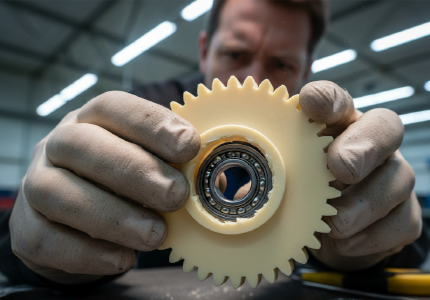
3. Tight Fit (0.05mm - 0.1mm Clearance): This is the "Danger Zone" where wie viel Toleranz für 3D-Druck hinzugefügt werden muss reaches its physical limit. This is intended for parts that should stay together through friction once assembled but can still be pulled apart.
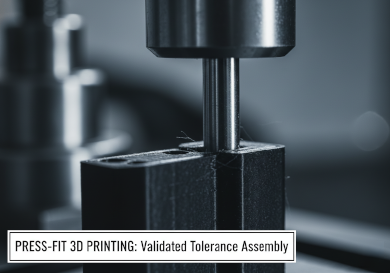
4. Press Fit (0.0mm or Interference): For parts that must be hammered or pressed together permanently. This requires a specific design strategy involving "Crush Ribs," which we will explore in subsequent technical articles. By applying these tiered rules to your CAD model, you ensure that JUCHENG can deliver a part that functions exactly as your assembly logic intended.
Materialeinfluss: Wie Polymere den Konstruktionsspalt bestimmen

The chemistry of the material is the invisible hand that shifts your tolerances. A 0.2mm clearance in a rigid, stable resin (like Somos Next) feels completely different than the same clearance in a hygroscopic Nylon 12. At Jucheng Precision, we analyze the "Material Personality" before we approve a fitment design. Rigid materials allow for tighter clearances because they don't deform under the pressure of assembly. However, they are also less forgiving of errors—if the clearance is too small, they will crack rather than yield.
Nylons (SLS/MJF) present a unique challenge. While they are tough and can "yield" into a fit, they also absorb moisture from the air and swell in volume. If you design a precision hinge in Nylon with a 0.1mm clearance, it may work perfectly in our climate-controlled lab but seize up after a week in a humid shipping container. We often recommend adding an extra 0.05mm of clearance to Nylon parts specifically to account for this environmental "thirst." For high-performance polymers like PEEK 3D Printing, the challenge is thermal shrinkage. The material contracts aggressively as it cools. We help our clients navigate these chemical trade-offs, ensuring that wie viel Toleranz für 3D-Druck hinzugefügt werden muss is calculated based on the material's real-world behavior, not just its theoretical datasheet. We bridge the gap between polymer science and mechanical fit.
Schichtlinienreibung: Die Oberflächentextursteuer

A 3D printed surface is not flat; it is a landscape of microscopic ridges and valleys. In 3D-Druck-Toleranzen, these layer lines act like a series of tiny mechanical teeth. When two 3D printed surfaces slide against each other, these teeth interlock, creating a "Texture Tax"—an artificial increase in friction that can make a correctly sized clearance feel "tight" or "gritty." This is especially prevalent in FDM and MJF technologies where the surface roughness (Ra) is higher.
To achieve a smooth "User Experience" (UX) in your prototypes, JUCHENG suggests a "Texture Offset." We advise adding an additional 0.05mm of clearance beyond the machine's tolerance just to compensate for the "peak-to-peak" contact of the layer lines. Alternatively, we utilize Vapor Smoothing to melt these peaks, effectively turning a "gritty" SLS part into a "silky" injection-molded surrogate. By sealing the surface, we reduce the coefficient of friction, allowing you to use tighter clearances for a more professional mechanical feel. We treat surface integrity as a functional variable, ensuring that the "tactile honesty" of your part is not ruined by the unintended physics of the build process. We don't just print layers; we manage the interface where those layers meet.
JUCHENGs DFM-Protokoll: Validierung der Montagelogik

The final hallmark of a professional manufacturing partner is the move away from guesswork. At Jucheng Precision, we have codified the wie viel Toleranz für 3D-Druck hinzugefügt werden muss query into a rigorous DFM protocol. We don't just "hope" your assembly fits; we validate it. When you upload an assembly file to our system, our engineers perform a "Virtual Fitment Check." We look for "Zero-Gap" zones and flag them immediately. We know that for a surgical instrument prototype or a high-speed robotics mount, a seized assembly is a lost week of R&D.
We also offer "Tolerance Testing Kits" for our long-term partners. Before a massive production run, we can print a small coupon featuring a series of pins and holes with varying clearances (0.1mm to 0.5mm). This allows you to physically test the fitment with your chosen material and technology, identifying the exact "feel" your end-user requires. This empirical approach eliminates the uncertainty of digital modeling, providing you with the data needed to lock in your final dimensions with 100% confidence. When you receive a shipment from JUCHENG, you receive components that are visually identical to your vision and mechanically ready for work. Contact Jucheng Precision today for a technical DFM review and see how our assembly protocols can clarify and secure your next 3D manufacturing breakthrough.


ㆍDatenschutz: Wir respektieren Ihre Privatsphäre. Hier finden Sie ein Beispiel einer Geheimhaltungsvereinbarung. Mit dem Absenden dieses Formulars stimmen Sie unseren AGB und der Datenschutzerklärung zu.
