


Das Senden von Legierungen mit hohem Siliziumgehalt an eine Standard-Oberflächenbehandlungswerkstatt garantiert eine kosmetische Katastrophe. Einkaufsteams erwarten oft glänzende, schöne Smartphone-Oberflächen auf ihren Strukturgussteilen und ignorieren dabei völlig die zugrunde liegende Metallurgie. Die Durchführung von Eloxierprotokollen für Aluminium-Druckguss erfordert den Kampf gegen genau die Elemente, die das flüssige Metall so gut in der Form fließen lassen. Silizium weigert sich zu oxidieren und hinterlässt eine schreckliche, fleckige, schlammig-graue Oberfläche, die sofort die visuelle Qualitätskontrolle nicht besteht.

Die Rettung dieser beeinträchtigten Chargen verschwendet enormes Kapital und verzögert Produkteinführungen erheblich. Die Bewertung Ihrer Ausgangsbasis- Druckguss-Oberflächenfinish Strategie muss erfolgen, bevor Sie jemals das Werkzeugbudget genehmigen. Mit unseren massiven chemischen Verarbeitungslinien in Shenzhen verhindert JUCHENG aktiv diese kostspieligen Fehler, indem es Ihre ästhetischen Anforderungen mit der kommerziellen metallurgischen Realität abgleicht.
Das Erzwingen inkompatibler Chemie zerstört schnell Gewinnmargen. Lassen Sie uns genau entschlüsseln, warum Silizium elektrische Oxidationsbäder ruiniert, wie unsere speziellen sauren Vorbehandlungen die Oberfläche sauber abtragen und wann Sie auf alternative schwere Beschichtungen umsteigen sollten.
Inhalt:
Der Silizium-Albtraum: Warum erscheinen schwarze Flecken?
Spezielle Vorbehandlung: Angriff auf die Oberflächenchemie
Type III Hartanodisierung vs. Einzelhandelskosmetik
JUCHENG Hub: Beherrschung der Chemie im eigenen Haus
FAQ: Ehrliche Antworten zu Maßveränderung und Farbe
Der Silizium-Albtraum: Warum erscheinen schwarze Flecken?
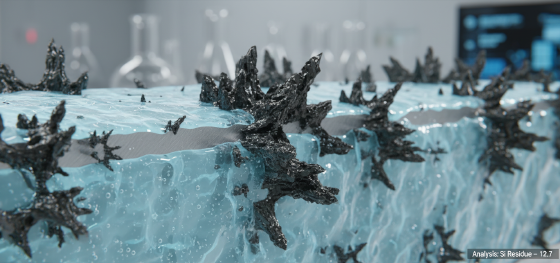
Das Gießen von flüssigem Metall erfordert hohe Dosen von Silizium, um sicherzustellen, dass die Legierung komplexe Hohlräume füllt, ohne vorzeitig zu erstarren. Dasselbe vorteilhafte Silizium wird im chemischen Bad zu einer massiven Belastung. Standard-Schwefelsäure löst die umgebende Metallmatrix vollständig auf, lässt aber die Siliziumflocken auf der Außenhaut unberührt.
Das Zurücklassen dieser mikroskopischen Inseln erzeugt einen schrecklichen Defekt, der in der Branche als Smutting bekannt ist. Die visuelle Inspektion zeigt eine hässliche, gesprenkelte Textur, die wie verbrannte Asche aussieht, anstatt wie hochwertige Metallpanzerung. Unwissende Drittanbieter-Oberflächenbehandlungswerkstätten zucken einfach mit den Schultern und geben Ihrer Gießerei die Schuld für die Bereitstellung schmutziger Rohmaterialien.
Die Behebung dieser chemischen Inkompatibilität erfordert aggressive, hochspezialisierte Fabrikeingriffe. Das Senden von Standard-ADC12- oder A380-Teilen in eine normale Tauchlinie ist gleichbedeutend mit dem Verbrennen Ihres Fertigungsbudgets.
Spezielle Vorbehandlung: Angriff auf die Oberflächenchemie
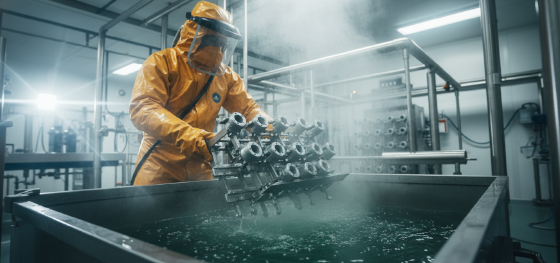
How do professional factories successfully oxidize high-silicon parts?
By submerging the raw hardware into highly hazardous fluoride-based acid dips, which aggressively dissolve the stubborn silicon flakes off the skin before the part ever enters the final electrical tank.
Standard alkaline etching baths used for extruded metal will absolutely destroy a raw casting. Controlling this severe pre-treatment precisely allows the subsequent protective layer to grow uniformly across the substrate. While you still cannot achieve a bright, clear cosmetic color, this specialized prep delivers a highly consistent, dark matte finish.
Managing these dangerous chemicals requires extreme environmental controls. Cheap brokers avoid this process entirely because handling hydrofluoric acid safely demands massive infrastructure investments that small machine shops simply cannot afford.
Type III Hartanodisierung vs. Einzelhandelskosmetik
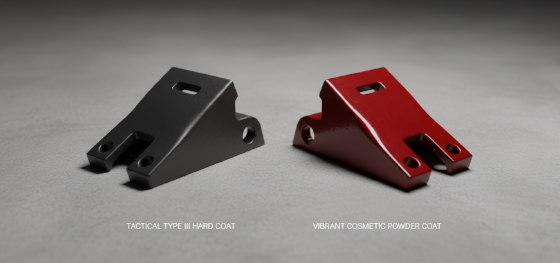
When should hardware engineers actively demand this specific chemical treatment?
Military and aerospace buyers mandate this dark, tactical finish when extreme mechanical abrasion resistance and electrical insulation completely outrank visual beauty.
Type III hard coats build a thick, incredibly tough ceramic-like armor directly into the metal substrate. Demanding bright red or vibrant blue colors on these specific alloys remains mathematically impossible. The thick oxide layer naturally cures into deep olive or gunmetal gray.
Pivoting your strategy toward robust aluminum die casting powder coating completely bypasses the silicon trap if your consumer product requires vibrant retail aesthetics. This alternative delivers flawless, colorful cosmetic protection while hiding the underlying raw metal completely.
JUCHENG Hub: Beherrschung der Chemie im eigenen Haus
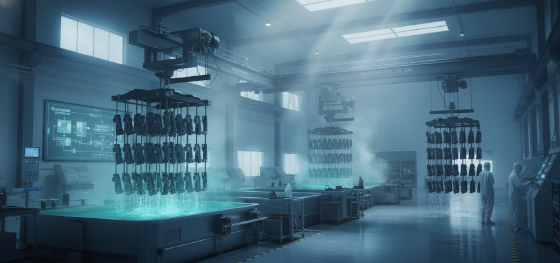
Fragmented supply chains destroy accountability. If a raw casting sits in a humid warehouse for a week before plating, natural oxidation permanently ruins the microscopic surface chemistry. Housing our automated dipping lines directly next to our high-tonnage injection presses eliminates this transit decay entirely.
Transitioning your hardware seamlessly into our chromate conversion coating die casting bay ensures absolute corrosion defense if hard oxidation proves too expensive for your commercial application. We adapt the chemical defense dynamically based on your budget.
Stop paying for ruined batches of mottled, ugly hardware. Send your structural CAD files to our engineering team today. We ruthlessly audit your material choices and deploy the perfect chemical defense strategy for your global rollout.
FAQ: Ehrliche Antworten zu Maßveränderung und Farbe

Can you perform bright dip cosmetic processing on ADC12 or A380 alloys?
Absolutely not. The inherent chemistry of those specific high-flow grades guarantees a dark, patchy finish. Bright cosmetic colors strictly require extruded or CNC-machined billet stock.
Does the thick oxide layer change the dimensions of my tapped screw holes?
Yes, the protective coating grows both into and out of the metal surface, adding measurable thickness. We mathematically oversize our CNC threading operations beforehand to compensate for this exact chemical growth.
Will aggressive mechanical polishing fix the ugly dark spots before the acid bath?
Polishing creates a smoother baseline but cannot change the chemical reality of the silicon flakes. The dark smutting effect will still appear during oxidation, regardless of how aggressively the raw metal was buffed.
What happens if the part is left in the etching tank for too long?
Over-etching physically burns the metallic matrix, dissolving critical dimensional tolerances and leaving the component structurally weakened and completely useless for assembly.

