


Korrosion ist der geduldige Feind von Industriestahl. Egal wie präzise die Bearbeitung oder wie starr die Legierung ist, die Einwirkung von Feuchtigkeit beginnt den chemischen Countdown in Richtung Eisenoxid. Für massenproduzierte Verbindungselemente, Halterungen und Strukturkomponenten benötigen Ingenieure eine Verteidigung, die ebenso zuverlässig wie wirtschaftlich ist. Diese technische Lücke wird perfekt gefüllt durch Verzinkung von Stahl. Es ist die weltweit am häufigsten verwendete CNC-Bearbeitung Oberflächenbehandlung, die als wesentliche "Rüstung" für Kohlenstoffstahlteile dient, die in realen Umgebungen überleben müssen, ohne die Kosten von Edelstahl.
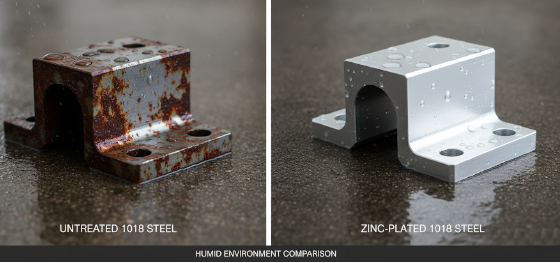
Bei Jucheng Precision erkennen wir an, dass Beschichtung nicht nur eine kosmetische Schicht ist; sie ist eine technische Barriere. Wir verstehen, dass eine 10-Mikron-Zinkschicht den Unterschied zwischen einem Teil, das zehn Jahre hält, und einem, das in zehn Wochen versagt, ausmachen kann. Der Prozess ist jedoch nicht ohne Risiko, insbesondere bei hochfesten Legierungen. Dieser Leitfaden taucht ein in die elektrochemische Physik des Zinkschutzes, die strategische Auswahl von Chromatierungskonversionsfarben und die kritische Gefahr der Wasserstoffversprödung, die JUCHENG für jedes missionskritische Projekt verwaltet.
Erfolg bei der Rostverhütung erfordert mehr als nur ein Eintauchen in einen Tank. Es erfordert eine Einrichtung, die die Beziehung zwischen dem Stahlsubstrat und der metallischen Beschichtung versteht. Lassen Sie uns die technischen Säulen untersuchen, die Zink zum Goldstandard für kostengünstigen Schutz machen.
Chemie der Opferung: Wie Zink Stahl schützt
Chromatierungskonversion: Von Klar zu Gelb und Schwarz
Versteckter Killer: Umgang mit Wasserstoffversprödung
Maßkontrolle: Dicke und Gewindetoleranzen
JUCHENG-Standard: Integrierter Rostschutz
Chemie der Opferung: Wie Zink Stahl schützt
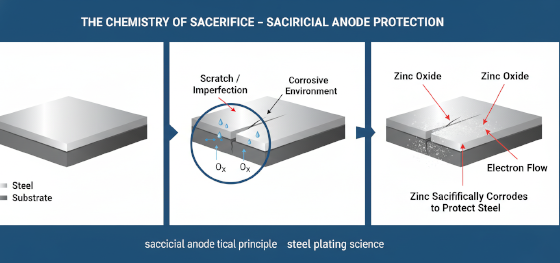
Um den Wert von Verzinkung von Stahl, muss man sich die galvanische Spannungsreihe der Metalle ansehen. Stahl ist ein relativ "edles" Metall, während Zink hochaktiv ist. Wenn Sie Stahl mit Zink beschichten, schaffen Sie nicht nur eine physische Wand; Sie schaffen eine "Opferanode". Wenn die Zinkschicht zerkratzt wird und der darunterliegende Stahl Feuchtigkeit ausgesetzt ist, reagiert das Zink zuerst chemisch. Es "opfert" seine eigenen Elektronen, um den Sauerstoff und die Feuchtigkeit zu neutralisieren, bevor sie die Eisenatome im Stahl angreifen können.
Dies ist der grundlegende Grund, warum Zink für den grundlegenden Rostschutz Nickel oder Chrom überlegen ist. Wenn Sie ein verchromtes Teil zerkratzen, rostet der Stahl unter dem Kratzer aggressiv, wodurch oft die restliche Beschichtung vom Teil abgehoben wird. Wenn Sie ein verzinktes Teil zerkratzen, "heilt" das umgebende Zink die Wunde effektiv durch elektrochemischen Strom und verhindert, dass sich der Rost ausbreitet. Bei Jucheng Precision erklären wir unseren Kunden diese Logik täglich: Sie kaufen nicht nur eine Farbe; Sie kaufen ein aktives chemisches Verteidigungssystem, das 24/7 ohne Strom oder Wartung arbeitet. Dieser galvanische Schutz macht verzinkten Stahl zum Standard für Automobilhalterungen, Industriebefestigungen und landwirtschaftliche Geräte, die in Schlamm, Regen und Feuchtigkeit überleben müssen.
Chromatierungskonversion: Von Klar zu Gelb und Schwarz
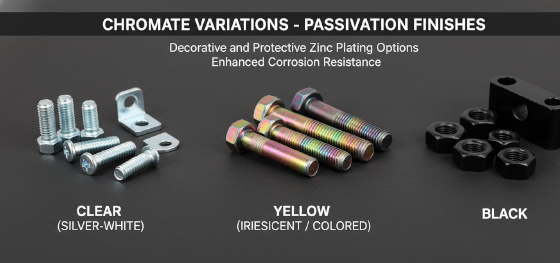
Die Zinkschicht selbst ist ziemlich weich und neigt zu einer weißen, pulvrigen Korrosion, die als "Weißrost" bekannt ist. Um dies zu verhindern und die optische Attraktivität zu verbessern, tragen wir einen sekundären chemischen Film auf, der als Chromatierungskonversionsbeschichtung bekannt ist. Dieser Film bestimmt sowohl die endgültige Ästhetik als auch die Anzahl der Stunden, die das Teil in einer Salzsprühkammer überleben kann. Die Wahl des Chromatierungsmittels ist eine strategische technische Entscheidung.
Klar (Blau-Weiß) Zink: This provides a clean, silvery appearance that looks similar to stainless steel. It is the most common finish for electronics and medical components. However, its corrosion resistance is the lowest of the family, usually rated for 12 to 24 hours before white rust appears.
Yellow (Iridescent) Zinc: Often called "Gold Zinc," this finish uses hexavalent or trivalent chromium to provide a significantly thicker and more durable film. It is the industrial workhorse, often rated for 96 to 150 hours of salt spray protection.
Black Zinc: Used primarily for aesthetics and to reduce light reflection in optical or military assemblies. It offers a sleek matte or semi-gloss black finish while providing protection comparable to yellow zinc. JUCHENG technicians manage these chemical baths with strict concentration controls, ensuring that the color you specify today matches the batch we ship next year.
Versteckter Killer: Umgang mit Wasserstoffversprödung
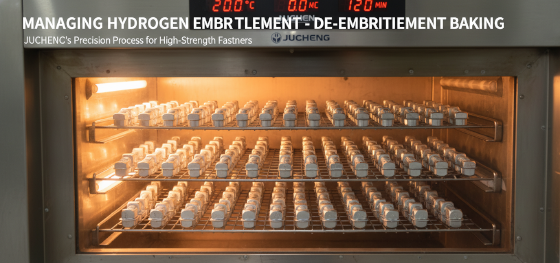
There is a critical danger in Verzinkung von Stahl that many inexperienced shops ignore: Hydrogen Embrittlement. During the acid cleaning and electroplating stages, atomic hydrogen is released and can be absorbed into the crystalline structure of the steel. In standard low-carbon steel like 1018, this is not an issue. But in high-strength steels (typically those with a hardness over 31 HRC or a tensile strength over 1000 MPa), these hydrogen atoms act like tiny wedges, causing the metal to become brittle and snap under load without warning.
At Jucheng Precision, we implement a mandatory "De-Embrittlement Baking" protocol for all high-strength alloy parts. Within four hours of leaving the plating tank, parts are placed in a calibrated industrial oven at roughly 190°C to 210°C for up to 24 hours. This thermal energy forces the trapped hydrogen atoms to migrate out of the metal, restoring its original toughness. We understand that for a Grade 8.8 or 12.9 fastener, skipping this step is a recipe for a catastrophic field failure. Our integrated quality system tracks the time between plating and baking, providing our aerospace and automotive clients with the documentation required for mission-critical safety standards. We don't just protect the surface; we preserve the structural soul of the metal.
Maßkontrolle: Dicke und Gewindetoleranzen
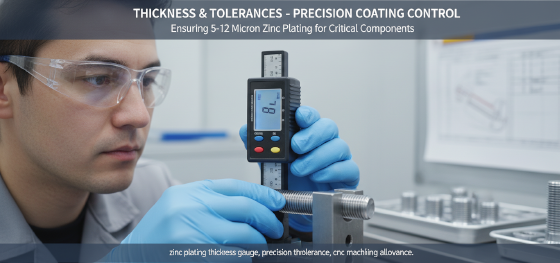
One of the most frequent headaches for a CNC machinist is the "buildup" of the finish. Zinc plating is an additive process. A standard commercial plating adds between 5 to 12 microns (0.0002" to 0.0005") of thickness per surface. While this sounds microscopic, it is effectively doubled on a diameter. A 10-micron plating on a shaft increases the diameter by 20 microns. If your design features tight bearing fits or precision internal threads, this buildup can ruin the assembly.
Jucheng Precision solves this through proactive DFM engineering. We utilize "Pitch Diameter Offsets" for threaded parts. By machining the threads slightly undersized before plating, we ensure that they "grow" into the perfect class-fit after the zinc is applied. For bearing seats, we often suggest masking the bore entirely to maintain the raw machined precision, or we calculate the specific micron-level allowance to ensure the press-fit remains accurate. We utilize non-destructive digital thickness testers on every batch to verify that the coating is exactly where the print demands. This integration of machining and finishing is why JUCHENG is the preferred partner for complex steel assemblies where "it doesn't fit" is not an acceptable answer.
JUCHENG-Standard: Integrierter Rostschutz
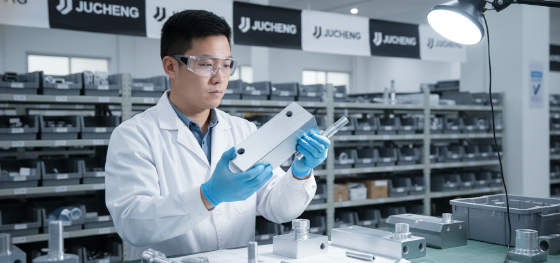
The greatest risk in the supply chain is the "hand-off" between the machine shop and the finisher. If you buy machining from one shop and plating from another, you lose accountability. If the parts rust because the pre-treatment was poor, who pays for the rework? Jucheng Precision eliminates this friction by offering a comprehensive one-stop-shop for CNC-Bearbeitung Oberflächenbehandlung. We manage the material sourcing, the 5-axis milling, and the final zinc chemistry under a single quality umbrella.
Our facility is optimized for the high-volume turnaround needed for industrial components. We perform adhesion testing (the tape test) and salt spray validation to ensure that the "sacrificial shield" we provide is robust enough for your environment. When you receive your order from JUCHENG, the parts are cleaned, plated, verified, and packaged with rust-preventive desiccants. You receive a component that is ready to install the moment you open the crate. Whether you are building 10,000 industrial mounts or a single high-strength gear shaft, Jucheng Precision has the technical rigor to armor your steel against the elements. Contact our engineering team today for a technical review of your next steel project and see how our zinc plating protocols can clarify your supply chain.

