
Professionelle Metall-Wärmebehandlungslösungen
Die Bearbeitung erzeugt die Form, aber die Wärmebehandlung definiert die Leistung. Es ist der kontrollierte Prozess des Erhitzens und Abkühlens von Metallen, um ihre physikalischen und mechanischen Eigenschaften zu verändern, ohne die Produktform zu ändern. Ob Sie die Härte für Verschleißfestigkeit erhöhen, die Duktilität zur Vermeidung von Rissen verbessern oder innere Spannungen für Dimensionsstabilität abbauen müssen, eine präzise Wärmebehandlung ist für hochleistungsfähige technische Komponenten unerlässlich.
Bei JUCHENG integrieren wir die Wärmebehandlung in unseren Fertigungsablauf. Vom Vakuumhärten von Werkzeugstählen bis zum Einsatzhärten von Automobilgetrieben arbeiten wir mit zertifizierten Wärmebehandlungsbetrieben zusammen, um sicherzustellen, dass Ihre Teile die genaue Rockwell-Härte (HRC) und Mikrostruktur erreichen, die in Ihren technischen Zeichnungen angegeben sind.
Bei JUCHENG integrieren wir die Wärmebehandlung in unseren Fertigungsablauf. Vom Vakuumhärten von Werkzeugstählen bis zum Einsatzhärten von Automobilgetrieben arbeiten wir mit zertifizierten Wärmebehandlungsbetrieben zusammen, um sicherzustellen, dass Ihre Teile die genaue Rockwell-Härte (HRC) und Mikrostruktur erreichen, die in Ihren technischen Zeichnungen angegeben sind.
Wärmebehandlung
JUCHENGs Wärmebehandlungskapazitäten
Wir bieten ein volles Spektrum an Wärmebehandlungen, die auf Materialtyp und Anwendung zugeschnitten sind:
- Durchhärten (Vergüten): Erhitzen des gesamten Teils und Abschrecken, um eine gleichmäßige Härte über den gesamten Querschnitt zu erreichen. Ideal für hochfeste Schrauben und legierte Baustähle (4140, 4340).
- Einsatzhärten (Aufkohlen): Eindiffundieren von Kohlenstoff in die Oberfläche von kohlenstoffarmen Stählen, um eine harte, verschleißfeste "Randschicht" zu erzeugen, während ein zäher, duktiler Kern erhalten bleibt. Perfekt für Zahnräder und Wellen.
- Vakuum-Wärmebehandlung: Durchgeführt in einer Vakuumkammer, um Oberflächenoxidation und Zunderbildung zu verhindern. Unverzichtbar für Präzisionswerkzeugstähle (D2, A2) und Edelstähle (440C, 17-4PH), um eine helle, saubere Oberfläche zu erhalten.
- Nitrieren / Nitrocarburieren: Ein Niedertemperaturprozess, bei dem Stickstoff in die Oberfläche eindiffundiert wird, wodurch eine harte, korrosionsbeständige Schicht mit minimaler Verformung entsteht.
- Glühen und Spannungsarmglühen: Kontrolliertes Erhitzen und langsames Abkühlen, um das Metall zu erweichen, die Bearbeitbarkeit zu verbessern oder innere Eigenspannungen zu entfernen, die durch Bearbeitung oder Schweißen entstanden sind.

Produktgalerie-Kategorien
Vakuumgehärteter Werkzeugstahl

Einsatzgehärtete Zahnräder

Nitrierte Wellen

Flammgehärtete Komponenten

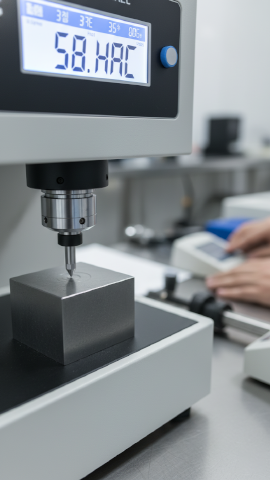
Härteprüfung & Qualitätskontrolle
Verfügbare Materialien
Werkstoffe, die eine Wärmebehandlung erfordern
Wir verarbeiten eine Vielzahl von Eisen- und Nichteisenlegierungen:
| Materialklasse | Gängige Güten | Typische Behandlungen |
| Werkzeugstähle | D2, A2, O1, H13 | Vakuumhärten & Anlassen (50-62 HRC). |
| Legierte Stähle | 4140, 4340, 4130 | Abschrecken & Anlassen (Q&T), Nitrieren, Induktionshärten. |
| Edelstahl | 17-4 PH, 440C, 420 | Ausscheidungshärtung (H900), Vakuumhärten. |
| Kohlenstoffstahl | 1018, 1045, 1215 | Aufkohlen (Einsatzhärten), Normalglühen. |
| Aluminium | 6061, 7075 | Lösungsglühen und Auslagern (T6) - normalerweise im Werk durchgeführt, aber wir können bei Bedarf nachbehandeln. |
Vergleich
Vergleich: Durchhärten vs. Einsatzhärten
Welches Härteverfahren passt zu Ihrem Design?
Welches Härteverfahren passt zu Ihrem Design?
| Merkmal | Durchhärten | Einsatzhärtung |
| Auswirkung | Härtet das gesamte Bauteil (Oberfläche + Kern). | Härtet nur die äußere Schicht (0,5 mm - 2 mm). |
| Kerneigenschaft | Hart, aber spröde. | Zäh und duktil (Stoßdämpfend). |
| Materialien | Mittel-/Hochkohlenstoffstähle (1045, 4140). | Niedrigkohlenstoffstähle (1018, 8620). |
| Verschleißfestigkeit | Gut. | Hervorragend (Oberfläche ist härter). |
| Verzugsrisiko | Höher (aufgrund schnellen Abschreckens). | Niedriger. |
| Am besten geeignet für | Strukturelle Festigkeit, Verbindungselemente. | Zahnräder, Wellen, Verschleißplatten. |
Warum uns wählen
- Verzugsmanagement: Wärmebehandlung führt zu Bewegungen des Metalls. Wir lassen präzise Schleifzugaben auf kritischen Abmessungen und verwenden spezielle Vorrichtungen, um Verzug während des Abschreckzyklus zu minimieren.
- Zertifizierte Berichte: Wir liefern Wärmebehandlungsdiagramme und Härteprüfberichte (Rockwell C/B oder Brinell) mit jeder Lieferung, um die Verantwortlichkeit sicherzustellen.
- Integriertes Schleifen: Da gehärtete Teile oft verzogen sind, bieten wir hauseigenes Präzisionsschleifen an, um das Teil nach der Wärmebehandlung wieder auf die endgültige Toleranz zu bringen.
- Saubere Oberflächen: Durch den Einsatz von Vakuumöfen kommen Ihre Teile hell und sauber zurück, nicht bedeckt mit schwarzer Zunder, der teures Sandstrahlen zur Entfernung erfordert.
Vorteile
- Verschleißfestigkeit: Verlängert die Lebensdauer beweglicher Teile erheblich, indem Oberflächenabrieb und Fressen verhindert werden.
- Festigkeit: Erhöht die Streckgrenze und Zugfestigkeit, ermöglicht leichtere und stärkere Konstruktionen.
- Maßhaltigkeit: Spannungsarmglühen verhindert Verzug von Teilen im Laufe der Zeit oder während nachfolgender Bearbeitungsvorgänge.
- Schlagfestigkeit: Richtiges Anlassen macht spröde Materialien zäh genug, um Stoßbelastungen standzuhalten.
Branchen, die bedient werden
- Automobil: Getriebezahnräder, Nockenwellen, Kurbelwellen, Aufhängungskomponenten.
- Luft- und Raumfahrt: Fahrwerkstreben (Hochfester Stahl), Turbinenschaufeln.
- Werkzeug- & Formenbau: Stanzwerkzeuge, Spritzgussformen, Schneidstempel.
- Öl & Gas: Bohrer, Ventilkörper, Hochdruckarmaturen.
- Medizinisch: Chirurgische Instrumente (Gehärteter Edelstahl).

Fordern Sie Ihr DFM & Angebot an – Laden Sie Ihre Zeichnungen hoch
ㆍGeben Sie Ihre Anforderungen ein und laden Sie Ihre 2D- und 3D-Dateien hoch. Wir senden Ihnen innerhalb von 24 Stunden Ihr Projektangebot und DFM zurück.ㆍDateitypen: STEP, STP, IGES, IGS, SLDPRT, 3DM, SAT, X_T, DWG, DXF, STL, PDF, ZIP und mehr. Dateigröße: < 128 MB Teilegröße: < 1500*1500*1500 mm
ㆍDatenschutz: Wir respektieren Ihre Privatsphäre. Hier finden Sie ein Beispiel einer Geheimhaltungsvereinbarung. Mit dem Absenden dieses Formulars stimmen Sie unseren AGB und der Datenschutzerklärung zu.
ㆍDatenschutz: Wir respektieren Ihre Privatsphäre. Hier finden Sie ein Beispiel einer Geheimhaltungsvereinbarung. Mit dem Absenden dieses Formulars stimmen Sie unseren AGB und der Datenschutzerklärung zu.
