


Wenn man einen Hochgeschwindigkeits-Palettierroboter oder eine automatisierte Schweißzelle im Jahr [2026] beobachtet, wird die entscheidende Bedeutung von Industrieroboterteile: Die Handgelenksschnittstelle ist der Punkt, an dem die Mission gelingt oder scheitert. Während der Arm die Reichweite bereitstellt, sorgen der Flansch und die zugehörigen Adapterplatten für die starre Verbindung zum Werkzeug am Armende (EOAT). Wenn diese Schnittstelle auch nur einen Mikrometer "Spiel" hat oder sich unter Last verbiegt, wird die gesamte Präzision des Roboters irrelevant. Die Herstellung von Roboterflansch- und Adapterplatten erfordert eine Beherrschung standardisierter Lochbilder und die Verwendung hochfester Legierungen wie 17-4 PH-Edelstahl, um eine Null-Drift-Leistung zu gewährleisten.

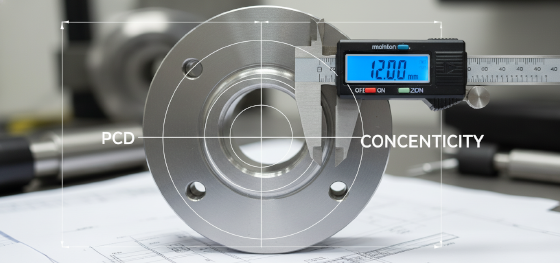
Die mechanische Integrität an der Werkzeugschnittstelle bestimmt die dynamische Nutzlastkapazität des Roboters. Jeder Beschleunigungs- und Verzögerungszyklus überträgt massive Trägheitskräfte direkt durch die Flanschschrauben. Bei Präzisionsmontageaufgaben führt jede Fehlausrichtung zwischen Roboterhandgelenk und Werkzeug zu fehlgeschlagenen Einführvorgängen und beschädigten Werkstücken. Jucheng Precision begegnet diesen kritischen Schnittstellenherausforderungen durch den Einsatz hochpräziser CNC-Dreh-Fräszentren und stellt sicher, dass jeder PCD (Teilkreisdurchmesser) und jede Passstiftbohrung mit Submikron-Konzentrizität relativ zur Rotationsachse ausgeführt wird.
Als Teil des Shenzhener Präzisionsfertigungszentrums bietet JUCHENG eine "Brücke zur Produktion" für Roboter-OEMs und Hersteller automatisierter Werkzeuge. Wir transformieren hochfestes Stangenmaterial in ISO 9409-1-konforme Schnittstellen, die das unzerbrechliche Bindeglied zwischen Roboter und Nutzlast darstellen. Dieser Leitfaden untersucht die wesentlichen ISO-Normen, Materialleistungs-Kompromisse und Null-Spiel-Bearbeitungsstrategien, die für die Herstellung von Roboterflanschen und Adapterplatten erforderlich sind, die ihre Ausrichtung über Millionen von Werkzeugwechselzyklen beibehalten.
Inhalt:
Standardisierung der Schnittstelle: ISO 9409-1-Konformität
Technische Daten: Vergleich von Legierungen für Werkzeugadapter
Null-Spiel-Schraubenbilder: Eliminierung von Positionsdrift
17-4 PH-Haltbarkeit: Konstruktion für Hochdrehmoment-Handgelenke
JUCHENG: Das Shenzhener Zentrum für Roboter-Werkzeugschnittstellen
FAQ: Hochpräzise Schnittstellen für Industriewerkzeuge
Standardisierung der Schnittstelle: ISO 9409-1-Konformität
Universelle Werkzeugkompatibilität in der Robotik von [2026] basiert auf der Norm ISO 9409-1. Diese Spezifikation definiert die Schraubenbilder, Zentrierdurchmesser und Passstiftpositionen für Roboter-Handgelenkflansche. In Roboterflansch- und Adapterplatten manufacturing, even a 0.02mm deviation from these standards can make it impossible to mount a standard gripper or welding torch. JUCHENG machines these interfaces to the tightest limit of the standard, ensuring that tools from brands like SCHUNK, OnRobot, or ATI fit perfectly every time without the need for manual shimming.
Centering accuracy is the most significant metric for flange performance. The "pilot diameter" on the flange must be concentric with the robot’s last axis of rotation. JUCHENG utilizes CNC turning and grinding to hold these diameters to a g6 or h6 tolerance, providing a "snug-fit" that eliminates radial movement. This ensures that the Tool Center Point (TCP) remains calibrated even after a high-impact collision or a sudden emergency stop, reducing the need for frequent robot re-homing in high-speed production environments.
Locating pin holes provide the clocking accuracy needed for multi-tool applications. In complex Industrieroboterteile, these holes must be positioned with extreme pitch accuracy relative to the central bore. JUCHENG utilizes coordinate-measuring machines (CMM) to verify that the pin-hole PCD is accurate to within 5 microns. This allows for rapid tool changes where the new tool is "digitally identical" to the old one, ensuring that the robot's vision system and motion path do not require any software adjustment after a hardware swap.
Weight management at the wrist is a constant battle. Every gram added to the adapter plate is a gram removed from the robot's available payload. For collaborative robots (cobots), JUCHENG often machines ISO-standard flanges with internal weight-reduction pockets. This "skeletal" design maintains the rigid mounting faces required by the standard while reducing the inertial load on the J6 motor, allowing for higher accelerations and shorter cycle times in delicate electronics assembly tasks.
Technische Daten: Vergleich von Legierungen für Werkzeugadapter
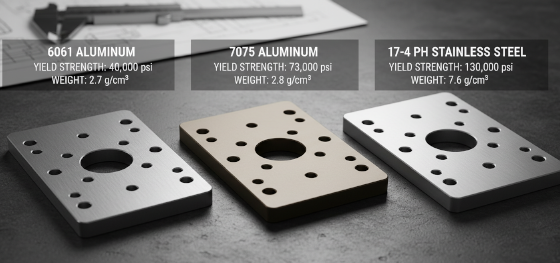
Selecting the right material for an adapter plate requires balancing weight against the need for extreme thread strength. For high-payload robots, the "pull-out" strength of the threads is the primary failure mode. Jucheng Precision provides technical consultations to help you match the alloy to your robot's torque profile. The following table compares the materials most frequently used in high-performance Roboterflansch- und Adapterplatten für den [2026] Markt verwendet werden.
| Materialgüte | Streckgrenze (MPa) | Härte (HRC) | Primary Benefit |
|---|---|---|---|
| 17-4 PH Edelstahl | 1000 - 1150 | 35 - 45 | Ultimate Durability / Stiffness |
| 7075-T6 Aluminium | 500 - 540 | Standard | Hohes Festigkeits-Gewichts-Verhältnis |
| Titan Gr. 5 | 850 - 950 | 30 - 36 | Weight / Corrosion |
| Carbon Steel (4140) | 650 - 950 | 28 - 32 | High Torque / Cost |
17-4 PH Stainless Steel is the gold standard for heavy-duty robot flanges because it offers the corrosion resistance of stainless steel with the mechanical strength of high-alloy tool steels. This material can be heat-treated to H1150 or H900 conditions, providing a yield strength that is four times higher than standard 304 stainless. JUCHENG utilizes specialized carbide tooling to machine 17-4 PH in its aged state, ensuring that the finished Industrieroboterteile possess the extreme thread integrity required to hold heavy welding guns or casting grippers through millions of vibration cycles.
7075-T6 Aluminum is preferred for high-speed pick-and-place robots where reducing "wrist-weight" is the priority. While aluminum is softer than steel, 7075 offers a yield strength comparable to mild steels. JUCHENG enhances these aluminum adapter plates with specialized hard-anodizing (Type III) to protect the mounting faces from "galling" and surface wear. We also utilize hardened steel thread inserts (Helicoils) in all aluminum flange plates to ensure the threads do not strip under the high-torque loads of emergency stops.
Null-Spiel-Schraubenbilder: Eliminierung von Positionsdrift

Positional drift at the tool is often caused by microscopic movement in the bolt pattern. In Roboterflansch- und Adapterplatten, if the bolt holes are even slightly oversized, the tool can shift during high-acceleration moves. JUCHENG eliminates this "play" by utilizing precision CNC drilling and reaming to achieve a "H7" fit for locating pins and a "Class 3B" fit for all internal threads. This ensures that the tool is mechanically locked to the flange, preventing the "creep" that can slowly ruin a robot's calibration over weeks of 24/7 operation.
Parallelism of the mounting faces determines the angular accuracy of the tool. If the adapter plate is "wedge-shaped" by only 0.05mm across its diameter, the tool tip at the end of a 500mm gripper will be offset by nearly a full millimeter. JUCHENG utilizes precision surface grinding and dual-setup CNC milling to ensure that the top and bottom faces are parallel within 0.01mm. This level of mechanical perfection is essential for high-precision tasks like laser marking or micro-assembly where angular drift is unacceptable.
Deburring and surface prep are critical for the "mating" of these interfaces. Any microscopic burr left on a flange hole can act as a shim, preventing the tool from seating perfectly flat. JUCHENG utilizes automated deburring and ultrasonic cleaning to ensure that every Industrieroboterteile shipment is surgically clean. We ensure that the mounting faces provide 100% surface contact, distributing the torque load evenly across the entire interface and preventing the localized stress concentrations that lead to flange cracking in heavy-duty applications.
Integrated sensor mounts are becoming a standard feature in modern adapter plates. JUCHENG machines recessed pockets for force-torque sensors and internal channels for pneumatic lines directly into the adapter plate. This "integrated manifold" design reduces the bulk of the robot wrist, allowing the arm to navigate tighter spaces in automotive interiors or electronics housings. By consolidating these features into a single CNC-machined component, we reduce the total part count and eliminate multiple potential failure points in the robot's "wrist-to-tool" chain.
17-4 PH-Haltbarkeit: Konstruktion für Hochdrehmoment-Handgelenke

Fatigue resistance is the silent metric of robot hardware. A robotic wrist is constantly subjected to reversing torque—thousands of times per hour. In Roboterflansch- und Adapterplatten, this can lead to microscopic fatigue cracks around the bolt holes. 17-4 PH stainless steel is chosen for these high-torque environments because of its exceptional "endurance limit." JUCHENG manages the heat-treatment process for 17-4 PH to optimize the balance between hardness and toughness, ensuring that the flange can absorb the shocks of a collision without shattering while remaining rigid enough to maintain sub-micron alignment.
Thermal stability is the second reason 17-4 PH is the industry's choice for precision interfaces. As the robot motors heat up during a shift, the heat travels down the arm to the wrist. If the adapter plate expands irregularly, it can loosen the bolts or cause the centering pilot to bind. 17-4 PH has a predictable, low coefficient of thermal expansion that closely matches the steel drivetrain of the robot, ensuring that the "fit" of the tool remains constant from the first minute of the shift to the last.
Surface integrity during the machining of 17-4 PH is managed through JUCHENG’s "cold-cut" CNC strategies. Excessive heat during the milling of high-strength alloys can create localized "white layers"—brittle zones that are prone to stress-corrosion cracking. We utilize high-pressure oil cooling and specialized ceramic inserts to machine 17-4 PH flanges at high speeds while maintaining a stable metallurgical state. This ensures that the Industrieroboterteile we provide have a predictable service life, even in corrosive environments like food processing or chemical handling.
Final verification includes magnetic particle inspection (MPI) and 3D scanning. At Jucheng Precision, we understand that a "strong" part is useless if it contains a hidden defect. Our quality assurance lab ensures that every 17-4 PH flange and adapter plate leaving our Shenzhen hub is free of surface imperfections and meets the exact GD&T standards of the original CAD. This level of rigor is why JUCHENG remains the preferred partner for the world's leading high-payload robot manufacturers.
JUCHENG: Das Shenzhener Zentrum für Roboter-Werkzeugschnittstellen

Dominating the [2026] industrial automation market requires a manufacturing partner that can scale from prototype to massive fleet production without losing precision. Jucheng Precision operates with a 24/7 manufacturing mindset in our Shenzhen precision manufacturing hub, delivering high-tolerance adapter plates and robotic flanges with lead times as fast as 12 business days. We provide a "Bridge to Production" that allows you to move from a single hand-fitted tool interface to a commercial deployment of 1,000 units with consistent ISO-standard quality.
Integrating your interface design with JUCHENG’s expertise ensures that your tool survives the "First-Year Fatigue" and moves into long-term adoption. We offer comprehensive DFM reviews within 24 hours, identifying potential thread-loading risks or "flex-zones" in your adapter design before they become field failures. Whether you are building a collaborative gripper for electronics or a 1000kg-payload palletizing fork, Jucheng Precision provides the rigid, precise "interfaces" that keep your innovation moving through the high-speed cycles and the years of hard labor.
Our facility is equipped with 150+ CNC machines, including the latest Mori Seiki turn-mill centers and CMM inspection labs, allowing us to manage the entire interface lifecycle from raw bar stock to finished, verified assembly. We manage the complexity of ISO-standard machining so your engineering team can focus on the tool's function and the AI. By combining Shenzhen's speed with industrial-grade material verification, JUCHENG remains the preferred partner for the world's most aggressive Industrieroboterteile challenges. Contact us today to start your next project.
FAQ: Hochpräzise Schnittstellen für Industriewerkzeuge
What is the standard tolerance for an ISO 9409-1 pilot diameter?
High-precision flanges require an h6 or g6 tolerance to ensure a snug centering fit without radial play.
Why is 17-4 PH stainless steel better than 304 for adapter plates?
17-4 PH offers nearly triple the yield strength and much higher thread pull-out resistance for heavy-duty torque.
Can JUCHENG integrate air manifolds into an adapter plate?
Yes. We use deep-hole drilling and precision CNC milling to create internal pneumatic channels and valve mounts.
How do you prevent thread stripping in aluminum adapter plates?
We utilize hardened steel Helicoil inserts in all aluminum flange plates to ensure long-term thread durability.
What is the typical lead time for custom robotic adapter plates?
Precision-machined flanges and adapter plates are typically delivered in 10 to 15 business days.
Interface drift in industrial robotics is an absolute hardware killer. Partnering with Jucheng Precision ensures that your connections are built with the zero-play bolt patterns and specialized 17-4 PH machining techniques the industry demands. Reach out to our Shenzhen manufacturing hub today for a complete DFM review and build the rigid foundation your autonomous fleet requires.

