


Gehen Sie durch jede Produktionsstätte mit hohem Volumen, und Sie werden die allgegenwärtige Präsenz von Polyamiden bemerken. In der Ingenieurwelt sind diese Materialien das Bindegewebe der modernen Industrie. Doch selbst erfahrene Konstrukteure sind oft gelähmt von einer scheinbar einfachen numerischen Wahl. Soll das Teil aus Polyamid 6 oder Polyamid 66 gefertigt werden? Für den flüchtigen Betrachter sind sie nahezu identische weiße oder schwarze Feststoffe. Aber für den Maschinisten und den Endanwender ist die Wahl von Nylon 6 vs Nylon 66 eine Entscheidung, die bestimmt, ob ein Teil in einem heißen Motorraum gedeiht oder bei einer Schnappverbindung zerbricht.
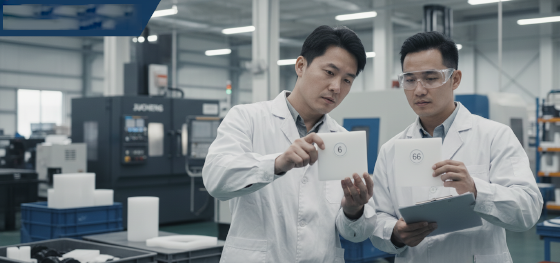
Die Beherrschung Nylon CNC-Bearbeitung erfordert tiefen Respekt für diese subtilen Unterschiede. Obwohl beide Sorten zur gleichen Familie langkettiger teilkristalliner Polymere gehören, ist ihr individuelles Verhalten unter einem Schneidwerkzeug unterschiedlich. Nylon 6 ist der Athlet der Zähigkeit und Ästhetik, während Nylon 66 der Gelehrte der Hitzebeständigkeit und mechanischen Steifigkeit ist. Bei Jucheng Precision agieren wir nicht nur als Produktionsstätte; wir dienen als technische Prüfer für Ihre Materialspezifikationen. Wir wissen, dass die Wahl der falschen Sorte zu Oberflächenverschmierung, Maßabweichungen oder vorzeitiger mechanischer Ermüdung im Einsatz führen kann.
Dieser Leitfaden taucht in die atomaren Grundlagen dieser beiden industriellen Giganten ein. Wir werden erkunden, warum einer früher schmilzt als der andere, warum einer eine überlegene ästhetische Oberfläche bietet und wie JUCHENG mit der unvermeidlichen Feuchtigkeitsaufnahme umgeht, die alle Nylonarten plagt. Wenn Sie Schwierigkeiten haben, Ihre Stückliste zu finalisieren, wird diese Aufschlüsselung genau klären, welche Sorte auf Ihrem CNC-Maschinenbett liegen sollte, um maximale Leistung und Kosteneffizienz zu gewährleisten.
Atomare Nuance: Der Unterschied zwischen 6 und 66
Hitzebeständigkeit: Überleben im Motorraum
Zerspanungsverhalten: Klebrig vs. Knackig
Optische Attraktivität: Der PA6-Vorteil
Feuchtigkeitsrealitäten: Quellen in beiden Welten
JUCHENGs Urteil: Die endgültige Auswahlmatrix
Atomare Nuance: Der Unterschied zwischen 6 und 66
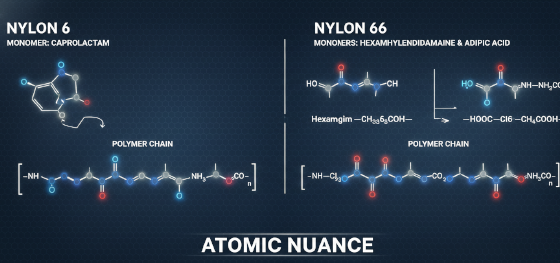
Die Namenskonvention dieser Materialien ist nicht willkürlich; sie bezieht sich auf die Anzahl der Kohlenstoffatome in den Ausgangsmonomeren. Nylon 6 wird aus einem einzigen Monomer – Caprolactam – hergestellt, das sechs Kohlenstoffatome besitzt. Dies führt zu einer Molekülkette, die hochgradig gleichmäßig und relativ einfach zu synthetisieren ist. Nylon 66 hingegen entsteht durch die Reaktion von zwei verschiedenen Monomeren: Hexamethylendiamin und Adipinsäure. Beide Monomere enthalten sechs Kohlenstoffatome, daher die Bezeichnung "66". Diese Zweimonomer-Struktur erzeugt eine komplexere und dichter gepackte kristalline Matrix.
In der Nylon 6 vs Nylon 66 Vergleich, diese molekulare Dichte ist die Quelle aller Leistungsunterschiede. Die dichtere Packung der PA66-Ketten macht das Material natürlicherweise steifer und härter. Es besitzt einen höheren Elastizitätsmodul, was bedeutet, dass es Biegung effektiver widersteht als PA6. Nylon 6 bietet mit seiner etwas entspannteren Molekülstruktur eine höhere Schlagzähigkeit. Es hat einen höheren "Bruchdehnungs"-Wert, sodass es sich vor dem Bruch weiter verformen kann. Wenn Jucheng Precision durchführt Nylon CNC-Bearbeitung, we account for these internal tensions, knowing that PA66 will hold a sharp corner better, while PA6 will absorb a hammer blow more gracefully.
Hitzebeständigkeit: Überleben im Motorraum
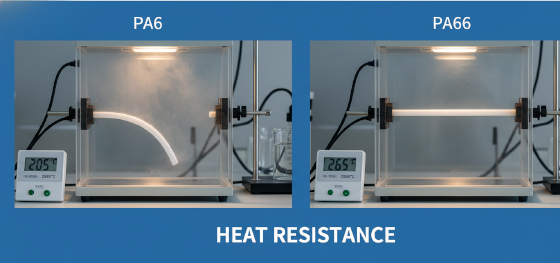
Temperature is the Great Filter of engineering plastics. If your part is destined for a hot environment—such as an automotive engine compartment or a high-performance electrical enclosure—the thermal threshold of the material is the first thing you must consider. Nylon 66 boasts a significantly higher melting point, typically around 255°C (491°F). Nylon 6 melts at a lower 220°C (428°F). While a 35-degree difference might not sound massive, it represents a critical safety margin in industrial applications.
Beyond just melting, PA66 maintains its mechanical stiffness at elevated temperatures much better than PA6. This resistance to thermal softening is why PA66 is the default choice for manifold spacers, high-heat bushings, and heavy-duty structural parts that must operate continuously in warm air. Nylon 6 is more prone to "creeping"—slowly deforming under load—when the temperature begins to rise. At Jucheng Precision, we use this thermal data to advise our clients during the quoting phase. If we see a part destined for a high-RPM mechanical assembly, we will push for PA66 to ensure the part doesn't lose its dimensional integrity the moment the system heats up.
Zerspanungsverhalten: Klebrig vs. Knackig
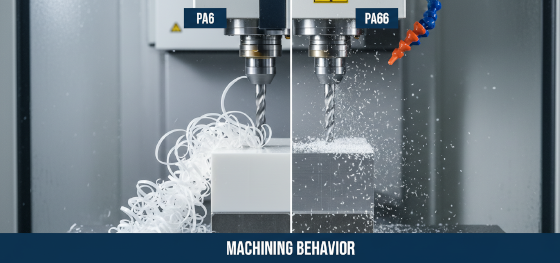
From the perspective of a CNC machinist, Nylon 6 vs Nylon 66 presents two distinct operational challenges. Nylon 66 is generally considered a "cleaner" machining material. Because it is harder and more rigid, the cutting tool can shear the fibers of the plastic with less deflection. The chips generated during PA66 machining are crisper and break into smaller fragments more easily. This improved chip control is vital for automated production where "bird-nesting" can cause tool breakage and surface scarring.
Nylon 6 is a "gummier" material. It is softer and more ductile, which means it tends to move away from the tool rather than being cut by it. This results in the infamous stringy, continuous chips that love to wrap around the spindle. To achieve a high-quality finish on PA6, JUCHENG engineers utilize ultra-sharp, high-rake tooling and aggressive feed rates. We want to "surprise" the material, cutting it before it has a chance to bend or melt. While PA66 is easier to hit tight tolerances with (+/- 0.05mm), PA6 requires more craftsmanship to manage the surface "fuzz" or burrs. Our facility is equipped with specialized air-cooling systems to keep the tool tip at a constant temperature, preventing either grade from smearing during high-speed finishing passes.
Optische Attraktivität: Der PA6-Vorteil
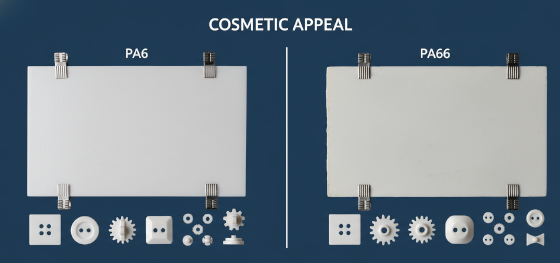
If the primary goal of your part is aesthetics—perhaps a visible consumer-facing bezel or a decorative housing—Nylon 6 is the superior candidate. Because of its lower crystallinity and more uniform molecular structure, PA6 offers a much better "as-machined" surface finish. It has less of the visible "grain" that can sometimes appear in PA66. It also takes dyes and pigments more uniformly, resulting in deeper, richer colors if the part is to be tinted after machining.
PA66 parts, while mechanically excellent, can sometimes have a slightly "matte" or textured look that isn't as visually striking. Furthermore, PA6 has less mold shrinkage (for the raw stock) which translates to a more uniform density in large cross-sections. When Jucheng Precision produces prototypes for the consumer electronics sector, we often default to PA6 for components that must survive a drop test while maintaining a high-quality tactile feel. It provides a "silky" smoothness that hard, brittle materials simply cannot mimic. For parts where looking good is half the job, Nylon 6 wins the aesthetic war.
Feuchtigkeitsrealitäten: Quellen in beiden Welten
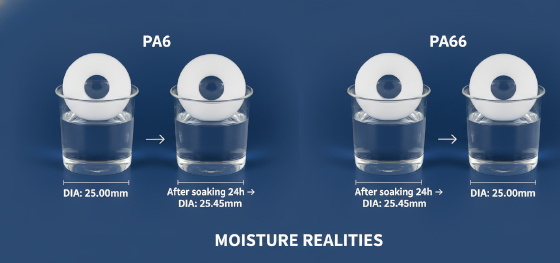
We must address the shared weakness of the Polyamide family: Hygroscopy. Both materials are "water drinkers." They absorb moisture from the air, and as they do, they swell. However, the rate and impact of this absorption vary slightly. Nylon 6 absorbs moisture more readily and has a slightly higher saturation point than Nylon 66. This means a PA6 part will expand more and lose its stiffness more rapidly in a humid environment than a PA66 part.
| Metrik | Nylon 6 (PA6) | Nylon 66 (PA66) |
|---|---|---|
| Moisture Absorption (Sat) | ~9.5% | ~8.5% |
| Schmelzpunkt | 220°C | 255°C |
| Schlagzähigkeit | Hervorragend | Standard |
| Zerspanbarkeit | Gummy | Crisp |
At Jucheng Precision, we solve the moisture problem through atmospheric control and technical foresight. We store all nylon stock in humidity-stabilized zones. For critical assemblies, we perform "over-machining" based on calculated saturation curves, ensuring the part expands into the correct tolerance by the time it reaches your facility. While neither grade is as stable as Delrin, PA66 provides a slightly more predictable platform for designers who are worried about dimensional drift in changing climates.
JUCHENGs Urteil: Die endgültige Auswahlmatrix
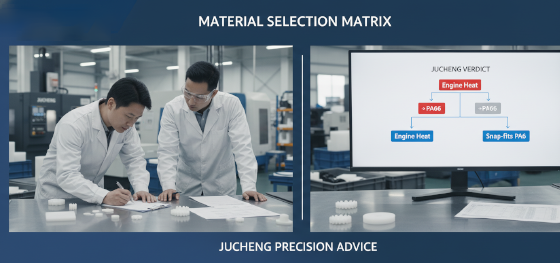
So, which number should you choose? Jucheng Precision uses a simple logic tree to settle the Nylon 6 vs Nylon 66 debate during our DFM reviews.
Choose Nylon 6 (PA6) if:
• The part requires maximum impact resistance or will be dropped.
• Aesthetic appearance and surface smoothness are the primary goals.
• The application involves snap-fits or living hinges.
• You are on a strict budget for non-critical components.
Choose Nylon 66 (PA66) if:
• The part will be exposed to temperatures exceeding 80°C for long periods.
• High mechanical stiffness and load-bearing capacity are required.
• You need the best possible chip control for high-precision internal threads.
• Dimensional stability in humid air is a technical priority.
Jucheng Precision stocks both high-grade PA6 and PA66 in various colors and additives, including MoS2-filled and glass-filled variants. Our 5-axis Nylon CNC-Bearbeitung services are optimized for the thermal and chemical nuances of both materials. Whether you are building an automotive manifold or a consumer-facing enclosure, we have the expertise to deliver. Don't leave your material selection to chance. Contact our engineering team today for a technical review of your next project.

