


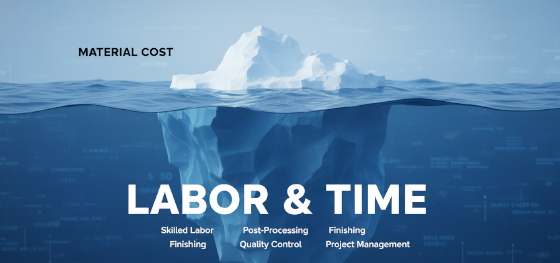
Einkaufsteams prüfen oft den Preis eines Urethangussteils with a skepticism born from mass production logic. If an injection-molded ABS housing costs $1.50, why does the exact same geometry cast in polyurethane cost $45.00? This disparity exists because Vakuumguss is not a manufacturing commodity; it is a time-intensive service. When you purchase a cast part, you are not merely paying for the petrochemicals; you are renting the hands of a skilled artisan and the operational time of a vacuum chamber. Unlike 3D printing, which runs unattended overnight, casting requires constant human intervention. From the moment the silicone mold is preheated to the final extraction of the cured unit, a technician is actively managing the physics of the process. Understanding this "Labor-to-Material Ratio" is the only way to accurately forecast your prototyping budget.
Harzökonomie: Flüssige Technik vs. Pellets
Handwerkliche Fertigung: Warum Gießen nicht automatisiert ist
Endbearbeitungsprämie: Die Kosten der Ästhetik
Chargeneffizienz: Optimierung des Ofenzyklus
JUCHENG-Wert: Preisgestaltung für Leistung
Harzökonomie: Flüssige Technik vs. Pellets
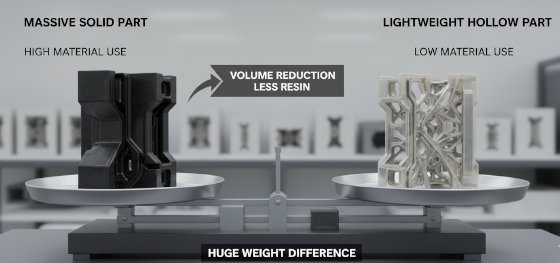
Die Rohmaterialkosten beim Vakuumguss sind deutlich höher als beim Spritzguss. Thermoplastische Pellets, die in Stahlformen verwendet werden, werden tonnenweise produziert und kosten Pfennige. Spezialisierte Polyurethanharze wie Hei-Cast oder Axson sind technische Zweikomponenten-Chemiesysteme, die in kleinen Chargen verkauft werden. Diese Flüssigkeiten sind formuliert, um spezifische mechanische Eigenschaften zu simulieren – hohe Wärmeformbeständigkeit, optische Klarheit oder gummiartige Elastizität – ohne hohen Druck. Folglich kann der Grundpreis pro Gramm eines Hochleistungsgießharzes zwanzigmal höher sein als der von generischen ABS-Pellets.
Das Volumen bestimmt die Basis. Ein schwerer, massiver Block verbraucht eine große Menge dieser teuren Flüssigkeit, was den Stückpreis allein durch das Materialgewicht in die Höhe treibt. Kluge Ingenieure senken hier die Kosten, indem sie dicke Abschnitte "auskernen" oder hohle Teile entwerfen, was den Harzverbrauch minimiert. Bei kleinen Präzisionsteilen sind die Materialkosten jedoch im Vergleich zur erforderlichen Arbeit vernachlässigbar.
Handwerkliche Fertigung: Warum Gießen nicht automatisiert ist

Automatisierung ist im Gießraum praktisch nicht vorhanden. Jedes einzelne Teil erfordert einen Techniker, der die Form manuell abklebt, die A- und B-Komponenten in einer Vakuumkammer mischt, den Entgasungszyklus steuert und die Flüssigkeit in den Trichter gießt. Nach dem Gießen muss die Form in einen Heizofen gebracht werden, um je nach Harzchemie 45 Minuten bis 4 Stunden auszuhärten.
Das Entformen ist ebenso arbeitsintensiv. Der Techniker muss den Silikonblock vorsichtig aufhebeln, das Teil entnehmen, ohne die empfindlichen Formdetails zu beschädigen, und die Angüsse und Entlüftungen manuell beschneiden. Dies ist keine "Knopfdruck"-Operation; es ist eine Abfolge qualifizierter manueller Aufgaben. Der Preis eines Urethangussteils spiegelt diese abrechenbaren Stunden wider. Komplexe Teile mit mehreren Einsätzen oder empfindlichen Hinterschnitten erfordern noch mehr Sorgfalt, was den Arbeitsanteil am Endpreis weiter erhöht.
Endbearbeitungsprämie: Die Kosten der Ästhetik
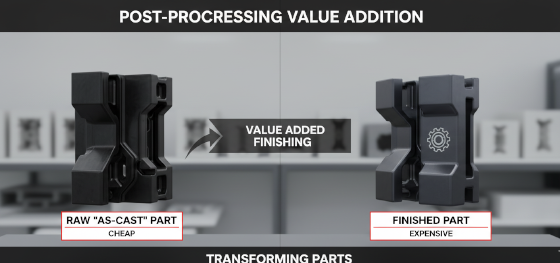
"As-cast" parts are rarely the final deliverable. Most clients demand a cosmetic appearance that mimics a production unit. This introduces the "Finishing Premium." If your specification calls for a specific Pantone color match, we must mix custom pigments or apply a high-quality spray paint in our booth. If you need a "Soft-Touch" rubberized feel or a heavy texture, we apply specialized coatings.
Logos and branding add another layer. Silk-screening a company logo or laser-etching a serial number are separate manual operations that occur after the part is cast. Installing brass threaded inserts for assembly requires heat-staking them one by one. Each of these value-added steps increases the unit price but saves you the immense cost of setting up a dedicated finishing line in your own facility.
Chargeneffizienz: Optimierung des Ofenzyklus

Quantity is the lever that controls cost. Ordering a single cast part is the most expensive way to buy. We have to set up the vacuum machine, mix the resin, and run the heating oven for just one unit. However, if you order twenty units, we can optimize the workflow. We can pour multiple molds simultaneously and cure them in the same oven cycle. The technician's setup time is amortized across the entire batch.
This "Batch Efficiency" explains why the first part might cost $100, but the twentieth part only costs $30. Jucheng Precision actively encourages batch ordering. By consolidating your prototype needs into a single run of 20-50 units, you unlock significant labor efficiencies that drive the per-unit price down closer to production levels.
JUCHENG-Wert: Preisgestaltung für Leistung
We do not offer the cheapest plastic on the market; we offer the most accurate simulation of your final product. Jucheng Precision prices our casting services based on a transparent calculation of material volume, labor hours, and finishing requirements. We employ veteran technicians who minimize scrap rates and maximize mold life, passing those savings directly to you. When you see our quote, understand that you are investing in a process that guarantees your prototype will function, fit, and feel exactly like the mass-produced version, de-risking your entire product launch.

