


Additive manufacturing, commonly known as 3D printing, has revolutionized prototyping and production across industries. Among the various technologies available, Stereolithography (SLA) and Selective Laser Sintering (SLS) stand out as popular choices for creating complex parts. While both methods fall under the umbrella of rapid prototyping, they differ significantly in principles, applications, and outcomes. Understanding the distinctions between SLA and SLS is crucial for selecting the right technology based on project requirements, such as surface quality, mechanical strength, and production speed. This article delves into a detailed comparison of SLA and SLS, covering aspects like surface finish, strength, printer mechanisms, and mechanical properties, to help engineers and designers make informed decisions.
Inhalt:
Which One Makes Smoother Toys?
Which One is Stronger?
All About the SLA Printer
Making Models Fast: Rapid Prototyping
Imagine you're building a tiny, detailed model of a dragon.
SLA Printing is like using a magical tracing pen. The printer has a vat of special liquid plastic (called resin). A super-fine laser beam acts like the pen, drawing one thin slice of the dragon on the surface of the liquid. Wherever the laser touches, the liquid turns solid. The platform then lifts up, and the laser draws the next layer right underneath the first one. It keeps doing this until your solid plastic dragon is complete!
SLS Printing is more like building a sandcastle with a laser. The printer has a bed of super-fine plastic powder (like really smooth sand). A powerful laser beam zaps the powder in the shape of your dragon's first layer. The heat from the laser melts the powder particles just enough to fuse them together. Then, a fresh layer of powder is spread over the top, and the laser draws the next layer. The cool part? The unused powder acts as a support, holding up the model as it prints, so you can make really complex shapes.

Which One Makes Smoother Toys?
When we look at SLA vs SLS surface finish, it's all about smoothness.
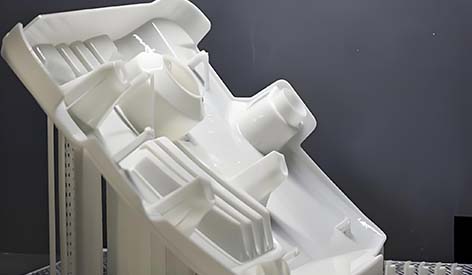
SLA is the winner for creating super smooth and shiny surfaces. The parts that come out of an SLA-Druckers often look like they were bought from a store. They have very fine details and a glossy finish, making them perfect for detailed figures, smooth jewelry models, or parts that need to look really pretty.
SLS parts come out with a more rough, gritty, or chalky feel. Since they are made from fused powder, they look a bit like a fine sandcastle. You can sand them to make them smoother, but they usually won't get as naturally shiny as SLA parts.
Which One is Stronger?
Now, let's talk about SLA vs SLS strength. If you need a part that won't break easily, which printer should you choose?
SLS erzeugt viel stärkere und langlebigere Teile. Stellen Sie es sich wie den Unterschied zwischen einem harten Plastikspielzeug (SLA) und einem robusten, flexiblen Lego-Stein (SLS) vor. SLS-Teile eignen sich hervorragend für Dinge, die Belastungen standhalten müssen, wie Scharniere, Zahnräder oder Schutzhüllen. Sie können sich ein wenig biegen, ohne zu brechen.
SLA-Teile sind detailliert, können aber spröde sein. Wenn Sie ein SLA-Teil auf den Boden fallen lassen, könnte es reißen oder zerbrechen. Sie sind nicht die beste Wahl für Teile, die grob behandelt werden oder viel Kraft aushalten müssen.
Wenn wir die mechanischen Eigenschaften von SLS vs. SLA vergleichen (das ist nur eine ausgefallene Art zu sagen, "wie stark und zäh sie sind"), ist SLS fast immer die stärkere Wahl.
All About the SLA Printer
Was ist also ein SLA-Drucker? Es ist die Maschine, die das "magische Nachzeichnen" macht, von dem wir gesprochen haben. Die Hauptteile sind ein Tank für das flüssige Harz, ein Laser, der wie der Zeichenstift wirkt, und eine Plattform, die das fertige Modell langsam aus der Flüssigkeit hebt. Der gesamte SLA-Druck Prozess ist erstaunlich anzusehen, wenn Ihr Objekt scheinbar aus der Flüssigkeit herauswächst!
Making Models Fast: Rapid Prototyping
Ingenieure und Designer verwenden diese Drucker oft für "Rapid-Prototyping," was eine schnelle und kostengünstige Möglichkeit ist, eine neue Idee zu testen, bevor man Millionen davon in einer Fabrik herstellt. Bei der Entscheidung zwischen Rapid Prototyping SLA vs. SLS ist hier die einfache Wahl:
Wählen Sie SLA, wenn Sie ein Modell herstellen, um zu sehen, wie es aussieht. Ist es die richtige Form? Ist es hübsch?
Wählen Sie SLS, wenn Sie ein Modell herstellen, um zu sehen, was es kann. Kann es Klicken, Fallenlassen oder Herumbewegen verkraften?
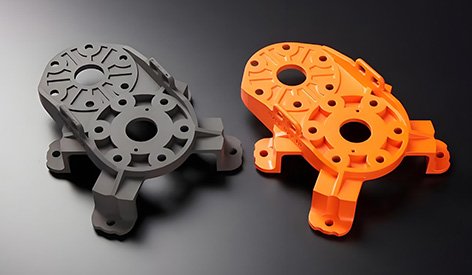
Die Entscheidung zwischen SLA und SLS in der additiven Fertigung hängt von einer gründlichen Bewertung der Projektanforderungen ab, einschließlich Oberflächenbeschaffenheit, Festigkeit und Anwendungskontext. SLA bietet außergewöhnliche Details und Glätte und ist daher ideal für visuelle Prototypen und Präzisionsteile, während SLS überlegene mechanische Eigenschaften und Haltbarkeit für funktionale Komponenten bietet. Durch das Verständnis der Nuancen von SLA vs. SLS, einschließlich Aspekten wie SLA-Druckermechanismen und dem Vergleich der mechanischen Eigenschaften von SLS vs. SLA, können Fachleute ihre Rapid-Prototyping-Strategien optimieren. Mit dem Fortschritt der Technologie entwickeln sich beide Methoden weiter und bieten noch größere Möglichkeiten für Innovationen. Ob für Rapid Prototyping oder die Produktion von Endprodukten, die Ausrichtung der Technologie auf spezifische Anforderungen gewährleistet Effizienz und Erfolg in der modernen Fertigung.

