


Was wäre, wenn ein einziges Material eine steinharte Strukturkomponente, ein zäher und flexibler Stoßfänger und ein weicher, kuscheliger Schaumstoff sein könnte? Das klingt nach Science-Fiction. Ist es aber nicht.
Das ist die unglaubliche Vielseitigkeit von Polyurethan. Es ist der unangefochtene Star der Reaktionsspritzgießmaschine (RIM)-Welt. Es ist ein Chamäleon. Ein Material mit tausend verschiedenen Gesichtern.
Die Möglichkeiten des Polyurethan-Reaktionsspritzgießens zu verstehen, bedeutet nicht nur, ein Material zu verstehen. Es bedeutet, eine neue Ebene der Designfreiheit zu erschließen. Dieser Leitfaden stellt Ihnen seine vielen Persönlichkeiten vor.
Inhalt:
Ein Name, viele Persönlichkeiten
Formulierung: Das Rezeptbuch des Chemikers
Rolle #1: Der unzerbrechliche Beschützer (feste Elastomere)
Rolle #2: Das leichte Skelett (Strukturschäume)
Die richtige 'Figur' für Ihr Bauteil wählen
Ein Name, viele Persönlichkeiten
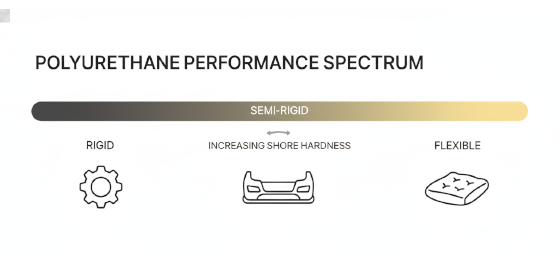
Wenn ein Ingenieur "Polyurethan" sagt, könnte er über eine riesige Bandbreite an Materialien sprechen.
Am einen Ende des Spektrums gibt es extrem weiche und flexible Polyurethan-Elastomere. Diese fühlen sich wie ein zäher Gummi an. Am anderen Ende gibt es hochsteife und feste Polyurethane. Diese verhalten sich wie ein Standard-Technik-Kunststoff, wie ABS.
Und dazwischen gibt es ein ganzes Universum an Möglichkeiten. Halbsteife Materialien. Materialien mit unterschiedlichen Schlagfestigkeitsgraden. Materialien mit unterschiedlichen Texturen. Und sogar Schäume. Diese unglaubliche Bandbreite macht Polyurethan zur ersten Wahl für das vielseitige Reaktionsspritzgießverfahren.
Formulierung: Das Rezeptbuch des Chemikers

Wie ist diese Vielseitigkeit möglich? Das Geheimnis liegt in der Chemie.
Alle Polyurethane entstehen durch die Reaktion zweier flüssiger Komponenten: eines Polyols und eines Isocyanats. Aber das sind keine einzelnen Chemikalien. Es sind Chemikalienfamilien.
Durch die sorgfältige Auswahl eines bestimmten Polyoltyps und eines bestimmten Isocyanattyps und durch das Mischen in einem präzisen Verhältnis kann ein Chemiker die endgültigen Eigenschaften des Kunststoffs "einstellen". Es ist wie ein Meisterkoch, der eine Sauce kreiert. Ein bisschen mehr davon, ein bisschen weniger davon, und der gesamte Charakter des endgültigen Gerichts ändert sich.
This is why it is called a "formulation." Each formulation is a unique recipe, designed for a specific job.
Rolle #1: Der unzerbrechliche Beschützer (feste Elastomere)
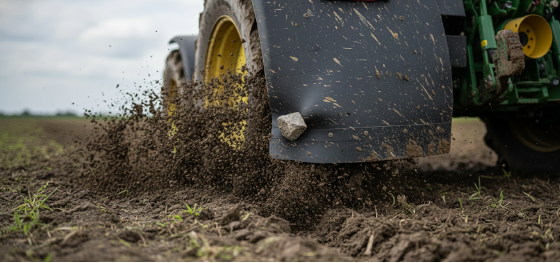
One of the most popular roles for polyurethane reaction injection molding is to create tough, solid, rubber-like parts. These are called elastomers.
These formulations are designed for maximum impact resistance and durability. They can be bent, stretched, and compressed, and they will always return to their original shape.
This makes them the perfect choice for parts that need to be "tough as nails." Think of the large, flexible bumpers on a city bus. Or the rugged fenders on a piece of agricultural equipment. These parts are constantly getting hit, scraped, and abused. A rigid plastic would shatter. But a polyurethane elastomer just shrugs off the damage.
Rolle #2: Das leichte Skelett (Strukturschäume)

The other major role for polyurethane is completely different. By adding a "blowing agent" to the chemical recipe, we can create a structural foam.
As the chemical reaction happens in the mold, the blowing agent releases a gas. This creates millions of tiny, uniform bubbles within the material. The material expands to fill the mold.
The result is a part with a "sandwich" structure. It has a solid, dense outer skin where it touched the cold mold. And it has a lighter, less dense foam core.
This is a brilliant engineering trick. It is the same principle used in an I-beam. The structure is incredibly stiff and strong for its weight. This makes it perfect for large, lightweight, structural parts. Think of the large housing for a medical imaging machine or a panel on a piece of construction equipment.
Die richtige 'Figur' für Ihr Bauteil wählen
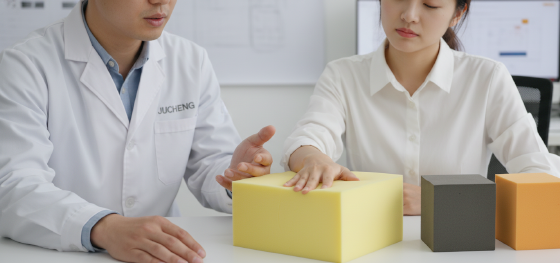
So, which polyurethane personality is right for your project?
Do you need a part that can absorb impacts and survive a tough life? You need a solid elastomer. Do you need a huge part that is as light and stiff as possible? You need a structural foam. Do you need a rigid housing with a beautiful surface finish? You need a solid, rigid polyurethane.
This is a critical decision that goes beyond just the part's geometry. It is about defining the part's character.
A good manufacturing partner like JUCHENG has deep expertise in these different formulations. We can help you navigate the huge world of polyurethane reaction injection molding. We can provide samples. We can offer advice. We can help you choose the perfect material to bring your product's unique personality to life.

