


Rohe Stärke ist oft das erste Opfer komplexer Konstruktionen. In der traditionellen Fertigungslandschaft sind Sie, wenn Sie ein Bauteil benötigen, das sowohl kristallklar als auch praktisch unzerbrechlich ist, gezwungen, in die teure Welt von Hochdruckglas oder gepressten Polycarbonatplatten einzusteigen. Für iterative Forschung und Entwicklung sowie Kleinserienproduktion schaffen diese Methoden jedoch einen endgültigen Engpass durch Werkzeugkosten. Dies ist die technische Kluft, die von einem professionellen Polycarbonat-3D-Druckservice. überbrückt wird. Polycarbonat (PC) ist der "Iron Man" der technischen Polymere und bietet eine Schlagfestigkeit, die 250-mal höher ist als die von Glas, sowie eine thermische Stabilität, die es ihm ermöglicht, in Motorräumen und medizinischen Autoklaven zu überleben. Doch PC ist nicht nur ein weiteres Filament; es ist ein thermischer Rebell, der sich dem Bauzyklus widersetzt. Erfolg in der additiven Fertigung von PC erfordert mehr als nur eine Hochtemperaturdüse – es erfordert absolute Souveränität über die Kühlungsdynamik des Materials.
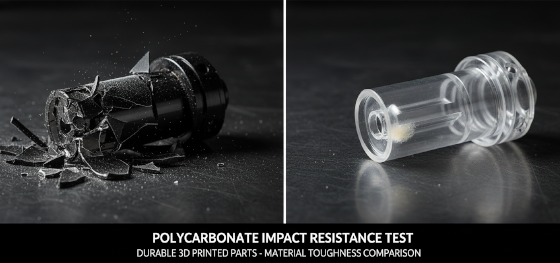
Jucheng Precision agiert als hochpräziser Knotenpunkt für die anspruchsvollsten Automobil- und Luftfahrtmarken der Welt. Wir erkennen, dass bei einem robusten Sensorgehäuse oder einer hochklaren Lichtleiter "meistens stark" ein technischer Fehler ist. Durch die Integration industrieller FDM- und SLA-Systeme mit aktiv beheizten Baukammern bieten wir einen technischen Schutzraum für dieses temperamentvolle Harz. Wir haben die Ära der generischen "klaren" Modelle hinter uns gelassen und liefern funktionale, flugbereite Hardware, die ihre Integrität unter Überschallvibrationen und intensiven thermischen Zyklen bewahrt. Dieser Leitfaden ist ein 2.000 Wörter tiefer Einblick in die Thermodynamik der 300°C-Schmelze, die Logik der optischen Verfeinerung in der Dampfphase und warum JUCHENGs integrierter Ansatz für den Polycarbonat-3D-Druckservice sicherstellt, dass Ihre Konstruktionen den Übergang vom digitalen Modell zur brutalen Realität im Feld überleben.
Rentabilität in der Hochleistungsprototypenfertigung wird von denen erzielt, die die Aufprallphysik frühzeitig validieren können. Sie kaufen nicht nur ein Kunststoffteil; Sie kaufen die verifizierte Gewissheit, dass Ihre Baugruppe einen Falltest oder einen Hochdruck-Flüssigkeitsschub übersteht. Ob Sie ein innovatives medizinisches Ventil oder einen Schutzschild für einen Roboterarm bauen, die Logik der Carbonatbindung ist Ihr größter taktischer Vorteil. Lassen Sie uns die physikalischen Gesetze der industriellen PC-Produktion aufschlüsseln und sehen, wie technische Weitsicht die Seele Ihres nächsten Hardware-Designs in die physische Realität einschließen kann.
Thermodynamischer Kampf: Umgang mit dem 140°C-Glasübergang
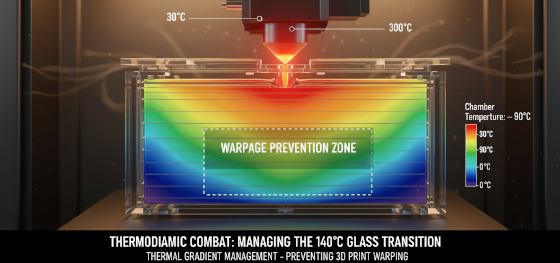
Der Hauptunterschied zwischen einem visuellen Modell und einem strukturellen Bauteil ist die Handhabung innerer Spannungen. Polycarbonat hat eine hohe Glasübergangstemperatur (Tg) von etwa 147°C. Wenn ein Polycarbonat-3D-Druckservice Standard-Desktop-Maschinen verwendet, wird das Material in Raumtemperatur-Luft extrudiert. Dies erzeugt einen heftigen thermischen Schock. Wenn der Kunststoff in Sekunden von seinem 300°C-Schmelzpunkt auf 25°C abkühlt, ziehen sich die Polymerketten ungleichmäßig zusammen, was zu "Verzug" und Zwischenschichtdelamination führt. Dies sind nicht nur kosmetische Mängel; es sind strukturelle Brüche, die nur darauf warten, zu passieren.
JUCHENG eliminiert dieses Risiko durch absolute thermische Souveränität. Unsere industriellen FDM-Zentren arbeiten in aktiv beheizten und umgewälzten Baukammern, die eine konstante Umgebung von 90°C bis 110°C aufrechterhalten. Dies hält den Kunststoff während des mehrtägigen Bauzyklus in einem halbentspannten, getemperten Zustand. Durch die Minimierung des Temperaturunterschieds zwischen Düse und Atmosphäre stellen wir sicher, dass die Schichten auf molekularer Ebene verschmelzen und ein dichtes, strukturelles Festmaterial entsteht, kein Stapel verklebter Fäden. Diese Umgebungskontrolle ermöglicht es uns, großformatige PC-Gehäuse – bis zu 400 mm Länge – mit einer Ebenheit und Maßgenauigkeit zu liefern, die Spritzgussteilen in nichts nachsteht. Wir drücken nicht einfach "Start" an einer Maschine; wir orchestrieren eine Abkühlkurve, die die Geometrie fixiert und sicherstellt, dass Ihre Passungsmerkmale perfekt in der Montagelinie sitzen.
Optischer Realismus: Erzielen von glasähnlicher Transparenz
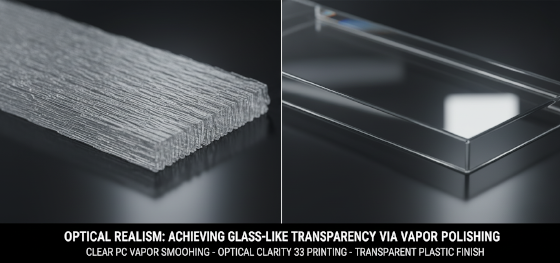
Transparenz in der Welt der 3D-Druckmaterialien ist oft eine Lüge. Ein roher 3D-Druck in Polycarbonat ist bestenfalls durchscheinend, bedeckt mit Schichtlinien, die Licht wie ein Milchglas streuen. Für Automobilingenieure, die eine neue LED-Lichtleiter validieren, oder medizinische Konstrukteure, die einen transparenten Fluidverteiler bauen, ist diese Trübung ein endgültiger Defekt. Das Erreichen von echtem "Optischen Realismus" erfordert einen Übergang von der Maschinenhalle zum chemischen Finishing-Labor. Jucheng Precision hat die Alchemie des Dampfglättens speziell für Polycarbonat gemeistert.
Dieser automatisierte Prozess setzt das Teil einem kontrollierten chemischen Dampf aus, der die mikroskopischen Spitzen der Oberfläche auf molekularer Ebene schmilzt. Während die Oberfläche kurzzeitig verflüssigt wird, zieht die Oberflächenspannung sie glatt, wodurch die Schichtlinien effektiv "gelöscht" werden. Sobald das Lösungsmittel verdunstet, ist das Ergebnis eine versiegelte, hochglänzende "Haut", die praktisch nicht von einer spritzgegossenen Oberfläche zu unterscheiden ist. Diese Behandlung verbessert nicht nur das Aussehen; sie versiegelt die inneren Poren, macht das Teil wasserdicht und resistent gegen bakterielle Adhäsion – ein kritischer Faktor für Prototypen chirurgischer Instrumente. Wir überbrücken die Lücke zwischen "rauem Prototyp" und "marktreifer Hardware" und bieten die visuelle Tiefe, die Ihre Markenidentität verlangt.
Strukturelle Unbesiegbarkeit: PC als ultimativer Aufprallschutz
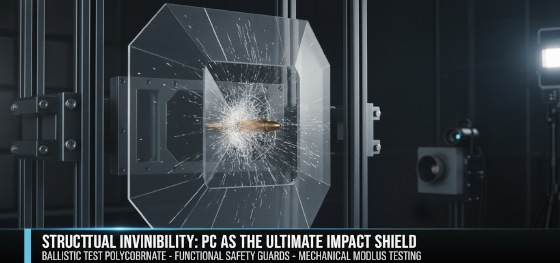
Warum für einen professionellen Polycarbonat-3D-Druckservice bezahlen, wenn Standard-Nylon billiger ist? Die Antwort ist "Bruchzähigkeit". Polycarbonat ist einzigartig aufgrund seiner Fähigkeit, kinetische Energie zu absorbieren und sich plastisch zu verformen, bevor es bricht. In einem Izod-Schlagtest versagen Standardharze bei weniger als 50 J/m. Polycarbonat übersteigt routinemäßig 600 J/m. Diese "strukturelle Unbesiegbarkeit" macht es zur zwingenden Wahl für Komponenten, die Hochgeschwindigkeits-Schmutz ausgesetzt sind, wie Schutzschilde für Roboterzellen oder funktionale Gehäuse für handgehaltene Industriescanner.
At JUCHENG, we utilize the material's high flexural modulus to build "Living Frames"—parts that can bend and flex under stress but return to their original shape without fatigue cracking. This resilience is vital for aerospace interiors where safety-critical components must not shatter into dangerous needles during a structural load-event. We provide the mechanical baseline data to prove that our 3D printed PC components possess 90% of the strength of a wrought sheet, ensuring your functional prototypes survive the most brutal vibration and drop audits. We treat the part’s survival as a functional specification, providing the engineered armor needed for your most ambitious designs to thrive in the real world.
Additive Technology Divide: FDM vs. SLA for Polycarbonate
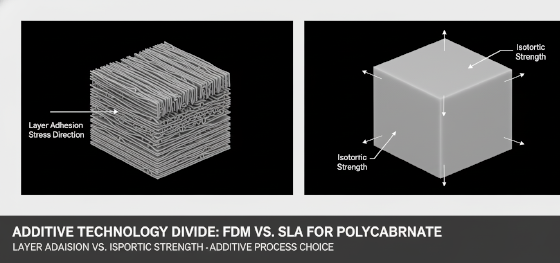
Navigating the equipment choice is the first fork in the road for any engineering project. Not all polycarbonate is processed using the same physics. At our facility, we utilize two distinct additive pathways based on the part's mechanical destiny. Industrial FDM (Fused Deposition Modeling) is the champion of structural "Grit." It utilizes a solid filament of PC that is melted and extruded. Because the material is a production-grade thermoplastic, the resulting parts possess the highest impact strength and thermal resistance. This is the preferred method for machine guards and rugged internal brackets where aesthetics are secondary to raw survival. However, FDM is anisotropic; its strength is dependent on the layer orientation. We manage this through precise tool-path orchestration, ensuring that the highest stress loads align with the strongest axis of the material.
SLA (Stereolithography) represents the "Optical" alternative. Instead of melting a filament, it utilizes a liquid photopolymer resin that has been engineered to simulate polycarbonate’s properties. While these simulants may lack the extreme fracture toughness of FDM-extruded PC, they offer absolute "Geometric Sovereignty." SLA produces nearly isotropic parts with mirror-smooth surfaces and microscopic detail resolution. This is the definitive choice for clear lenses, light pipes, and complex medical manifolds where internal fluid flow must be visible. JUCHENG helps our clients perform a "Mission Audit"—if your part must withstand a sledgehammer, we go FDM; if it must pass an optical bench test, we go SLA. By providing both technologies under one roof, we eliminate the bias found in smaller bureaus, ensuring your delivers the specific physics your assembly requires.
Environmental Survival: Heat, Flame, and Chemical Resistance
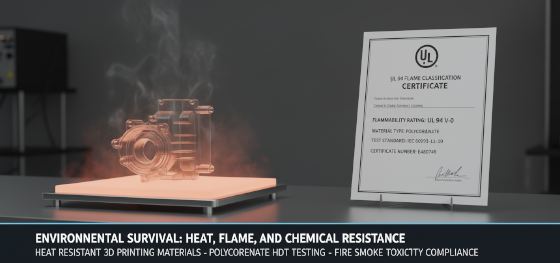
Industrial environments are hostile to standard plastics. A part designed for the medical sector or the automotive engine bay must survive more than just physical impact; it must survive the chemistry of its surroundings. Polycarbonate is favored by JUCHENG’s clients for its impressive Heat Deflection Temperature (HDT), which typically reaches 135°C to 140°C. Unlike lower-grade polymers that soften in a warm enclosure, PC maintains its structural "spine," ensuring that mounting points don't loosen and seals don't weep under thermal load.
Safety compliance is another critical pillar of our polycarbonate 3d printing service. For our aerospace and electronics partners, we utilize specialized PC resins that meet the UL94 V-0 flame-retardant standard. These materials are "self-extinguishing," meaning they won't contribute to the spread of a fire—a mandatory requirement for aircraft cabin interiors and high-voltage power enclosures. However, we also provide a technical warning regarding chemical exposure. Polycarbonate is notoriously sensitive to common alcohols and certain industrial solvents. Exposure to these chemicals can trigger "Crazing"—thousands of tiny hairline fractures that destroy both the clarity and the impact strength of the part. JUCHENG’s engineers evaluate your cleaning and sterilization protocols before we start the build, suggesting protective coatings or material alternatives like PEEK if your environment is chemically aggressive. We don't just print a part; we engineer its long-term survival against the elements.
Hybrid Metamorphosis: CNC Machining the Unprintable Fits
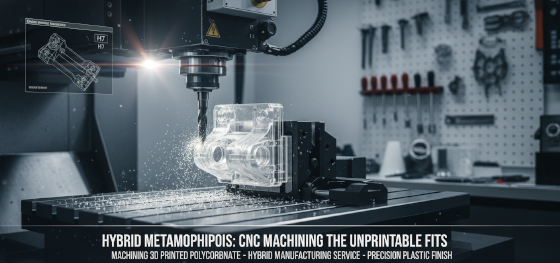
Complexity is a superpower, but it shouldn't come at the cost of precision. Additive manufacturing provides the "Impossible Geometry"—internal labyrinths and topologically optimized frames—but it often fails at the "Critical Interface." A 3D printer cannot consistently deliver an H7 bearing bore or a mirror-finish seal surface to a +/- 0.01mm tolerance. Jucheng Precision eliminates this "Accuracy Gap" through our hybrid manufacturing workflow. We treat the 3D printer as a high-tech foundry that produces an "Advanced Preform."
Our polycarbonate 3d printing service includes the option for "Post-Build Precision." We print your complex PC parts with an extra 1.5mm of "Machining Stock" on all critical assembly datums. Once the part has been thermally stabilized to release internal stresses, it moves to our 5-axis CNC floor. Our high-speed mills then carve away the near-net texture, revealing the surgical accuracy needed for high-performance assemblies. This integrated approach is why JUCHENG is the preferred partner for global robotics and medical firms. We eliminate the accountability gap between vendors, providing a single, verified engineered solution that possesses the lightweight freedom of additive and the sub-micron certainty of CNC. We bridge the gap between design theory and real-world assembly, ensuring your parts fit perfectly the first time, every time.
Technical Validation: Locking in Component Integrity
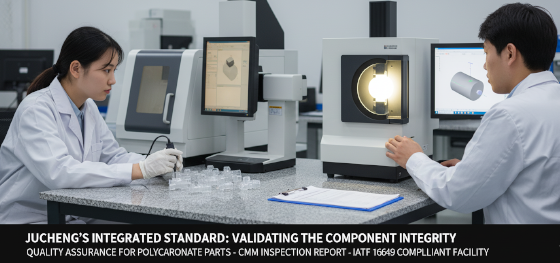
The final hallmark of a professional 3D printing partner is the refusal to accept visual quality as a proxy for technical precision. In the world of high-stakes aerospace and medical hardware, an unverified part is a dangerous liability. Jucheng Precision operates a facility where additive manufacturing is a documented engineering discipline, not a visual craft. Our polycarbonate 3d printing service protocol includes full material lot-traceability and documented process validation. We understand that your reputation depends on the integrity of the plastic we extrude or cure.
Our metrology lab utilize high-resolution CMM (Coordinate Measuring Machines) and laser scanners to generate 3D "Error Maps" of your components. We compare the physical part against your master STEP file to identify any thermal drift that occurred during the cooling phase. We also perform "Shore Hardness" audits and cross-hatch adhesion tests on secondary coatings to ensure the structural "skin" of the part is as tough as the core. For our automotive clients, we provide full PPAP documentation, providing the paper trail required for Tier-1 supply chain compliance. When you receive a shipment from JUCHENG, you aren't just getting 3D prints; you are getting verified engineered solutions that have been audited for survival. We don't just ship plastic; we manufacture trust through data-driven quality control.
Strategic Verdict: Why Professional PC Printing Defines Success
Success in the modern market requires the ability to move from CAD to a functional, field-ready component in days. The decision to utilize a professional Polycarbonat-3D-Druckservice is a strategic move toward manufacturing agility. It allows your engineers to test real impact physics and thermal loads without the anchor of high-pressure tooling costs. By choosing Jucheng Precision, you are accessing a decade of industrial data and a facility that treats polymers with the technical reverence usually reserved for aerospace metals.
Our integrated approach—combining 5-axis CNC precision, chemical vapor smoothing, and IATF 16949-aligned quality standards—makes us the definitive partner for your most challenging transparent and high-strength designs. We remove the uncertainty of material behavior, delivering parts that are visually striking and structurally invincible. Don't let your innovation be limited by the low quality of desktop prints or the high cost of fragmented vendors. Experience the clarity and the capability that industrial-grade polycarbonate replication can bring to your next breakthrough. Contact Jucheng Precision today for a technical DFM review and let our engineers help you build a bigger, better, and more profitable physical reality. We clarify the complex, ensuring your most ambitious visions are armored for survival in the real world.

