

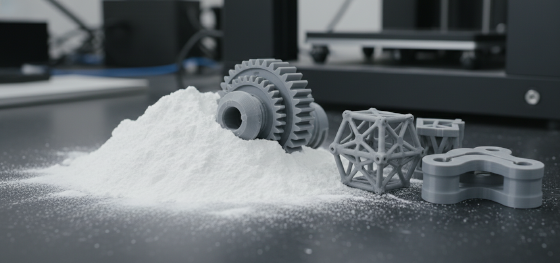
Zuverlässigkeit in der additiven Fertigung wird selten allein durch den Drucker erreicht; sie entsteht aus der molekularen Integrität des Polymerbetts. In der sich schnell verändernden Landschaft der 3D-Druck-Kunststoffe hat eine Materialfamilie die Grenze zwischen "visuellem Modell" und "funktionalem Endteil" überschritten. Dies ist das Reich des Nylon-3D-Drucks. Polyamide sind das industrielle Arbeitstier des 21. Jahrhunderts und bieten eine Kombination aus hoher Zugfestigkeit, chemischer Beständigkeit und der Duktilität, die benötigt wird, um realen mechanischen Belastungen standzuhalten. Während Harzsysteme nach Ästhetik streben, konstruieren Nylon-basierte Pulverfusionstechnologien wie SLS und MJF das strukturelle "Rückgrat" moderner Robotik, Automobil-Motorräume und medizinischer Instrumente.
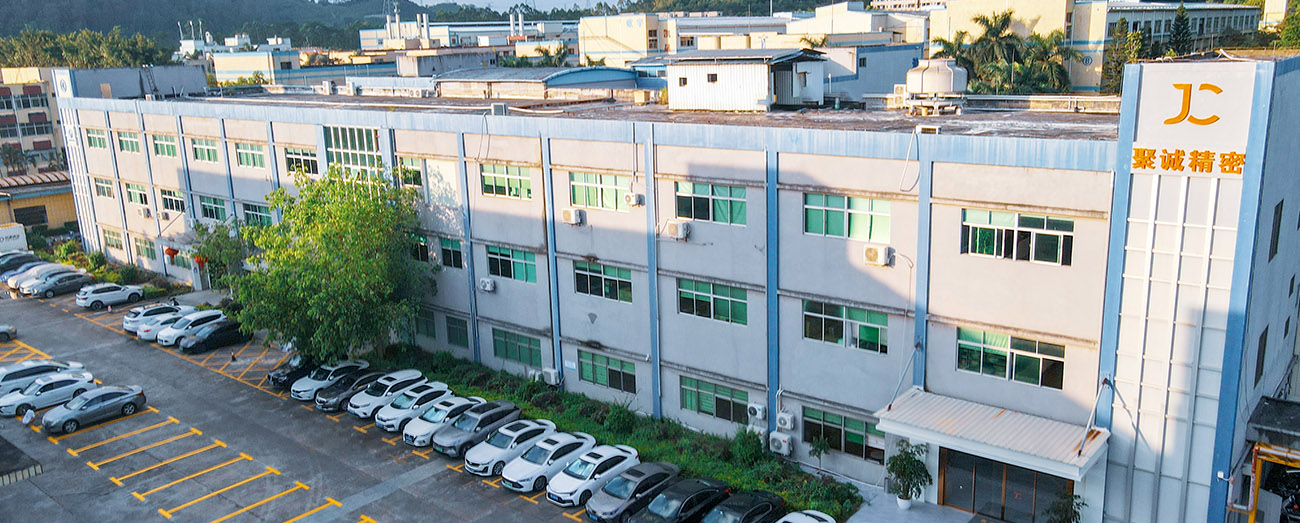
At JUCHENG, we recognize that an engineer’s primary fear is the "layer weakness" inherent in traditional 3D printing. We have centered our facility around technologies that mitigate this risk. Powder bed processes can produce strong nylon parts, but strength, elongation and fatigue resistance may vary with build direction and the exact grade. This guide moves beyond the standard sales pitches to explore the thermodynamic grit of powder bed fusion, the chemical divide between PA11 and PA12, and why JUCHENG’s focus on high-density MJF production is the definitive answer for those looking to bridge the gap between initial prototyping and full-scale injection molding.
Konsistenz in der Kunststoffherstellung ist ein Kampf gegen Wärmeverteilung und Feuchtigkeitsmanagement. Sie stapeln nicht nur Schichten; Sie verwalten ein Phasenwechselereignis, das die mechanische Seele des Teils definiert. Ob Sie einen innovativen Drohnenrahmen oder eine Reihe komplexer Fluidverteiler bauen, die Logik des Pulvers ist Ihr größtes Kapital. Lassen Sie uns die technischen Säulen des industriellen Nylons untersuchen und sehen, wie es das Überleben Ihrer ambitioniertesten 3D-Designs neu definiert.
Die Technologielücke: Sintern vs. Fusion
Chemische Widerstandsfähigkeit: Navigation durch PA11- und PA12-Leistung
Verstärkte Befestigung: Glas- und Kohlenstoffinfusion
Technische Daten: Mechanische Leistungstabelle
JUCHENGs Urteil: Prototyping vs. CNC-Bearbeitung
Die Technologielücke: Sintern vs. Fusion
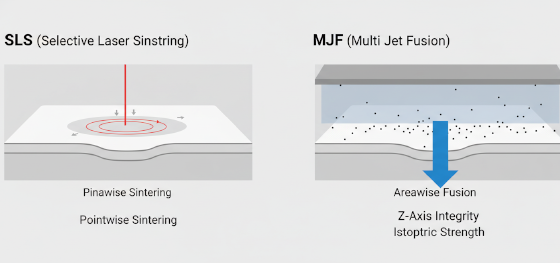
Um zu meistern Nylon-3D-Drucks, müssen Sie zuerst die zwei Titanen des Pulverbetts verstehen: Selektives Lasersintern (SLS) und Multi Jet Fusion (MJF). Während beide ein Bett aus Nylonpulver verwenden, sind ihre thermodynamischen Wege zu einem festen Teil grundlegend unterschiedlich. SLS verwendet einen einzelnen, hochpräzisen CO2-Laser, um die Geometrie eines Teils zu "zeichnen", wobei die Pulverpartikel am Kontaktpunkt gesintert werden. Diese Methode ist das ursprüngliche Arbeitstier der Branche und kann Teile ohne Stützstrukturen herstellen, was die Erstellung komplexer, ineinandergreifender Geometrien ermöglicht, die durch Fräsen physisch unmöglich herzustellen sind.
MJF, entwickelt von HP, stellt die nächste Evolution in 3D-Druckmaterialien processing. Instead of a laser point, it utilizes an inkjet array to apply a "fusing agent" across the entire surface of the bed, followed by an intense infrared lamp pass that melts the material in a single sweep. At JUCHENG, we use MJF for some small-batch jobs (50 to 500 units). Do not infer equal strength in every direction or a pressure rating from the process name. For housings or manifolds, confirm the grade and build direction, and verify representative finished parts under the relevant loads and leak-test conditions.
Chemische Widerstandsfähigkeit: Navigation durch PA11- und PA12-Leistung
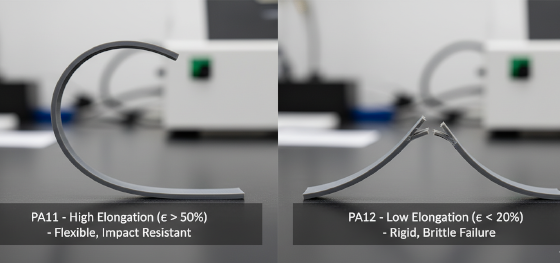
The naming convention of polyamides—11 and 12—is not arbitrary; the number refers to the carbon count in the repeating unit of these nylon types. Select by grade and measured properties, not the number alone. Nylon 12 (PA12) is the most common material in our facility. PA12 is often used for housings and fittings, but moisture and temperature can still affect dimensions and mechanical behavior. Verify bearing seats and snap-fits on representative parts conditioned for the intended service environment.
Some PA11 grades offer higher elongation than some PA12 grades, but compare the exact grade, build direction and condition. Elongation at break is not a measure of hinge life. For hinges or clips, validate representative parts through the specified cycle count, deflection and service conditions.
Verstärkte Befestigung: Glas- und Kohlenstoffinfusion
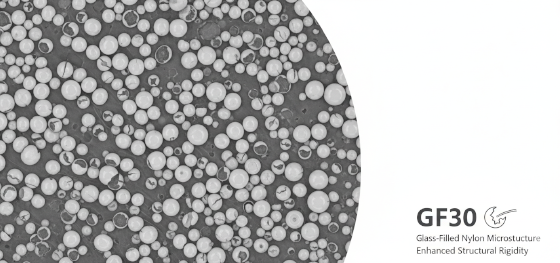
Sometimes, the raw polymer reaches its physical ceiling. When a design requires the stiffness of a cast metal but the weight of a plastic, we turn to "Composite Fortification." JUCHENG specializes in the processing of Glass-Filled (GF) and Carbon-Fiber (CF) reinforced nylon powders. Glass-filled grades can use beads or fibers, depending on the product. EOS's PA 3200 GF glass-bead grade is stiffer than PA 2200 Balance in the table, but both report the same HDT at 0.45 MPa. Specify the actual load, temperature and exposure duration rather than assuming higher stiffness means higher usable temperature.
Carbon-Fiber Nylon takes this even further, providing a massive boost in tensile modulus. It turns a "plastic" part into a structural component capable of replacing aluminum brackets in non-critical aerospace assemblies. However, machining or finishing these composites is a technical high-wire act. The fibers are abrasive and can cause "fuzzing" on the surface if the fusion parameters are incorrect. Composite behavior depends on grade, build direction and the complete finishing process. Where stiffness, wear or fatigue is critical, qualify the final geometry and process under the actual loading conditions.
Technische Daten: Mechanische Leistungstabelle
The table compares three EOS selective laser sintering grades using supplier data for dry specimens built in the X orientation. These are screening values, not Jucheng production test results. Heat deflection under the stated load is not a continuous-use temperature rating.
| Eigenschaft | EOS PA 2200 Balance (PA12) | EOS PA 1101 (PA11) | EOS PA 3200 GF (glass-bead PA12) |
|---|---|---|---|
| Tensile Strength (ISO 527) | 48 MPa | 50 MPa | 51 MPa |
| Strain at Break (ISO 527) | 18% | 30% | 9% |
| HDT (ISO 75, 0.45 MPa) | 157°C | 180°C | 157°C |
| Tensile Modulus (ISO 527) | 1,650 MPa | 1,650 MPa | 3,200 MPa |
JUCHENGs Urteil: Prototyping vs. CNC-Bearbeitung
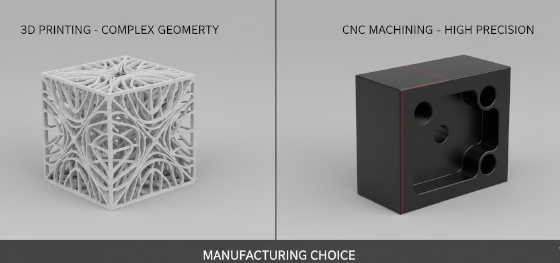
The final hallmark of a one-stop-shop like Jucheng Precision is the ability to tell you when not to use 3D printing. In the 3D-Druckmaterialien world, nylon is a godsend for complexity, but it cannot always compete with the raw density and sub-micron accuracy of a 5-axis mill. When a design features a massive solid volume or requires an H7 bearing tolerance, we will steer you toward our CNC Nylon Machining cells.
We view these technologies as partners, not competitors. For a single assembly, we may print the complex, topologically-optimized outer housing via Nylon-3D-Drucks and machine the high-precision internal lock mechanisms via CNC. This hybrid approach ensures you get the lightweight benefits of additive and the functional precision of subtractive. We bridge the gap between design theory and real-world assembly. Whether you are building an innovative medical device or a mission-critical satellite mount, our expertise in high-fidelity polymers ensures your vision is delivered with absolute integrity. Contact Jucheng Precision today for a comprehensive technical DFM review and let our material protocols clarify and elevate your next manufacturing challenge.