


Die Natur baut nie mit massiven, gleichförmigen Blöcken. Betrachtet man den Querschnitt eines menschlichen Oberschenkelknochens oder die innere Geometrie eines Vogelflügels, sieht man ein komplexes, poröses Netzwerk, das darauf ausgelegt ist, Festigkeit zu maximieren und gleichzeitig Masse zu minimieren. Jahrhundertelang war die Fertigung nicht in der Lage, diese biologische Effizienz nachzubilden; wir waren gezwungen, massive Formen zu fräsen oder zu gießen, weil unsere Werkzeuge zu grob waren, um die Leere zu sehen. Diese Einschränkung wurde durch das Gitterstrukturdesign. dauerhaft beseitigt. In der anspruchsvollen Welt der 3D-Druck-Konstruktion, ist die Leere kein Vakuum mehr – sie ist ein technisch gestaltetes Subsystem. Wir bewegen uns in die Ära des "Digitalen Knochens", in der die innere Architektur eines Bauteils mathematisch optimiert wird, um spezifische Spannungspfade zu bewältigen, was Komponenten ermöglicht, die 70% leichter sind als ihre massiven Vorgänger, ohne auch nur ein Newton an struktureller Steifigkeit einzubüßen.
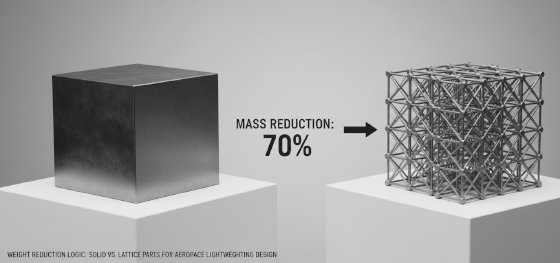
Jucheng Precision arbeitet an der Spitze dieser strukturellen Revolution. Wir verstehen, dass ein Gitter nicht nur ein "Infill"-Muster ist, das von Hobby-Slicern übernommen wurde; es ist ein mechanisches Meta-Material. Durch die Manipulation der Einheitszellengeometrie, des Strebendurchmessers und der Knotenverbindungen können wir die Reaktion eines Bauteils auf Stöße, Vibrationen und thermische Ausdehnung konstruieren. Ob Sie ein Titan-Orthopädieimplantat entwickeln, das das Knocheneinwachsen fördern soll, oder einen Hochleistungs-Wärmetauscher mit maximierter Oberfläche – die Logik des Gitters ist Ihr primärer Wettbewerbsvorteil. Dieser Leitfaden geht über die grundlegenden Definitionen hinaus und untersucht die Physik der triply periodic minimal surfaces (TPMS), die technische Herausforderung der Pulverentfernung und warum JUCHENGs integrierter Ansatz des generativen Engineerings sicherstellt, dass Ihre Skelettdesigns den Übergang vom Bildschirm in die reale Welt überleben.
Konsistenz in Hochleistungshardware wird durch die Entfernung unnötiger Masse erreicht. Sie drucken nicht nur eine Form; Sie koordinieren Millionen mikroskopischer Schnittpunkte, die als ein einheitlicher, struktureller Schild wirken. Lassen Sie uns die technischen Säulen des digitalen Raums aufschlüsseln und sehen, wie algorithmische Voraussicht die Integrität Ihrer ambitioniertesten Designs in die physische Realität verankern kann.
Geometrische Architekturen: Truss- vs. TPMS-Logik
Mechanische Anpassung: Konstruktion der Spannungs-Dehnungs-Kurve
Leichtbau-Souveränität: Massereduktion bei hochwertigen Legierungen
Das Nachbearbeitungsparadoxon: Design für Pulverentfernung
JUCHENGs technischer Standard: Vom Algorithmus zur Baugruppe
Geometrische Architekturen: Truss- vs. TPMS-Logik

Der erste technische Scheideweg in Gitterstrukturdesign ist die Auswahl der Einheitszellenarchitektur. Traditionelles Engineering verlässt sich auf "Truss-basierte" Gitter – Strukturen aus miteinander verbundenen geraden Balken oder Streben. Dies sind die digitalen Äquivalente der I-Träger und Träger in Wolkenkratzern. Übliche Geometrien wie das Octet-Truss werden wegen ihres hohen Steifigkeits-Gewichts-Verhältnisses und ihres vorhersagbaren linearen Verhaltens bevorzugt. Für Teile wie Luftfahrtkonsolen oder industrielle Montagerahmen bieten Truss-basierte Designs eine robuste, kristalline Steifigkeit, die sicherstellt, dass das Bauteil unter statischen Lasten nicht durchbiegt. Sie haben jedoch einen erheblichen Nachteil: Spannungskonzentration. Jeder Punkt, an dem zwei Streben aufeinandertreffen, ist eine scharfe Verbindung, die als lokaler Spannungssteigerer wirkt und im Laufe der Zeit zu Ermüdungsversagen führen kann.
Die moderne Evolution der Leere findet sich in "TPMS" (Triply Periodic Minimal Surfaces). Dies sind organische, mathematisch abgeleitete Formen wie der Gyroid oder die Schwarz-P-Fläche. Anders als die scharfen Winkel eines Trusses bestehen TPMS-Strukturen vollständig aus glatten, kontinuierlichen Kurven. Diese "Kurvilineare Souveränität" eliminiert die Spannungskonzentrationspunkte, die in Standardgittern zu finden sind, und macht sie weit überlegen für dynamische Anwendungen mit hohen Vibrationen oder zyklischer Belastung. Darüber hinaus sind TPMS-Geometrien "selbsttragend", was bedeutet, dass sie oft in Metall gedruckt werden können, ohne dass interne Stützstrukturen erforderlich sind. Bei Jucheng Precision befürworten wir TPMS in medizinischen Implantaten und hocheffizienten Wärmetauschern, da die fließenden Kanäle die Reinigung erleichtern und ein enormes Oberflächen-zu-Volumen-Verhältnis bieten. Durch die Wahl zwischen einem "Steifen Truss" und einer "Dauerhaften Kurve" bestimmen Sie, wie Ihr Bauteil mit den Gesetzen der mechanischen Spannung interagiert.
Mechanische Anpassung: Konstruktion der Spannungs-Dehnungs-Kurve

The primary superpower of additive manufacturing is the ability to create "Variable Density" components. In the traditional world, a material has a fixed set of mechanical properties. If you use aluminum, you get aluminum’s stiffness. With Gitterstrukturdesign, the machinist becomes a material architect. By strategically varying the thickness of the struts or the size of the cells across the part's geometry, JUCHENG can create "Tailored Stiffness." We can make the mounting points of a bracket rock-solid while keeping the center section soft enough to absorb vibrations. This is the ultimate tool for impact management.
This capability is particularly vital in the development of "Digital Foam" using TPU. We can replace traditional uniform-density foam liners in helmets or robotic grippers with a lattice that offers a "Non-Linear" response to force. Imagine a cushion that feels soft to a light touch but becomes exponentially stiffer during a high-impact collision—this progressive resistance is achieved entirely through geometric orchestration. We utilize advanced FEA (Finite Element Analysis) to map the expected stress loads of your design, then we populate the CAD model with a graded lattice that matches that stress map perfectly. This ensures that every gram of material is working at its maximum efficiency, providing a safety margin that solid blocks simply cannot replicate. We don't just fill space; we engineer the part's tactile and mechanical personality.
Leichtbau-Souveränität: Massereduktion bei hochwertigen Legierungen

In industries where every milligram is a tax on performance—like aerospace and motorsports—lightweighting is the only metric of success. Using 3D-Druck-Konstruktion to replace solid metal with a skeletal lattice is the most aggressive move an engineer can make. Consider a titanium structural node for a satellite. By utilizing a Diamond lattice infill, JUCHENG can reduce the part's weight by 60% while maintaining 90% of its original rigidity. When you are using expensive superalloys like Titanium or Inconel, this weight reduction isn't just about speed; it's about raw economic survival. The less metal we print, the lower the part cost.
| Structure Type | Stiffness Retention | Mass Reduction | Ideal Industry |
|---|---|---|---|
| Solid Billet | 100% | 0% | Tooling / Heavy Ind. |
| Honeycomb | ~85% | ~40% | Structural Panels |
| Truss Lattice | ~70% | ~65% | Aerospace Brackets |
| Gyroid TPMS | ~75% | ~55% | Medical / Thermal |
This "Mass Sovereignty" allows for the creation of monolithic designs that combine multiple functions into a single part. We can print an aluminum housing that serves as its own shock-absorber and heat-sink through the use of internal lattice zones. This eliminates the weight of assembly hardware and reduces the risk of vibration-induced loosening in high-speed machinery. By removing the burden of unnecessary material, JUCHENG enables your hardware to operate closer to the theoretical limits of performance. We help you transition from the "Carving" mindset of the 20th century to the "Growing" mindset of the 21st, where every milligram of metal must justify its existence.
Das Nachbearbeitungsparadoxon: Design für Pulverentfernung

Complexity is a liability if it cannot be cleaned. This is the most painful lesson for engineers exploring Gitterstrukturdesign. In the metal DMLS or nylon MJF processes, the part is born in a bed of loose powder. If your design features a dense, closed-off internal lattice, that powder becomes trapped inside. It cannot be removed. Instead of a lightweight structural part, you end up with a heavy, expensive container full of unsintered dust. This is the "Post-Processing Paradox": the more complex you make the void, the harder it is to reclaim it.
Successful implementation requires a "Cleaning-First" design strategy. At Jucheng Precision, our DFM team audits every lattice model for "Drainability." We ensure that the lattice "unit cell" is large enough to allow powder to flow freely during the breakout phase. We often suggest adding large, strategic "Clean-out Ports"—holes in the exterior skin that allow us to use high-pressure air or ultrasonic fluid to flush out every remaining particle. For resin-based SLA lattices, these ports are even more critical; if liquid resin is trapped inside and then post-cured, it will expand and explode the part from the inside out. We treat the exit path of the waste material with the same technical reverence as the load path of the metal. By engineering the evacuation route during the CAD phase, we ensure your "Lattice" dream doesn't become a "Residual" nightmare, guaranteeing a part that is 100% clean and functionally pure.
JUCHENGs technischer Standard: Vom Algorithmus zur Baugruppe
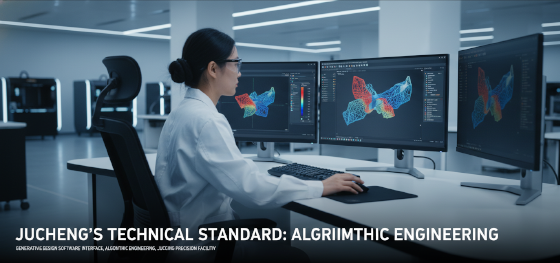
The final hallmark of a world-class manufacturing partner is the integration of software and hardware. Lattice structure design is too complex for standard CAD tools. At Jucheng Precision, we utilize advanced generative design and implicit modeling software to orchestrate the internal geometry of your parts. We don't just "infill" a volume; we weave a structure that aligns with the fluid dynamics and mechanical loads of your mission. Our facility is equipped with high-resolution DMLS and MJF systems that can resolve strut diameters as small as 0.2mm, allowing for the creation of microscopic dot-matrix textures.
Our quality assurance protocol includes CT scanning and high-resolution X-ray analysis for critical skeletal parts. We verify that the lattice is fully fused and that no internal struts have failed during the build or the post-process stress-relief cycles. This level of technical oversight is why JUCHENG is the preferred partner for the aerospace, medical, and high-end consumer sectors. When you receive a shipment from our facility, you aren't just getting 3D prints; you are getting verified engineering masterpieces that have been audited for survival. We bridge the gap between abstract mathematical beauty and the brutal reality of industrial service. Whether you are building an innovative orthopedic implant or a high-performance EV battery cooling plate, our lattice protocols clarify and elevate your most ambitious projects. Contact Jucheng Precision today for a technical DFM review and see how our digital space protocols can armor your next manufacturing breakthrough.

