


Die Beobachtung eines Hochgeschwindigkeits-Pickroboters in einem [2026] Logistikzentrum offenbart den stillen mechanischen Kampf von Industrieroboterteile: Das Kabelbündel kämpft ständig gegen Reibung und Zentrifugalkraft. Während der Arm die Reichweite und die Motoren die Kraft liefern, dient das Kabelmanagementsystem als schützender Kanal für die Nerven des Roboters. Wenn ein Kabel während eines von Millionen Biegezyklen hängen bleibt oder seine Isolierung durchscheuert, kann der daraus resultierende elektrische Kurzschluss eine gesamte Produktionslinie lahmlegen. Die Entwicklung kundenspezifischer Roboter-Kabelmanagement-Teile ist eine kritische Übung in Materialwissenschaft und geometrischer Optimierung, um eine Null-Ausfallzeit-Leistung zu gewährleisten.
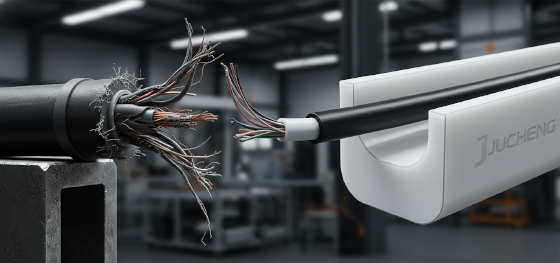
Kabelermüdung ist die Hauptursache für ungeplante Roboterausfälle in modernen Fabriken. Standard-Kabelbinder und generische Leitungen aus dem Handel bieten oft nicht die präzisen Biegeradien, die für Bewegungen mit hohem Freiheitsgrad erforderlich sind. Wenn sich der Arm durch komplexe J1-J6-Sequenzen bewegt, erfahren die Kabel intensive Torsions- und Zugspannungen. Jucheng Precision begegnet diesen Schwachstellen, indem es maßgeschneiderte Verlegehardware konstruiert und bearbeitet, die unabhängig von der Armposition eine optimale Kabelgeometrie aufrechterhält.
Mit Sitz im Shenzhener Präzisionsfertigungszentrum bietet JUCHENG eine umfassende "Brücke zur Produktion" für Automatisierungs-OEMs. Wir integrieren CNC-Kunststoffbearbeitung, Blechfertigung und Schnellformgebung, um komplette Kabelverlegungslösungen zu liefern, die selbst härtesten Industrieumgebungen standhalten. Dieser Leitfaden untersucht die wesentlichen Anforderungen an Biegelebensdauer, abriebfeste Materialien und kundenspezifische Abschirmstrategien für die Herstellung von Roboter-Kabelmanagementsystemen, die jahrzehntelang halten.
Biegezyklusdynamik: Konstruktion für ständige Bewegung
Technische Daten: Reibungsarme Polymere für Kabelkanäle
Abriebschutz: Bearbeitung glatter Innenradien
Kundenspezifische Abschirmung: Schutz der Nerven vor Schweißspritzern
JUCHENG: Das Shenzhener Zentrum für integrierte Kabellösungen
FAQ: Schutz von Hochflex-Kabeln in der Industrierobotik
Biegezyklusdynamik: Konstruktion für ständige Bewegung
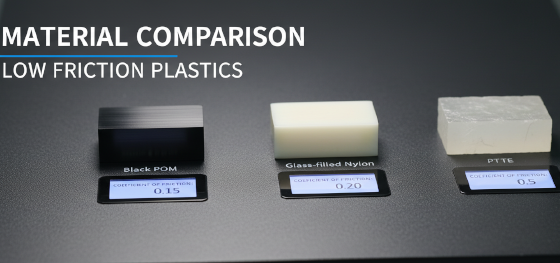
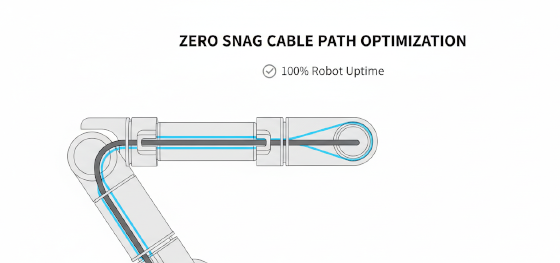
Die Verwaltung des physischen Pfads eines Kabelbündels erfordert ein tiefes Verständnis der Roboterkinematik. In kundenspezifischer Roboter-Kabelmanagement-Teile, muss die "neutrale Achse" des Kabels aufrechterhalten werden, um zu verhindern, dass die inneren Kupferlitzen übermäßig gedehnt oder gestaucht werden. Wenn sich ein Roboterarm von seiner Ausgangsposition zu einer voll ausgefahrenen Position bewegt, ändern sich die Kabellängenanforderungen dynamisch. JUCHENG nutzt 5-Achsen-CNC-Bearbeitung, um adaptive Halterungen zu schaffen, die es dem Kabel ermöglichen, innerhalb kontrollierter Grenzen zu gleiten oder zu "atmen", wodurch die Spannungsspitzen vermieden werden, die zu inneren Leiterbrüchen führen.
Torsional stress is a hidden killer of 6-axis robot cables. As the wrist (J5/J6) rotates, the cable pack is twisted like a rope. Standard cable management often fails here, causing the loom to "corkscrew" and eventually snag on the robot’s own structure. JUCHENG engineers custom rotational swivels and "slip-rings" machined from high-performance polymers. These components allow the cables to rotate independently of the arm’s motion, effectively decoupling the torsional load and extending the cable’s life from months to years in a high-volume assembly environment.
Bend radius compliance is the most fundamental rule of cable health. Every cable has a manufacturer-specified minimum bend radius; exceeding this limit triggers rapid insulation fatigue. JUCHENG machines cable trays and support gutters with integrated "stops" and curved paths that make it physically impossible for the cable to bend too sharply. By holding +/- 0.05mm tolerances on these curved geometries, we ensure that the cables are always supported by a smooth, mathematically perfect surface, reducing the localized stress that ruins Industrieroboterteile.
Dynamic interference checks are performed during the DFM phase. We simulate the entire range of robot motion to identify "pinch points" where the cables might get crushed between the arm links. JUCHENG’s custom brackets are often designed with "sacrificial" wear plates—easily replaceable plastic inserts that bear the brunt of any contact. This proactive engineering approach ensures that even if the robot operates in a cramped workspace, the critical data and power lines remain untouched and functional throughout the machine’s lifecycle.
Technische Daten: Reibungsarme Polymere für Kabelkanäle
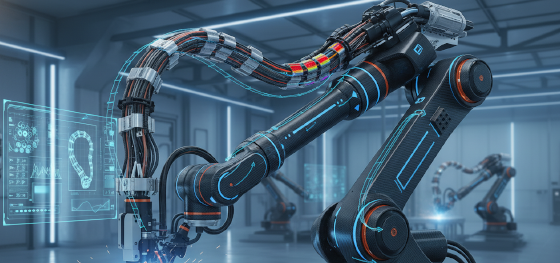
Selecting the right material for a cable tray or guide determines how much heat is generated during movement. High friction leads to localized "hot spots" on the cable jacket, which softens the plastic and accelerates wear. Jucheng Precision provides technical consultations to help you match the material to your specific flex-rate. The following table compares the friction and wear properties of polymers used in high-performance kundenspezifischer Roboter-Kabelmanagement-Teile für den [2026] Markt verwendet werden.
| Material | Coeff. of Friction (Dynamic) | Abriebfestigkeit | Primärer Vorteil |
|---|---|---|---|
| POM (Delrin) | 0.15 - 0.20 | Sehr Hoch | Self-Lubricating / Rigid |
| PA66 (Nylon) | 0.25 - 0.35 | Hoch | Impact Toughness / Cost |
| PTFE (Teflon) | 0.05 - 0.10 | Low (Soft) | Extreme Low Friction |
| UHMW-PE | 0.10 - 0.15 | Außergewöhnlich | Maximum Wear Life |
POM (Acetal/Delrin) is the preferred choice for robot cable guides because it provides a "hard" surface with exceptional dimensional stability. Its self-lubricating properties mean that cables can slide across its surface millions of times without needing external grease, which could attract dust and become abrasive. JUCHENG utilizes high-speed CNC milling to achieve a Ra 0.8 finish on POM trays, ensuring that the Industrieroboterteile we provide offer the lowest possible resistance to movement, maximizing the robot’s acceleration and motor efficiency.
UHMW-PE is utilized for the high-impact "rub blocks" found in large-scale palletizing robots. While less rigid than POM, its abrasion resistance is unrivaled among engineering plastics. JUCHENG machines these blocks with custom snap-fit features, allowing them to be replaced in seconds during routine maintenance cycles. This focus on "serviceability" is a hallmark of JUCHENG’s manufacturing philosophy, ensuring that your cable management system remains a high-value asset rather than a maintenance headache.
Abriebschutz: Bearbeitung glatter Innenradien
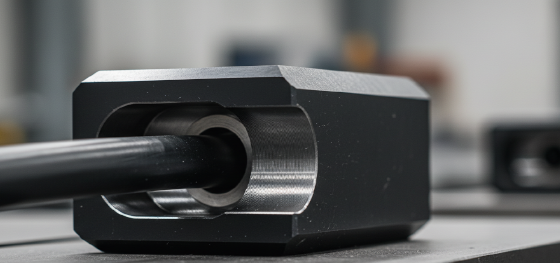
Micro-abrasion is a subtle but deadly failure mode in kundenspezifischer Roboter-Kabelmanagement-Teile. If a cable tray has even a single sharp machining burr or a rough milling transition, it acts as a microscopic saw against the cable jacket. Over thousands of hours, this burr will saw through the outer jacket and the braided shield, eventually shorting out the core conductors. JUCHENG utilizes specialized abrasive flow machining and manual deburring protocols to ensure that every internal radius is mirror-smooth. We inspect these surfaces under 10x magnification to guarantee "snag-free" performance.
Geometric continuity is the secret to low wear. In a complex cable track, the cable must transition between different support members. If there is a "step" or a gap between these members, the cable will "bump" across the interface, leading to localized fatigue. JUCHENG utilizes 5-axis CNC machining to create seamless transitions between brackets, ensuring that the cable’s support path is a continuous, uninterrupted curve. This level of precision is essential for robots performing high-repetition tasks like circuit board testing where the arm never stops moving.
Integrated strain relief is another critical detail. At the point where the cable loom enters the robot body or the end-effector, it must be rigidly clamped to prevent the movement of the arm from pulling on the internal connectors. JUCHENG machines custom "split-ring" clamps with elastomeric liners. These clamps provide a uniform 360-degree gripping force without crushing the cable insulation, effectively transferring the mechanical load into the robot’s structure and protecting the delicate "nerves" from axial tension.
Heat management within the cable bundle must also be addressed. Cables carrying high current for servo motors generate heat; if they are packed too tightly in a custom enclosure, they can cook their own insulation. JUCHENG designs cable trays with integrated ventilation ports and "spacer" features that maintain a minimum air gap between power and signal lines. This passive cooling ensures that your Industrieroboterteile operate within their thermal limits, preventing the insulation meltdowns that cause mysterious intermittent sensor errors in high-load applications.
Kundenspezifische Abschirmung: Schutz der Nerven vor Schweißspritzern
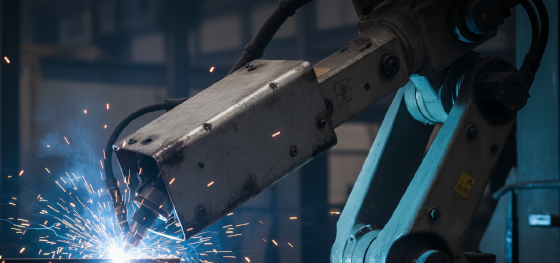
Agricultural and automotive robots often operate in environments where cables are under physical attack. In a welding cell, molten metal spatter can burn through a standard polyurethane cable jacket in seconds. JUCHENG’s kundenspezifischer Roboter-Kabelmanagement-Teile include specialized sheet-metal and molded enclosures that act as a "physical firewall." We fabricate lightweight aluminum or stainless steel shields that deflect spatter and grinding dust, ensuring that the cables remain in a clean-room environment while the robot works in the mud or sparks.
Corrosion resistance is mandatory for chemical-handling or food-processing robots. A standard cable track will degrade if exposed to aggressive cleaning agents or liquid fertilizers. JUCHENG utilizes Type III Hard Anodizing on aluminum shields and specialized fluoropolymer coatings on plastic guides. These treatments create a chemically inert barrier that prevents the cable management hardware from becoming a starting point for rust or material breakdown, ensuring the IP67/IP69K integrity of the entire robotic system is maintained.
Impact protection is the final layer of defense. In collaborative environments, cables are often exposed to accidental strikes from human operators or falling debris. JUCHENG designs "armored" conduits that utilize a dual-layer architecture: a flexible internal core for cable support and a rigid external shell for impact resistance. By using 5-axis CNC to machine these shells with organic, rounded geometries, we eliminate sharp edges that could pose a safety risk to humans while providing the "armored" protection your autonomy stack requires.
Integrated sensor mounts within the cable pack are a growing trend in [2026]. To monitor cable health in real-time, JUCHENG machines recessed pockets for accelerometers and temperature sensors directly into the cable trays. These sensors detect if a cable is vibrating excessively or overheating, allowing for predictive maintenance before a failure occurs. This level of smart Industrieroboterteile manufacturing is what allows JUCHENG to support the world’s most advanced "Lights-Out" manufacturing facilities where human intervention is minimized.
JUCHENG: Das Shenzhener Zentrum für integrierte Kabellösungen
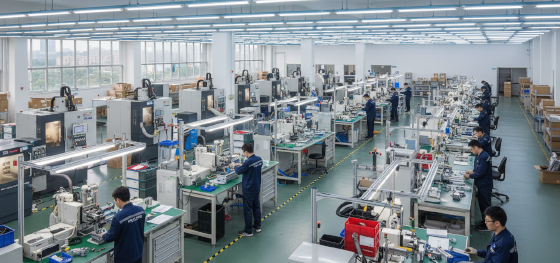
Dominating the [2026] industrial automation market requires a manufacturing partner that can bridge the gap between heavy fabrication and delicate assembly. Jucheng Precision operates with a 24/7 manufacturing mindset in our Shenzhen precision manufacturing hub, delivering high-tolerance cable trays and custom robotic cable management parts with lead times as fast as 12 business days. We provide a "Bridge to Production" that allows you to move from a single functional prototype to a commercial fleet of 1,000 robots with consistent cable-routing quality.
Integrating your routing design with JUCHENG’s expertise ensures that your robot survives the "First-Million Cycle" test and moves into long-term adoption. We offer comprehensive DFM reviews within 24 hours, identifying potential snag points or "flex-traps" in your design before they become field failures. Whether you are building an automotive welding robot or a high-speed electronics assembly bot, Jucheng Precision provides the rigid, precise conduits that keep your innovation moving through the high-speed cycles and the years of hard labor.
Our facility is equipped with 150+ CNC machines and dedicated sheet-metal and molding cells, allowing us to manage the entire cable management lifecycle in one location. We manage the complexity of multi-material bonding and precision deburring so your engineering team can focus on the control algorithms and the AI. By combining Shenzhen's speed with industrial-grade material verification, JUCHENG remains the preferred partner for the world's most aggressive Industrieroboterteile challenges. Contact us today to start your next project.
FAQ: Schutz von Hochflex-Kabeln in der Industrierobotik
What is the best material for low-friction cable guides?
POM (Acetal). It offers the best combination of self-lubrication, rigidity, and abrasion resistance.
How do you prevent cables from snagging during wrist rotation?
We utilize CNC-machined rotational swivels that decouple the twisting motion of the cable from the arm’s path.
Can JUCHENG machine cable trays for high-heat environments?
Yes. We utilize glass-filled Nylon or coated aluminum for environments exceeding 100°C.
What tolerance is required for integrated strain relief clamps?
We hold +/- 0.05mm on split-ring bores to ensure a perfect grip without damaging the cable insulation.
What are typical lead times for custom cable management assemblies?
Fully machined and assembled cable routing systems are typically delivered in 10 to 15 business days.
Cable failure in industrial automation is an absolute mission killer. Partnering with Jucheng Precision ensures that your nerves are protected with the custom robotic cable management parts and specialized POM machining techniques the industry demands. Reach out to our Shenzhen manufacturing hub today for a complete DFM review and build the high-flex foundation your autonomous fleet requires.

