


Design existiert an der Schnittstelle zwischen menschlicher Haut und kaltem Metall. In der weiten Landschaft der CNC-Bearbeitungsprozesses, meisten Operationen liegt der Fokus auf dem Entfernen von Material, um eine Dimension zu erreichen. Aber ein spezifischer Prozess konzentriert sich darauf, die Oberfläche in eine funktionale Schnittstelle zu verwandeln. Dies ist CNC-Rändelung. Es ist die technische Methode, eine Reihe von regelmäßigen, kreuzförmigen oder geraden Rillen auf einer zylindrischen Oberfläche zu erzeugen. Ob es sich um einen Drehmoment-Einstellknopf an einem Labormikroskop oder den rutschfesten Griff eines chirurgischen Titanwerkzeugs handelt, die Rändelung ist das, was es einer menschlichen Hand ermöglicht, Kontrolle über eine Maschine auszuüben.
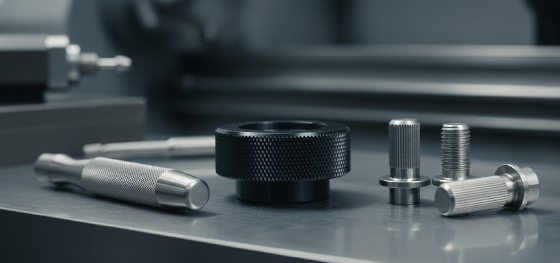
Bei Jucheng Precision behandeln wir die Rändelung sowohl als strukturelle Anforderung als auch als ästhetisches Markenzeichen. Wir verstehen, dass eine "schlechte Rändelung"—eine mit doppelten Linien oder abgeflachten Spitzen—ein Zeichen für schlechte Prozesskontrolle ist. Um ein klares, gleichmäßiges Muster zu erzielen, ist eine Beherrschung der Materialverdrängung und der Spindelsynchronisation erforderlich. Dieser Leitfaden untersucht die mechanische Trennung zwischen Formen und Schneiden, die kritische Berechnung des Durchmesserwachstums und warum die Integration von angetriebenen Werkzeugen bei JUCHENG sicherstellt, dass sich Ihre ergonomischen Designs so hochwertig anfühlen, wie sie aussehen.
Erfolg bei der Rändelung liegt in der Kontrolle von Werkzeugdruck und Materialfluss. Es ist ein Prozess, bei dem das Metall gezwungen wird, sich zu bewegen, nicht nur zu verschwinden. Lassen Sie uns die technischen Säulen der Oberflächentexturierung untersuchen und sehen, wie sie die taktile Integrität Ihrer Präzisions-CNC-Bauteile neu definiert.
Mechanische Physik: Formrändelung vs. Schnitträndelung
Muster-Vielfalt: Rauten-, Längs- und Diagonal-Logik
Materialverhalten: Umgang mit Härte und Duktilität
Dimensionale Souveränität: Berechnung des Durchmesserwachstums
JUCHENG-Ästhetikstandard: Null-Fehler-Texturen
Mechanische Physik: Formrändelung vs. Schnitträndelung
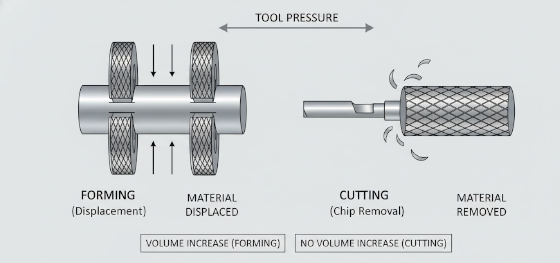
Der erste technische Scheideweg in CNC-Rändelung entscheidet, wie das Muster entstehen wird. Formrändelung ist die gebräuchlichste industrielle Methode. Sie verwendet schwere Rollen mit dem gewünschten Muster, das darauf eingraviert ist. Wenn diese Rollen in das rotierende Werkstück gedrückt werden, verdrängen sie physisch das Metall. Das Material wird aus den Tälern "herausgedrückt" und "häuft sich auf", um die Spitzen zu bilden. Dies ist ein Kaltumformprozess, der keine Späne erzeugt. Der Vorteil der Formrändelung ist Geschwindigkeit und strukturelle Festigkeit; da die Kornstruktur des Metalls komprimiert statt durchtrennt wird, wird der gerändelte Bereich kaltverfestigt und extrem langlebig. Allerdings kann der massive radiale Druck dünnwandige Teile oder Wellen mit kleinem Durchmesser ablenken, was zu einem Verlust der Konzentrizität führen kann.
Cut Knurling is the high-precision alternative. Instead of pushing the metal, the tool uses sharp cutting edges to carve the pattern into the surface, producing actual chips. At Jucheng Precision, we recommend cut knurling for delicate components or materials that are too hard for pressure forming. Because the radial forces are significantly lower, we can maintain tighter tolerances on the underlying shaft diameter. Cut knurling also produces much sharper, cleaner peaks, which is essential for medical instruments where the grip must be reliable even when covered in fluids. By understanding the physics of displacement versus shearing, JUCHENG selects the method that protects your part's geometry while delivering the exact tactile response your application demands.
Muster-Vielfalt: Rauten-, Längs- und Diagonal-Logik
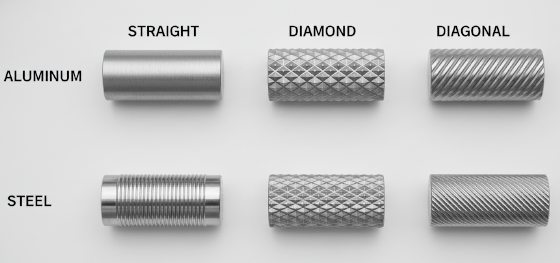
The visual and functional soul of CNC-Rändelung is the pattern. The choice of geometry is driven by the direction of the expected force. Diamond Knurling is the gold standard for multi-directional grip. It creates a field of microscopic four-sided pyramids that bite into the skin, providing maximum friction for both rotational and axial loads. It is the default choice for tool handles and heavy-duty knobs. Straight Knurling, consisting of parallel longitudinal ridges, is used primarily when the grip only needs to resist rotational slipping, or when the part must be pressed into a plastic housing where the ridges act as "splines" to prevent the part from turning.
At Jucheng Precision, we also offer Diagonal Knurling and custom "Spiral" textures for decorative or specialized indexing applications. We help our clients select the "Pitch" of the knurl—the distance between the peaks. A fine pitch (0.5mm) provides a sophisticated, jewelry-like feel suitable for consumer electronics, while a coarse pitch (1.5mm) offers a rugged, industrial grip for gloved hands. By controlling the depth and angle of the pattern, we ensure the ergonomics of your part are perfectly tuned. A knurl that is too sharp can be painful; a knurl that is too shallow is useless. We find the "Goldilocks" zone through careful tool selection and feed-rate optimization, ensuring your product communicates quality through touch.
Materialverhalten: Umgang mit Härte und Duktilität
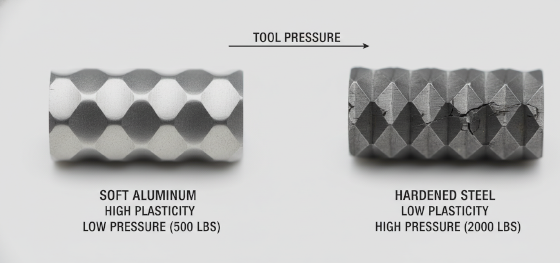
Material science is the invisible governor of CNC-Rändelung success. Soft metals like Aluminum 6061 and Brass are ideal for form knurling; they flow easily into the tool's pattern, resulting in full, well-defined peaks. However, their softness means they are susceptible to "over-rolling," where the tool creates a second, overlapping pattern if the timing isn't perfect. JUCHENG technicians utilize high-speed spindle synchronization to ensure the tool enters the material at the exact same orientation on every pass, eliminating the "double-tracking" that ruins aesthetic parts.
Harder alloys like Stainless Steel 316 or 4140 Chromoly present a different challenge. These materials resist displacement. If we use a standard forming tool, the pressure required can be so high that it damages the machine's spindle or causes the part to bend. For these materials, Jucheng Precision often shifts to cut knurling or utilizes specialized cobalt-infused rollers that can handle the extreme abrasion. We also adjust our CNC-Bearbeitungsprozesses to include flood cooling. Because knurling involves intense friction, the material can expand thermally, which leads to an inconsistent pattern depth as the part warms up. By keeping the workpiece at a stabilized temperature, we ensure that a three-meter-long knurled shaft is identical from end to end. We don't just "press" a pattern; we manage the material's internal resistance to deliver perfection.
Dimensionale Souveränität: Berechnung des Durchmesserwachstums
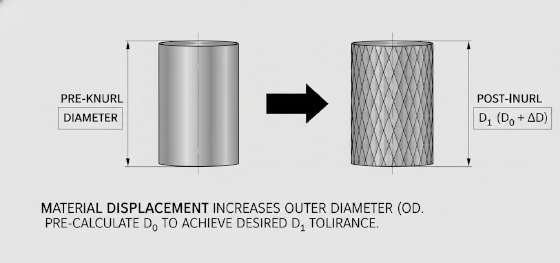
The most common engineering oversight in CNC-Rändelung is the failure to account for "Diameter Growth." In a form knurling operation, the material is not removed; it is redistributed. When the tool creates a valley, that metal has to go somewhere—it moves outward to form the peak. This means the final outside diameter (OD) of a knurled part will always be larger than the starting blank. If you need a knurled handle to fit inside a 20mm bore, you cannot start with a 20mm bar. The knurling will grow the part to 20.5mm or more, making it impossible to assemble.
Jucheng Precision solves this through "Pre-Knurl Math." Our engineers calculate the exact volumetric displacement based on the pitch and the depth of the pattern. We then machine the raw stock to a specific "pre-rolled diameter." This ensures that after the knurling tool has completed its pass, the peaks of the pattern reach the exact functional diameter required by your blueprints. We maintain Nylon-Bearbeitungstoleranzen and metal tolerances with the same rigor, using digital micrometers to measure across the peaks of the knurl. This level of dimensional sovereignty is vital for components that feature both a knurled grip and a precision bearing seat on the same shaft. We ensure the growth is controlled, repeatable, and functionally perfect for your final assembly.
JUCHENG-Ästhetikstandard: Null-Fehler-Texturen
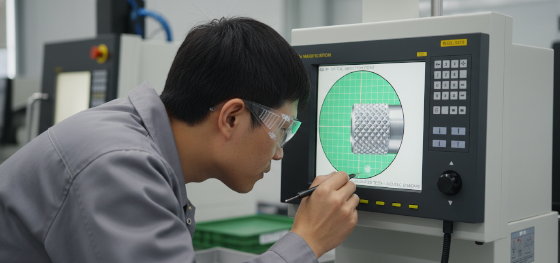
The final hallmark of a professional knurling service is the pursuit of visual perfection. A knurl is often the most visible part of an assembly; it is the first thing a user sees and feels. At Jucheng Precision, we treat CNC-Rändelung as a high-visibility cosmetic feature. We monitor tool wear with microscopic precision. A worn knurling wheel will produce "flaked" or "shaved" tooth peaks, which feel sharp and unpleasant. We replace our tooling at the first sign of degradation to ensure every part in a production run is identical.
Our quality control team utilizes optical comparators and 50x magnification scopes to verify the "Crest Symmetry" of the patterns. We look for uniform height and clean intersections where the diagonal lines meet. This attention to detail is essential for the medical device industry, where a knurled handle must not only provide grip but also be easy to sanitize—meaning no jagged metal "crumbs" can be left behind. Whether you are building a prototype for a luxury audio knob or a high-volume order of industrial fasteners, Jucheng Precision has the technical rigor and the specialized equipment to deliver. We don't just add grip; we add value through manufacturing excellence. Contact our team today for a technical DFM review and see how our knurling protocols can elevate the tactile experience of your next project.

