


Finanzmanager und Einkaufsleiter betrachten die Werkstatt oft durch das kalte Prisma einer Excel-Tabelle. In ihrer Welt ist die Wahl zwischen einer CNC-Maschine vs. 3D-Drucker keine technologische Debatte – es ist eine Debatte über das Endergebnis. Die meisten Ingenieure beginnen den Fertigungszyklus mit einer gefährlichen Annahme: dass 3D-Druck die universelle Lösung für kostengünstige Komplexität ist. Während dies für einen einzelnen handgehaltenen Prototypen zutrifft, kann dieselbe Logik ein Projekt in den Ruin treiben, sobald es auf fünfzig Einheiten skaliert wird. Die Realität der 3D-Druck vs. CNC-Kosten ist eine volatile Landschaft, in der der Gewinner nicht durch die Form des Teils, sondern durch die Menge auf dem Auftrag und das Volumen des verbrauchten Materials bestimmt wird.

Bei Jucheng Precision arbeiten wir als Dual-Technologie-Zentrum. Wir haben keine Voreingenommenheit gegenüber einem Verfahren, da wir das gesamte Spektrum an Hochgeschwindigkeits-5-Achsen-Fräsmaschinen und industriellen additiven Systemen besitzen. Dies versetzt uns in die einzigartige Position, als unvoreingenommener Finanzprüfer für Ihre Konstruktionen zu fungieren. Wir verstehen, dass "billig" ein relativer Begriff ist, der sich mit dem Ticken der Produktionsuhr verschiebt. Wenn Sie sich für additive Fertigung bei einer Großserie entscheiden, zahlen Sie eine "lineare Steuer" auf jedes Teil. Wenn Sie sich für subtraktive Fertigung bei einem Einzelstück entscheiden, ertrinken Sie in "Rüstschulden". Dieser Leitfaden ist ein 1.300 Wörter umfassendes wirtschaftliches Manifest, das Ihnen helfen soll, den Break-Even-Punkt zwischen Laser und Spindel zu navigieren und sicherzustellen, dass Ihr Projekt sowohl profitabel als auch präzise bleibt.
Effizienz in der modernen Produktion liegt in der Vermeidung unnötiger Maschinenzeit. Sie bezahlen nicht nur für Metall oder Kunststoff; Sie mieten die Kapazität einer millionenschweren Anlage. Ob Sie einen kundenspezifischen Luftfahrtsensor oder eine Serie von Industriegehäusen bauen, die Logik der Stückkostenkurve ist Ihr primärer Fertigungsregler. Lassen Sie uns die physikalischen und finanziellen Gesetze der Menge aufschlüsseln und sehen, wie technische Weitsicht die Integrität Ihres Budgets in die physische Realität verankern kann.
Wirtschaftlicher Break-Even: Analyse des Mengenschnittpunkts
Kostentreiber bei additiver Fertigung: Die Z-Höhen- und Volumensteuer
Kostentreiber bei subtraktiver Fertigung: Werkzeuge, Rüstzeiten und Abfall
Versteckte Zeitsteuern: Manuelle Arbeit vs. Spindeleffizienz
JUCHENGs Empfehlung: Datengetriebene Auswahlstrategie
Wirtschaftlicher Break-Even: Analyse des Mengenschnittpunkts
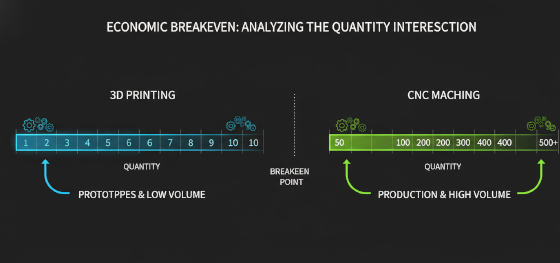
Die aussagekräftigste Grafik in der Werkstatt ist die Kurve "Stückkosten vs. Menge". In jeder 3D-Druck vs. CNC-Kosten analysis, these two technologies start at opposite ends of the chart. 3D printing begins with a remarkably low entry price. For a single complex part, the cost is essentially the price of the material plus a few hours of machine time. There are no fixtures to build and no complex CAM programs to write. This makes the "First Part Cost" of additive manufacturing nearly unbeatable. For prototypes numbering between 1 and 10, the 3D printer is the undisputed champion of the budget.
CNC machining, conversely, starts with a massive "Setup Debt." Before the spindle ever touches metal, a programmer must spend hours defining tool paths, a technician must build custom fixtures, and a set of specialized cutters must be loaded. This "Non-Recurring Engineering" (NRE) fee can be several hundred dollars for a single part. However, once that setup is complete, the per-part price drops precipitously. The machine can produce the 100th part for a fraction of the cost of the first. At JUCHENG, we generally find the breakeven point occurs between 30 and 50 units. If your order is below this threshold, the printer usually wins. If you are ordering 100 units or more, the efficiency of the CNC spindle amortizes the setup costs so effectively that the total invoice will be significantly lower than an additive run. We provide our clients with these comparative curves during the DFM phase, ensuring you don't choose a technology that feels cheap today but becomes a burden tomorrow.
Kostentreiber bei additiver Fertigung: Die Z-Höhen- und Volumensteuer
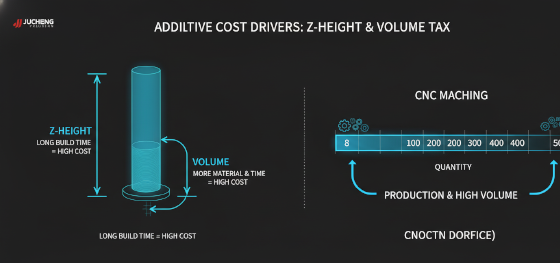
To understand why additive manufacturing is a "linear" cost model, you must look at how it consumes time and material. In 3D printing, volume is the enemy of the budget. Unlike CNC, where a large block of aluminum is relatively inexpensive, 3D printing powders and resins are priced by the gram and are significantly more costly than raw billet. If your design is bulky and solid, you are paying a "Volume Tax" for every cubic centimeter of material used. This is why hollowing out parts is such a critical cost-saving strategy in additive manufacturing.
The second major driver is the "Z-Height Tax." In technologies like SLA or FDM, the time it takes to print is largely determined by how tall the part is. Every additional layer requires a movement of the build plate and a fresh recoating cycle. A part that is tall and thin will take much longer to print than the same part laid flat, even if the material volume is identical. At JUCHENG, we optimize our 3D builds for "Packing Density." In technologies like MJF (Multi Jet Fusion), we can stack hundreds of parts into a single three-dimensional build volume. If we can fit more parts into one "bake," the cost-per-part drops. However, if your geometry is large and occupies most of the build chamber alone, the price remains stubbornly high because you are effectively renting the entire machine for a single part. This volume-and-height-based pricing means that as your part gets larger and more solid, the 3D-Druck vs. CNC-Kosten gap narrows quickly in favor of the mill.
Subtractive Cost Drivers: Tooling, Setups, and Block Size

Subtractive manufacturing operates under a completely different set of economic stressors. The primary driver in CNC is "Spindle Time"—the number of minutes the tool is actually in contact with the material. This makes complexity the enemy of the CNC budget. A part with hundreds of intricate pockets and deep internal radii requires multiple tool changes and slower feed rates, driving the price up. In the 3D-Druck vs. CNC-Kosten battle, complexity is "free" for the printer but "premium" for the mill.
Another critical factor is the "Buy-to-Fly" ratio—the amount of raw material you have to purchase compared to the final part volume. For a complex CNC part, you might start with a 10kg block of aluminum only to mill away 9kg of it into waste chips. You are paying for that 9kg of "lost" material. Furthermore, the number of setups dictates the labor cost. If a part requires five different orientations in a vice, it requires five different fixtures and five different touch-off cycles. Jucheng Precision mitigates this through our 5-axis infrastructure, which allows us to finish five sides of a part in one setup, drastically reducing the labor-load. By understanding that CNC cost is driven by machine-hours and material waste, we can help you simplify your designs to exploit the speed of the spindle, turning a complex "expensive" part into a streamlined "production" part that wins the cost race at scale.
Versteckte Zeitsteuern: Manuelle Arbeit vs. Spindeleffizienz
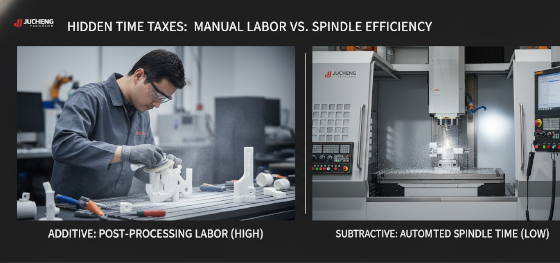
When comparing 3D-Druck vs. CNC-Kosten, many designers forget to account for the "Tail End" of the process. A 3D printer doesn't produce a finished part; it produces a "Near-Net-Shape" preform. Every 3D printed part—especially those in resin or metal—requires significant post-processing. Support structures must be manually clipped off, surfaces must be sanded to remove layer lines, and parts often need thermal curing or bead blasting to achieve an acceptable finish. This is highly variable, skilled manual labor. It doesn't scale well. If you have 500 parts, you need a small army of technicians to sand them all.
CNC machining is the opposite. The "Manual Labor" is front-loaded. It takes time to program and set up the machine, but once the green button is pushed, the process is automated. The part comes off the machine with a finished surface, tapped threads, and verified dimensions. In a production run, the "Human-Hour per Part" for CNC is nearly zero. At JUCHENG, we analyze these hidden taxes for our clients. We often find that for parts requiring a high-quality surface finish, the cost of manual post-processing for a 3D print actually makes the CNC option cheaper, even at lower quantities. We look past the "machine time" to the total "labor cycle," ensuring your material choice reflects the true cost of human intervention in the manufacturing loop.
JUCHENGs Empfehlung: Datengetriebene Auswahlstrategie
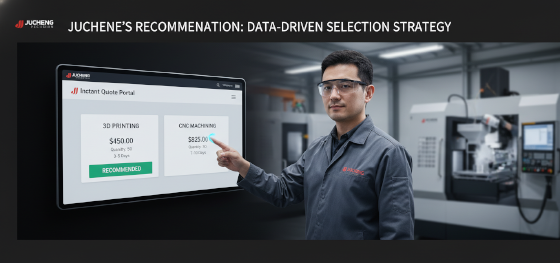
So, which technology wins the budget battle? Jucheng Precision remains neutral because we are experts in both. Our recommendation is always driven by the specific physics and the intended volume of your project. We don't just quote parts; we quote strategies.
| Project Variable | 3D Printing Advantage | CNC Machining Advantage |
|---|---|---|
| Quantity 1-10 | High (No Setup Fee) | Low (High Setup Cost) |
| Quantity 100+ | Low (Linear Material Cost) | High (Scale Efficiency) |
| Komplexität | Extreme Freedom (Internal Voids) | Limited (Line-of-Sight) |
| Oberflächenbeschaffenheit | Requires Manual Labor | Finished Off-Machine |
Choose 3D Printing if: You are in the early R&D phase, need a complex geometry that is impossible to mill (like internal cooling channels), or require a functional prototype within 48 hours for a critical board meeting. It is the king of agility.
Choose CNC Machining if: You have finalized your design, need a batch of 50 or more, or require production-grade material properties and absolute surface perfection. It is the king of scalability and structural certainty.
At Jucheng Precision, our instant quoting system often provides side-by-side pricing for both CNC-Maschine vs. 3D-Drucker options. This allows you to make an informed, data-driven decision based on the actual manufacturing capacity of our floor. We bridge the gap between a digital mock-up and a profitable product line. Whether you are building the next generation of medical diagnostics or a high-performance EV chassis, our technical rigor ensures your designs are realized with the best possible ROI. Contact our engineering team today for a comprehensive DFM review and let us help you choose the manufacturing path that clarifies and secures your project budget.

