


The perfect mechanical fit is an audible success—a satisfying "click" or a friction-held slide that communicates quality to the end-user. In the complex landscape of 3D-Druck-Toleranzen, achieving this tactile perfection is one of the most significant engineering hurdles. Most designers rely on theoretical CAD values, assuming a 10.00mm pin will automatically hold inside a 10.00mm hole. However, the physical reality of light-curing and thermal fusion introduces a chaotic variable of surface texture and dimensional drift. Mastering 3d printing tolerance for tight fit is not about achieving an impossible zero-deviation; it is about engineering the interference between two surfaces so they work with, rather than against, each other.
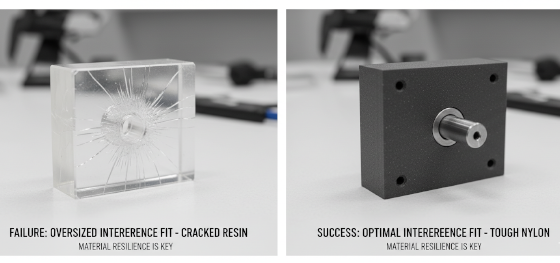
JUCHENG operates a unified technical hub where we treat assembly fits as functional mission-parameters. We understand that for a robotics joint or a high-pressure seal, "loose" is a failure and "too tight" is a crack. By integrating high-resolution SLA and MJF technologies with our 5-axis CNC finishing, we provide a validated roadmap for interference fits. We recognize that every material—from ductile Nylon 12 to brittle high-temp resins—has a different "elastic memory" that dictates how it responds to the pressure of assembly. This guide moves beyond the standard charts to explore the mechanics of the 0.05mm delta, the strategic use of crush ribs, and why JUCHENG’s iterative "Tolerance Kits" are the only way to lock in functional certainty before you commit to a full production run.
Profitability in assembly is won by those who can eliminate the post-build rework cycle. You aren't just buying a component; you are buying a verified mechanical relationship. Whether you are building a custom prosthetic interface or a ruggedized industrial sensor, the logic of the fit is your primary manufacturing governor. Let us break down the physical laws of tight-tolerance design and see how technical foresight can lock the integrity of your next assembly into physical reality.
Mechanics of Interference: Managing the 0.05mm Delta
Technological Stability: Why SLA and MJF Dominate Precise Assemblies
Geometric Guardrails: Designing Lead-In Chamfers and Crush Ribs
Material Resilience: Balancing Elasticity and Brittle Failure
Iterative Certainty: JUCHENG's High-Fidelity Tolerance Kits
Mechanics of Interference: Managing the 0.05mm Delta
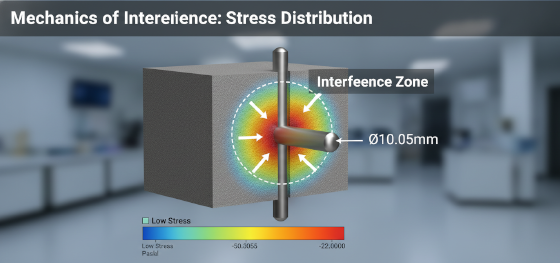
A "Tight Fit" in engineering is defined as an interference fit, where the internal member is slightly larger than the hole it inhabits. In 3d printing tolerance for tight fit, the success of this fit is governed by a delta as small as 0.05mm. If you design for a 0.02mm overlap, the natural surface roughness of the 3D print (the layer lines) will act as microscopic teeth that interlock, creating a "Friction Wall" that prevents assembly. Conversely, if you exceed 0.1mm of interference in a rigid plastic, the hoop stress on the hole will exceed the material's yield strength, leading to a visible crack that propagates from the point of entry.
Bei Jucheng Precision erklären wir unseren Kunden dies als den "0,05-mm-Sweet-Spot". Dieser Wert bietet genügend Reibung, um das Teil bei Vibrationen an Ort und Stelle zu halten, ohne die Grenze des "Sprödbruchs" des Harzes auszulösen. Wir berücksichtigen auch die "Anfangsscherung". Wenn Sie zwei 3D-gedruckte Oberflächen zusammendrücken, werden die mikroskopischen Spitzen der Schichtlinien tatsächlich abgeschert oder abgeflacht. Dies schafft eine "Einlaufzeit" für die Passung. Wir nutzen unsere hochauflösenden KMG-Taster, um diese Innendurchmesser zu überprüfen und sicherzustellen, dass die Ausgangsabmessung diese mechanische Glättung berücksichtigt. Durch die Steuerung der Mikromechanik der Interferenzzone verwandeln wir eine riskante "Schätzung" in eine vorhersagbare technische Spezifikation und bieten die dokumentierte Zuverlässigkeit, die Ihre Hochleistungshardware benötigt.
Technological Stability: Why SLA and MJF Dominate Precise Assemblies
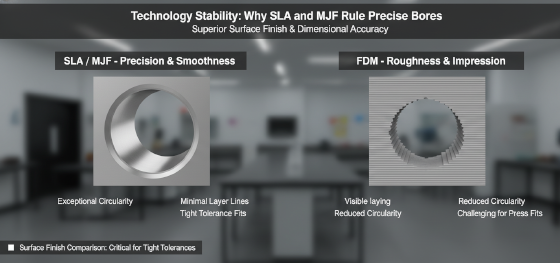
Nicht alle 3D-Technologien sind physikalisch in der Lage, eine enge Passung zu gewährleisten. FDM (Filament) ist notorisch schwierig für 3d printing tolerance for tight fit da die "Unrundheit" der Löcher aufgrund der X-Y-Portalbewegung hoch ist. Ein leicht elliptisches Loch greift einen Stift nur an zwei Punkten, was zu einer losen Passung führt, selbst wenn der durchschnittliche Durchmesser korrekt ist. Für Baugruppen, die absolute Rundheit und gleichbleibende Reibung erfordern, lenkt JUCHENG unsere Kunden zu SLA (Harz) oder MJF (Multi Jet Fusion).
SLA bietet die höchste Auflösung und erzeugt Bohrungen mit nazu spiegelglatten Wänden, die sich ähnlich wie bearbeitete Teile verhalten. Dies ermöglicht die engsten möglichen Interferenzen (bis zu 0,03 mm), da nur minimale "Oberflächenrauheit" die Passung beeinträchtigt. MJF, obwohl etwas körniger, bietet eine überlegene "Chargenstabilität". Da die Teile in einem selbsttragenden Pulverbett entstehen, bleibt die Rundheit der Löcher über eine Charge von 500 Einheiten hinweg konstant. Wir nutzen diese technologischen Stärken, um sie an die Aufgabe Ihrer Baugruppe anzupassen. Wenn Ihr Teil ein hochdetailliertes chirurgisches Instrument ist, ist SLA der Gewinner. Wenn es sich um einen robusten Automobilstecker handelt, bietet die strukturelle isotrope Festigkeit von MJF die "Zähigkeit", die für eine kraftvolle Presspassung erforderlich ist. Wir "drucken nicht nur Ihr Teil"; wir wählen das Photon oder die Wärmequelle, die sicherstellt, dass Ihre Toleranzen nach dem Bau nicht abweichen.
Geometric Guardrails: Designing Lead-In Chamfers and Crush Ribs
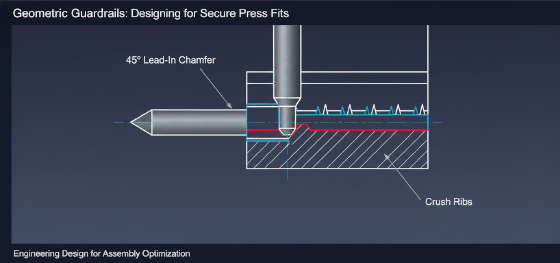
Bei einer engen Passung ist der erste Millimeter der gefährlichste. Wenn ein Stift in einem leichten Winkel in ein Loch eindringt, wirkt er wie ein Hebel, der das Teil sofort spalten kann. Deshalb sind "Geometrische Leitplanken" in 3d printing tolerance for tight fit Design obligatorisch. Die DFM-Ingenieure von JUCHENG befürworten die "Einführfase" – einen 45-Grad-Winkel an der Spitze des Stifts und am Eingang des Lochs. Dies dient als selbstzentrierende Führung und stellt sicher, dass die Teile perfekt ausgerichtet sind, bevor der Interferenzdruck beginnt.
Für Teile, die extreme Sicherheit erfordern, aber eine geringere Duktilität aufweisen, empfehlen wir die Verwendung von "Quetschrippen". Anstatt das gesamte Loch eng zu gestalten, entwerfen wir eine Reihe von drei oder vier kleinen dreieckigen Rippen im Inneren der Bohrung. Wenn der Stift eingeführt wird, muss er nur diese winzigen Rippen "quetschen", anstatt die gesamte Wand des Teils. Dies bietet eine sichere Reibpassung, reduziert die für die Montage erforderliche Gesamtkraft und eliminiert das Risiko eines katastrophalen Teilversagens. Dies ist ein "chirurgischer Schlag" im DFM – die lokale Verformung wird konstruiert, um die globale Integrität zu bewahren. Durch die Integration dieser Merkmale in Ihre CAD-Dateien ermöglichen Sie JUCHENG, Teile zu liefern, die sich mit industriellem Leichtigkeit montieren lassen, Ihre Arbeitskosten senken und Ihre Marke vor der Peinlichkeit eines "beim ersten Berühren zerbrochenen" Prototyps schützen.
Material Resilience: Balancing Elasticity and Brittle Failure
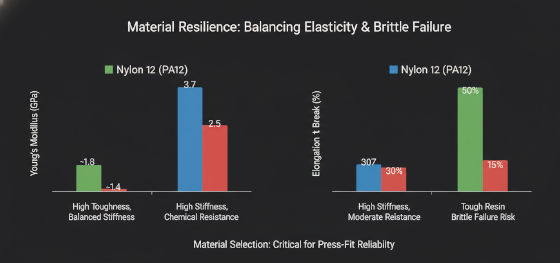
Daten sind das einzige Heilmittel gegen Montagezweifel. Um Ihnen bei der Auswahl des richtigen Materials für Ihre 3d printing tolerance for tight fit, zu helfen, stellt Jucheng Precision die folgenden mechanischen Grundlagen bereit. Die "elastische Rückstellung" eines Materials bestimmt, wie viel Interferenz es verarbeiten kann. Ein Material wie Nylon 12 hat eine hohe Bruchdehnung, was bedeutet, dass es sich dehnen und seine Form wiederherstellen kann, was es "nachsichtig" gegenüber engen Passungen macht. Ein Standard-SLA-Harz ist spröde; es hat eine niedrige Bruchdehnung und zerspringt wie Glas, wenn es zu stark belastet wird.
| Materialkategorie | Dehnung % (Elastizität) | Empfohlene Interferenz | Versagensmodus |
|---|---|---|---|
| MJF Nylon 12 | 15-20% (Hoch) | 0,05 mm - 0,10 mm | Deformation (Ductile) |
| Standard SLA Resin | 3-6% (Low) | 0.02mm - 0.05mm | Cracking (Brittle) |
| Tough/Flexible Resin | 30-50% (Extreme) | 0.10mm - 0.20mm | Oozing (Soft) |
| DMLS Titanium | 10-15% (Metal) | 0.01mm - 0.03mm | Seizing (Gall) |
We help our clients perform a "Mechanical Audit" of their designs. If we see a high-interference fit specified in a brittle material, we don't just print it; we suggest an upgrade to a "Tough" resin or a switch to our CNC Machining Services to ensure the material can handle the stress. By matching the molecular soul of the polymer to the mechanical mission of the fit, JUCHENG ensures your designs survive the transition from a digital rendering to a physical product. We bridge the gap between "concept" and "compliance," providing the technical clarity needed for successful functional testing.
Iterative Certainty: JUCHENG's High-Fidelity Tolerance Kits
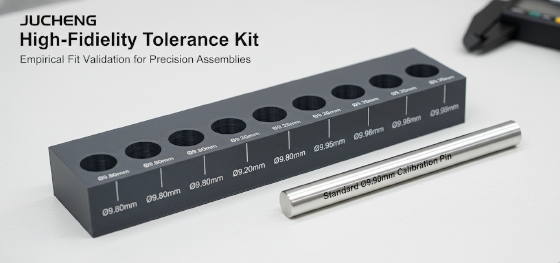
The final hallmark of a professional manufacturing partner is the move away from "transactional" printing toward iterative validation. At Jucheng Precision, we recognize that the "Perfect Fit" is often a matter of perception—what feels "tight" to one engineer might feel "loose" to another. To solve this, we offer our clients a "High-Fidelity Tolerance Kit" before starting a full-scale production run. We print a small test coupon—a "Comb" or "Matrix"—that features a series of pins and holes with incremental clearances ranging from 0.00mm to 0.50mm in 0.02mm steps.
This empirical approach removes the uncertainty of the 3D-Druck-Toleranzen cycle. You can physically test the fitment with your real hands, choosing the exact "click" or "friction" your assembly requires. Once you identify the winner (e.g., Hole #4), we apply that specific offset to your entire part order. This ensures that when you receive a crate of 500 components from JUCHENG, they assemble flawlessly without a single minute wasted on hand-sanding or rework. We don't just ship parts; we ship the verified engineered certainty that your product is ready for work. Whether you are building an innovative heart pump or a high-performance EV battery housing, our integrated tolerance kits clarify and elevate your vision. Contact our engineering team today for a technical DFM review and see how our iterative protocols can armor your next manufacturing breakthrough.

