


Die Helixgeometrie ist der ultimative Test für ein additives Verfahren. Im digitalen Vakuum einer CAD-Umgebung ist ein Gewinde eine mathematisch perfekte Spirale, aber in der physischen Landschaft der 3D-Druck-Toleranzen, wird diese Spirale aus Tausenden von diskreten, flachen Schichten aufgebaut. Dieser Übergang von einer glatten, kontinuierlichen Kurve zu einer gestuften Annäherung schafft ein funktionales Minenfeld. Die meisten Ingenieure erleben die Frustration einer gedruckten Schraube, die sofort klemmt, oder eines geschnittenen Gewindes, das schon bei geringstem Drehmoment ausreißt. Die Beherrschung der Toleranzen von 3D-Druck-Gewinden bedeutet nicht, einem Standard-Handbuch für Maschinenbauer zu folgen; es geht darum, den "Treppenstufen-Effekt" und die volumetrische Expansion von Harzen und Pulvern zu berücksichtigen. Der Erfolg hier entscheidet darüber, ob Ihre Baugruppe eine robuste mechanische Einheit oder eine Sammlung loser Teile ist, die nur durch Glück zusammenhält.
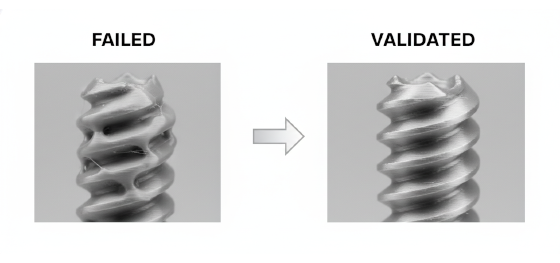
JUCHENG operates as a high-fidelity hub for complex medical and aerospace assemblies where fastening integrity is a safety-critical specification. We understand that for a high-pressure manifold or a satellite chassis, a failed thread is a failed mission. We have moved beyond the "print-and-pray" mindset to provide our clients with a "Fastening Strategy." By integrating high-resolution SLA and MJF, the joint may use printed threads, a secondary operation or metal hardware. Choose the route for the finished thread size, required assembly torque, axial load and number of assembly cycles.
Die Rentabilität in der 3D-Produktion wird durch die Auslegung auf die Scherfestigkeit des Materials erreicht. Sie bauen nicht nur ein Merkmal; Sie schaffen einen reibungsbasierten Lastpfad. Ob Sie nun eine Automobilsensorhalterung oder einen Mikrofluidik-Verteiler bauen, die Logik der Helix ist Ihr primärer Fertigungsregler. Lassen Sie uns die physikalischen Gesetze der Gewindekonstruktion aufschlüsseln und sehen, wie technische Weitsicht die Integrität Ihrer nächsten Baugruppe in die physische Realität umsetzen kann.
Mindestgrenzen: Warum M4 die untere Grenze definiert
Z-Achsen-Souveränität: Ausrichtung für helikale Genauigkeit
Spielanpassungen: Konstruktion des 0,1-mm-Ausgleichs
Wärmeeinbett-Einsätze: Die strategische Wahl für hohe Lasten
JUCHENGs Zuverlässigkeitsstandard: Validierung jeder Helix
Mindestgrenzen: Warum M4 die untere Grenze definiert

A minimum feature guideline is a starting point, not a universal thread limit. For the selected 3D-Druckverfahren, check diameter, pitch, material, orientation and access for cleaning. M4 is not a cutoff for every process; inspect and try representative parts with the specified mating hardware.
If a small or tightly controlled thread is not repeatable as printed, consider an accessible pilot hole followed by tapping or use an appropriate insert. For threads you drucken print, verify their profile and function after cleaning and finishing. Confirm the drawing and acceptance criteria for Toleranzen von 3D-Druck-Gewinden before placing the order.
Z-Achsen-Souveränität: Ausrichtung für helikale Genauigkeit
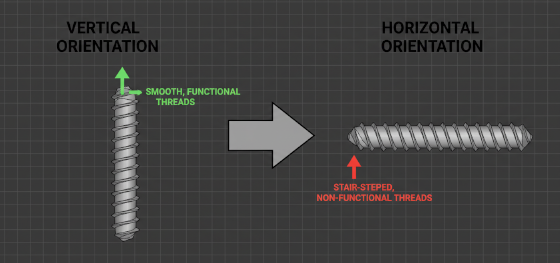
Build orientation can change the thread profile, support marks, form and cleanability. A vertical axis may help for some geometries and processes, but it does not guarantee a round or accurate thread. Compare candidate orientations on representative parts when the joint matters.
Balance thread quality with the rest of the geometry, cleanup and build height. Those choices can also change 3D-Druckkosten. Verify the finished thread rather than assuming that one orientation will always work.
Spielanpassungen: Konstruktion des 0,1-mm-Ausgleichs

Specify the finished thread size and fit on the drawing. If a class such as 6H is required, preserve it as the acceptance requirement. For Toleranzen von 3D-Druck-Gewinden, use trial data to decide if printing alone can meet that requirement.
There is no universal 0.10 to 0.15 mm allowance. If compensation is needed, validate it for the selected material, orientation, cleanup and finishing. An offset in the print model is not a change to the finished drawing requirement. Use the intended mating hardware or the applicable gauge to verify the result of the 3D-Druckverfahren.
Wärmeeinbett-Einsätze: Die strategische Wahl für hohe Lasten
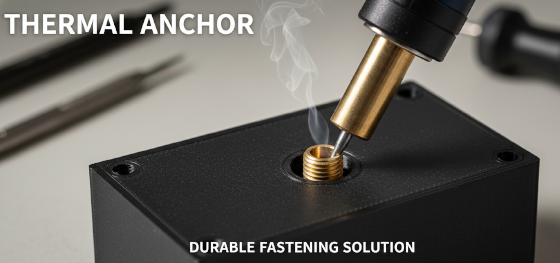
An insert can help when repeated assembly or axial load demands more than a directly printed thread. Choose it for the host material and access. A compatible thermoplastic boss may be designed for a Wärme-Einsatz-Insert.
Heat-set installation softens a compatible thermoplastic around the insert; it is not a remelting method for cured SLA resin. For cured SLA thermosets, evaluate a compatible bonded insert or a captive or through-fastener design. Follow the selected insert supplier’s hole and boss guidance and verify assembly torque and axial pull-out on representative parts. Confirm the selected 3D-Druckmaterialien and hardware together before release.
JUCHENGs Zuverlässigkeitsstandard: Validierung jeder Helix
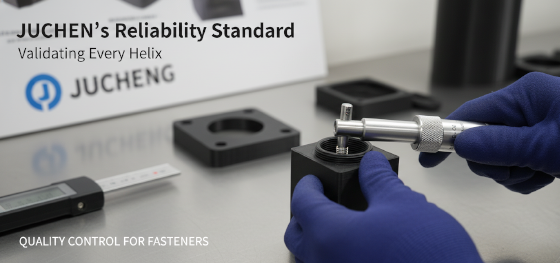
Temperature and humidity can affect fit in polymer parts, including Nylon 12. Agree on the conditioning and inspection method for Toleranzen von 3D-Druck-Gewinden. Where a tolerance class is specified, confirm the applicable go/no-go gauges and sampling plan.
Do not infer measurement accuracy from layer height or from a screw that fits. Agree on inspection method, sampling and reporting for Toleranzen von 3D-Druck-Gewinden; verify torque and pull-out separately when the joint carries load.

