


Schmelzbäder sind die volatilen Geburtsstätten der Präzision. In der intensiven Landschaft von 3D-Druck-Toleranzen, stellt die metallische additive Fertigung den ultimativen Kampf zwischen digitalem Design und lokaler Thermodynamik dar. Wenn ein Faserlaser ein Bett aus Metallstaub bei Temperaturen über 1.600 °C trifft, löst er ein metallurgisches Ereignis aus, das das Bauteil verziehen und in eine chaotische Geometrie ziehen will. Dies ist die kompromisslose Realität der Toleranzen beim 3D-Metalldruck. Es ist ein Prozess, bei dem der Ingenieur jedes Joule Energie berücksichtigen muss, um sicherzustellen, dass das schnelle Abschrecken des Metalls nicht zu einem strukturellen Versagen führt, bevor das Bauteil überhaupt die Bauplatte verlässt. Während der Kunststoffdruck gegen die Schwerkraft kämpft, kämpft der Metalldruck gegen thermische Feindseligkeit.

JUCHENG betreibt eine einheitliche technische Plattform, auf der wir einen Hundert-Mikrometer-Metalldrift mit derselben technischen Ernsthaftigkeit behandeln wie eine medizinische CNC-Bohrung. Wir verstehen, dass für ein Luftfahrt-Impeller oder eine Titan-Knochenplatte "Near-Net-Shape" nur der Anfang ist. Durch die Integration von über 25 hochpräzisen 5-Achs-Zentren mit unserer DMLS-Flotte (Direct Metal Laser Sintering) haben wir eine Fertigungsstätte geschaffen, die das Genauigkeitsparadoxon löst. Dieser Leitfaden geht über den üblichen Verkaufsglanz hinaus und untersucht die Mikrophysik der Schmelzbadstabilität, die strategische Logik von supportbasierten Wärmesenken und warum JUCHENGs hybride Metamorphose der obligatorische letzte Schritt für jedes Metalldesign ist, das absolute geometrische Wahrheit verlangt.
Effizienz in der Metallwelt wird durch die Beherrschung der Abkühlrampe gewonnen. Sie sintern nicht nur Partikel; Sie orchestrieren ein Schnellerstarrungsereignis, das das mechanische Schicksal des Bauteils bestimmt. Ob Sie einen komplexen Fluidverteiler für ein EV-Paket oder eine leichte Satellitenhalterung bauen, die Logik des thermischen Gradienten ist Ihr primärer Fertigungsregler. Lassen Sie uns die physikalischen Säulen der additiven Metallpräzision aufschlüsseln und sehen, wie technische Weitsicht die Integrität Ihres nächsten Luftfahrtdurchbruchs in physische Realität verankern kann.
Thermische Feindseligkeit: Die Ursache für Maßabweichungen
Die 0,1-mm-Realität: Kartierung der Genauigkeitsgrenzen im As-Printed-Zustand
Support-Evolution: Gerüste als thermische Wärmesenken
Oberflächenintegrität: Warum Ra-Werte messbare Grenzen beeinflussen
Hybride Metamorphose: Schließen der Lücke mit 5-Achs-CNC
JUCHENGs Standard: Validierung der Metallseele
Thermische Feindseligkeit: Die Ursache für Maßabweichungen
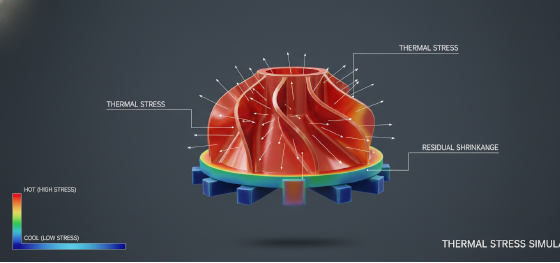
Um den Kampf um zu verstehen Toleranzen beim 3D-Metalldruck, you must visualize the intense thermal war happening on the build plate. DMLS works by localized melting; as the laser moves across the powder, the liquid metal cools from nearly 2000°C to the 80°C chamber temperature in the blink of an eye. This is a violent metallurgical quench. As the metal solidifies, it contracts aggressively. This contraction introduces "Residual Stress"—the hidden force that pulls on your geometry, causing thin walls to bow and flat plates to warp into a bowl shape.
If your design ignores these thermal gradients, the part will literally tear itself off the build plate before the build is 50% complete. JUCHENG’s engineers utilize advanced thermo-mechanical simulation to predict these stress zones. We suggest adding "thermal ribs" or modifying fillets to distribute the stress more evenly. The goal is to reach a state of physical equilibrium where the part remains stable throughout the cycle. We don't just "print" metal; we manage the cooling curve of every cubic millimeter, ensuring that the internal tension doesn't destroy the dimensional integrity of your design. By neutralizing these forces during the build, we deliver a part that is structurally sound and ready for the next level of precision refinement.
Die 0,1-mm-Realität: Kartierung der Genauigkeitsgrenzen im As-Printed-Zustand
Data dictates the budget. When we discuss Toleranzen beim 3D-Metalldruck, honesty is the primary engineering currency. In an "as-printed" state—straight off the DMLS machine—the standard industrial tolerance is typically between ±0.1mm and ±0.2mm. This is influenced by the 70-micron spot size of the fiber laser and the grain size of the metal powder. While this is exceptionally accurate for a technology that grows parts from dust, it is not sufficient for a bearing press-fit or a high-pressure seal face.
Scaling also introduces complexity. As a part gets larger, the cumulative error of thermal shrinkage grows linearly. A 200mm aerospace bracket will naturally have a wider tolerance range than a 20mm dental implant. At Jucheng Precision, we use a tiered approach: we provide ±0.1mm for small, high-detail features and allow for up to ±0.2% on large-format structural components. We help our clients identify the "Critical-to-Quality" (CTQ) dimensions. If a feature only needs to clear another part, the 0.1mm as-printed tolerance is perfectly economical. But if the part must assemble with sub-micron fitment, the as-printed surface is merely a "preform" for the final CNC pass. By mapping these limits early, we prevent the "Tolerance Shock" that happens when designers over-specify their expectations for additive manufacturing.
Support-Evolution: Gerüste als thermische Wärmesenken

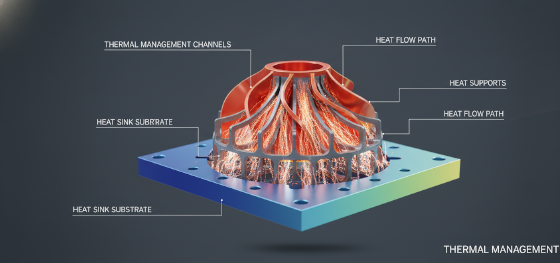
In der 3D-Druckverfahren for metals, supports serve a dual purpose: they are structural anchors and thermal conductors. When you build an overhanging feature, it has no direct path to dissipate the heat of the laser into the build plate. Without a technical bridge, that overhang will overheat, leading to a "burned" surface finish and collapsed tolerances. This is where Toleranzen beim 3D-Metalldruck are won or lost—in the engineering of the scaffolding.
JUCHENG’s DFM team designs "Smart Scaffolds" that act as high-efficiency heat sinks. We optimize the density and connection points of the supports to pull thermal energy away from the part as quickly as possible. This maintains a uniform temperature at the build interface, preventing the "lifting" effect that ruins dimensional accuracy. We also utilize "Perforated Interface" layers that provide a rigid anchor during the build but allow for easier removal during post-processing. By treating the support as an engineered cooling system rather than just a waste product, we preserve the geometric truth of your part, ensuring that even the most complex cantilevers and overhangs remain within spec throughout the grueling 24-hour build cycle.
Oberflächenintegrität: Warum Ra-Werte messbare Grenzen beeinflussen

Surface roughness is the invisible tax on Toleranzen beim 3D-Metalldruck. A DMLS part emerges from the powder bed with a texture similar to a fine-grit sand casting, typically Ra 6.3 to 12.5 µm. This "fuzzy" skin is composed of semi-fused metal particles at the boundary of the laser path. When a quality inspector uses a physical probe or micrometer to measure the part, the tool sits on top of these microscopic peaks. The "recorded" dimension is actually larger than the solid "structural" core of the part.
At Jucheng Precision, we account for this "Surface Bias." We utilize non-contact laser scanning to measure the part’s volume more accurately, or we utilize bead-blasting to homogenize the skin before final inspection. If your design requires a smooth surface for fluid flow or fatigue resistance, we advise on the "Aesthetic Premium"—the cost of polishing or vibratory finishing needed to bring the surface down to Ra 1.6 µm. By understanding how the raw texture of the metal print interferes with the metrology, we deliver parts that are functionally accurate, ensuring that your tolerance readings reflect the part’s true mechanical performance, not just the noise of its surface.
Hybride Metamorphose: Schließen der Lücke mit 5-Achs-CNC

Choosing between 3D printing and CNC machining is an outdated strategy. At Jucheng Precision, we operate a hybrid sanctuary where the two technologies work in a technical symbiosis. We use the 3D printer to grow the "unmachinable" complexity—internal cooling veins and lightweight lattices—and then move the part to our 5-axis CNC floor for the "Surgical Strike." This is the only reliable way to achieve +/- 0.01mm Toleranzen beim 3D-Metalldruck on critical mating surfaces.
We print your metal designs with "Machining Stock"—an extra 1.5mm of material on every bearing seat, thread, and mounting flange. Once the part is vacuum-annealed to release its build stresses, we mill those features to mirror-smooth perfection. This hybrid approach provides you with the lightweight freedom of additive manufacturing and the sub-micron fitment of traditional CNC. It eliminates the liability of the "as-printed" surface for high-stakes aerospace and medical hardware. We don't just ship you a print; we ship you a verified engineered component that fits your assembly perfectly the first time. This integrated flow is what makes JUCHENG a vital partner for innovators who refuse to compromise on quality for the sake of complexity.
JUCHENGs Standard: Validierung der Metallseele

The final hallmark of a professional manufacturing partner is the ability to prove the integrity of the part. In the world of high-integrity metal additive, you cannot manage what you do not verify. Jucheng Precision has built a metrology sanctuary specifically for the 3D-Druckverfahren. We utilize in-house XRF spectrometers to verify that the alloy composition matches your Mill Test Report exactly. We also perform "Thermal Stabilization" cycles in our vacuum furnaces to ensure that the stress-relief cycle hasn't induced new warping.
Our quality control lab is equipped with high-resolution CMMs from Zeiss and Hexagon. We take hundreds of points across your part’s geometry to generate a 3D digital comparison against your master STEP file. We provide our clients with full inspection reports and material traceability logs, providing the "Digital Birth Certificate" required for aerospace and defense compliance. When you partner with JUCHENG, you aren't just getting a 3D printed shape; you are getting a verified engineering solution that has been audited for structural and dimensional survival. Whether you are building an innovative medical device or a high-performance turbine manifold, our metal additive expertise ensures your vision is delivered with absolute precision. Contact Jucheng Precision today for a technical DFM review and see how our metal tolerance protocols can stabilize and elevate your next manufacturing breakthrough.

