
Technische Kunststoffe (PA, PC, POM, PET, PMMA) Materialseite
Technische Kunststoffe sind eine Gruppe robuster thermoplastischer Materialien, die im Vergleich zu Standardkunststoffen wie PE oder PP über überlegene mechanische und thermische Eigenschaften verfügen. Sie sind so konzipiert, dass sie mechanischer Belastung, hohen Temperaturen und chemischer Einwirkung standhalten, was sie zur bevorzugten Wahl für strukturelle Industriekomponenten und Anwendungen zum Metallersatz macht. Bei JUCHENG verfügen wir über umfangreiche Erfahrung im Spritzguss dieser Hochleistungsmaterialien. Unsere Anlage ist mit speziellen Entfeuchtungstrocknern und Öltemperiergeräten ausgestattet, um feuchtigkeitsempfindliche Harze wie Nylon (PA) und PET zu verarbeiten und sicherzustellen, dass jedes Teil strenge Maßtoleranzen und Leistungskriterien erfüllt.
Spritzgussmaterialien für technische Kunststoffe
JUCHENGs Fähigkeiten für technische Kunststoffe
Die Verarbeitung technischer Harze erfordert eine strengere Prozesskontrolle als bei Standardkunststoffen. JUCHENG bietet:
- PräzisionswerkzeugeWir bauen gehärtete Stahlformen, die enge Toleranzen (+/- 0,02 mm) einhalten können, die für technische Baugruppen wie Zahnräder und Steckverbinder erforderlich sind.
- FeuchtigkeitsmanagementMaterialien wie Nylon und PET sind hygroskopisch. Wir verwenden industrielle Trockenmitteltrockner, um sicherzustellen, dass der Feuchtigkeitsgehalt vor dem Spritzguss unter 0,02 % liegt, wodurch Hydrolyse und Oberflächendefekte verhindert werden.
- Hochtemperatur-SpritzgussUnsere Maschinen sind für die höheren Schmelztemperaturen und Werkzeugtemperaturen (bis zu 140 °C) ausgelegt, die für kristalline technische Kunststoffe erforderlich sind.
- FaserverstärkungWir sind auf den Spritzguss glasfaserverstärkter (GF) Varianten von Nylon und PET spezialisiert und optimieren die Angusslagen, um Verzug zu minimieren und die Festigkeit der Faserorientierung zu maximieren.
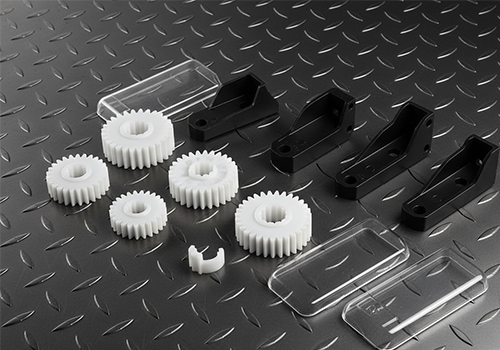
Detaillierte Materialprofile
Wir führen das gesamte Spektrum technischer Thermoplaste auf Lager und verarbeiten es:
1. Polyamid (PA / Nylon)
- BeschreibungEin teilkristalliner Kunststoff, der für seine Zähigkeit und Verschleißfestigkeit bekannt ist. Wir bieten PA6 (gute Oberflächenbeschaffenheit, zäh) und PA66 (höhere Hitzebeständigkeit, steifer) an.
- Wichtige Vorteile: Außergewöhnliche Ermüdungsbeständigkeit, niedriger Reibungskoeffizient, hohe chemische Beständigkeit (Öle/Kraftstoffe). Glasfaserverstärkte Typen bieten metallähnliche Steifigkeit.
- Ideale Anwendungen: Automobilteile im Motorraum, Zahnräder, Lager, Gehäuse für Elektrowerkzeuge, Kabelbinder.
- Beschreibung: Ein amorpher technischer Thermoplast, der sich durch hohe Schlagzähigkeit und optische Transparenz auszeichnet.
- Wichtige Vorteile: Praktisch unzerbrechliche Schlagzähigkeit, hohe Wärmeformbeständigkeit (ca. 135 °C), transparente Optionen verfügbar. Gute Dimensionsstabilität.
- Ideale Anwendungen: Schutzhelme, Autoscheinwerferlinsen, Panzerglas-Laminate, elektronische Anzeigefenster.
- Beschreibung: Ein hochkristallines Polymer, das oft als "Kunststoff mit Metalleigenschaften" bezeichnet wird. Es überbrückt die Lücke zwischen Metall- und Kunststoffeigenschaften.
- Wichtige Vorteile: Hervorragende Gleitfähigkeit (niedrige Reibung), hohe Steifigkeit, geringe Feuchtigkeitsaufnahme und ausgezeichnete Dimensionsstabilität in feuchten Umgebungen.
- Ideale Anwendungen: Präzisionszahnräder, Schnappverbindungen, Gleitlager, Türgriffe, Sanitärkomponenten.
- Beschreibung: Ein transparenter Thermoplast, der als leichte, splitterresistente Alternative zu Glas verwendet wird.
- Wichtige Vorteile: Höchste optische Klarheit (92 % Lichtdurchlässigkeit), ausgezeichnete UV-Beständigkeit (vergilbt nicht), hohe Oberflächenhärte (kratzfest).
- Ideale Anwendungen: Automobilrückleuchten, Lichtleiter, Kosmetikgläser, Anzeigetafeln, Linsen.
- Beschreibung: We refer here to Engineering Grade PET (often glass-filled), not the bottle grade. It is a semi-crystalline polyester.
- Wichtige Vorteile: Extremely high stiffness and strength when reinforced, excellent electrical insulation, low moisture absorption (compared to Nylon), high dimensional stability.
- Ideale Anwendungen: Automotive electrical connectors, coil bobbins, structural housings, wiper arms.
Design Guidelines for Engineering Plastics
- Ribbing: Essential for structural parts (PA, PBT, PET) to prevent warpage, but must be <60% of wall thickness to avoid sink marks.
- Entformungsschrägen:
PC/PMMA: Minimum 1° - 2° (amorphous materials tend to stick).
- Radii: Avoid sharp corners! Engineering plastics (especially PC and POM) are notch-sensitive. Use generous radii to distribute stress.
- Gate Location: Critical for glass-filled materials to hide weld lines and ensure strength in the load-bearing direction.
Umfassende Vergleichstabelle
Physical properties comparison of Engineering Plastics:
| Eigenschaft | Polyamide 66 (PA66) | Polycarbonat (PC) | POM (Acetal) | PMMA (Acryl) | PET (30% GF) | Einheit |
| Struktur | Teilkristallin | Amorph | Teilkristallin | Amorph | Teilkristallin | - |
| Dichte | 1.14 | 1.20 | 1.41 | 1.18 | 1.56 | g/cm³ |
| Schrumpfung | 1.0 - 2.0 | 0.5 - 0.7 | 1.8 - 2.2 | 0.2 - 0.6 | 0.2 - 0.9 | % |
| Zugfestigkeit | 80 | 65 | 70 | 70 | 140 | MPa |
| Biegemodul | 2,900 | 2,300 | 2,600 | 3,000 | 9,000 | MPa |
| Schlagzähigkeit | Hoch | Sehr Hoch | Mittel | Niedrig | Mittel | - |
| Wärmeformbeständigkeit (0,45 MPa) | 200 | 135 | 160 | 95 | 225 | °C |
| Optical Clarity | Undurchsichtig | Transparent | Undurchsichtig | Hervorragend | Undurchsichtig | - |
FAQ: Engineering Plastics
Q: Why does Nylon (PA) need conditioning?
A: Freshly molded nylon is dry and brittle. It absorbs moisture from the air (conditioning) to reach its final equilibrium toughness.
Q: Can PC be used for chemical environments?
A: PC is sensitive to solvents and stress cracking. For chemical resistance, we recommend semi-crystalline materials like POM or PA.
Q: Difference between PMMA and PC?
A: PMMA is clearer and more UV stable but brittle. PC is much stronger (impact resistant) but scratches easier and is less UV stable.
A: Freshly molded nylon is dry and brittle. It absorbs moisture from the air (conditioning) to reach its final equilibrium toughness.
Q: Can PC be used for chemical environments?
A: PC is sensitive to solvents and stress cracking. For chemical resistance, we recommend semi-crystalline materials like POM or PA.
Q: Difference between PMMA and PC?
A: PMMA is clearer and more UV stable but brittle. PC is much stronger (impact resistant) but scratches easier and is less UV stable.

Fordern Sie Ihr DFM & Angebot an – Laden Sie Ihre Zeichnungen hoch
ㆍGeben Sie Ihre Anforderungen ein und laden Sie Ihre 2D- und 3D-Dateien hoch. Wir senden Ihnen innerhalb von 24 Stunden Ihr Projektangebot und DFM zurück.ㆍDateitypen: STEP, STP, IGES, IGS, SLDPRT, 3DM, SAT, X_T, DWG, DXF, STL, PDF, ZIP und mehr. Dateigröße: < 128 MB Teilegröße: < 1500*1500*1500 mm
ㆍDatenschutz: Wir respektieren Ihre Privatsphäre. Hier finden Sie ein Beispiel einer Geheimhaltungsvereinbarung. Mit dem Absenden dieses Formulars stimmen Sie unseren AGB und der Datenschutzerklärung zu.
ㆍDatenschutz: Wir respektieren Ihre Privatsphäre. Hier finden Sie ein Beispiel einer Geheimhaltungsvereinbarung. Mit dem Absenden dieses Formulars stimmen Sie unseren AGB und der Datenschutzerklärung zu.
