


Sie bringen ein neues Produkt auf den Markt. Sie haben ein begrenztes Budget. Sie erhalten Ihr erstes Angebot für Spritzgießen, und Sie sehen zwei Zahlen. Eine sehr große Zahl für das "Werkzeug". Und eine überraschend kleine Zahl für den "Teilepreis"."
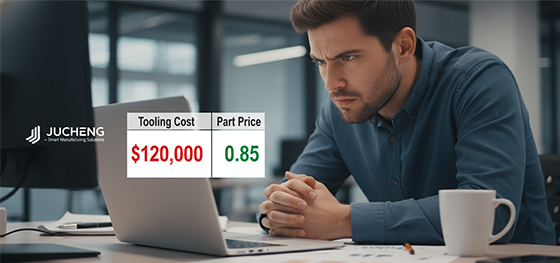
Wie machen Sie das verständlich? Lohnt sich die hohe Vorabinvestition? Wann ist es klüger als 3D-Druck?
Die Kosten des Spritzgusses zu verstehen, ist nicht nur Buchhaltung. Es ist eine strategische Berechnung. Es geht darum, das leistungsstarke wirtschaftliche Modell der Massenproduktion zu verstehen. Dieser Leitfaden wird dieses Modell für Sie aufschlüsseln.
Aufschlüsselung der Werkzeugkosten
Entschlüsselung des Teilepreises
Finden Ihres Break-Even-Punkts
Ein Partner für kluge Investitionen
Aufschlüsselung der Werkzeugkosten
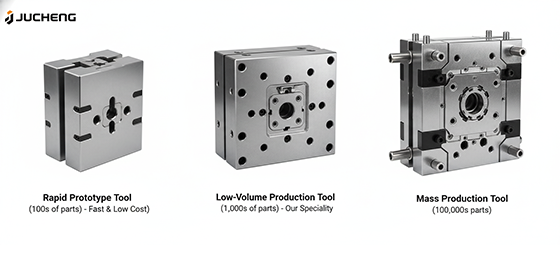
Die größte Zahl in jedem Spritzgussangebot ist das Werkzeug. Dies sind die einmaligen Kosten für die Herstellung der Form. Diese Form ist ein Meisterwerk der Präzisionstechnik, und ihre Kosten werden von mehreren Faktoren bestimmt.
Erstens die Komplexität. Eine Form für ein einfaches, flaches Teil ist relativ günstig. Eine Form für ein komplexes Teil mit vielen Hinterschneidungen (die Seitenbewegungen erfordern) und komplizierten Merkmalen wird viel teurer sein. Mehr Komplexität bedeutet mehr zu schneidenden Stahl und mehr Facharbeit.
Zweitens das Formmaterial. Für sehr hohe Stückzahlen (Millionen von Teilen) muss die Form aus gehärtetem Werkzeugstahl bestehen. Dies ist sehr teuer und langsam zu bearbeiten. Für niedrigere Stückzahlen (Tausende bis Zehntausende) kann eine Form aus weicherem vorvergütetem Stahl oder sogar Aluminium eine viel kostengünstigere Option sein.
Drittens die Anzahl der Kavitäten. Eine Einkavitätenform produziert ein Teil pro Zyklus. Eine Mehrkavitätenform kann 4, 8 oder 16 Teile pro Zyklus produzieren. Eine Mehrkavitätenform ist im Bau viel teurer, senkt aber später den Teilepreis drastisch.
Entschlüsselung des Teilepreises

Sobald die Form bezahlt ist, wird der Preis pro Teil unglaublich niedrig. Dieser Preis wird von zwei einfachen Faktoren bestimmt: Material und Zeit.
The first is the cost of the raw plastic material. The part price includes the weight of the plastic needed to make your part. An expensive engineering plastic will result in a higher part price than a cheap commodity plastic.
The second, and most important, factor is machine time. The part price is directly related to how long it takes to run one cycle. This "cycle time" is a combination of the injection time, cooling time, and ejection time. A part with very thick walls will need a very long cooling time, which increases the cycle time and the cost.
A good manufacturer works to get this cycle time as low as possible through smart mold design and an efficient process. This is how you get a part price of just pennies.
Finden Ihres Break-Even-Punkts

So, when does it make sense to pay the high upfront tooling cost? This is a "breakeven" calculation.
Imagine you need 1,000 units of your part. 3D printing might cost you $30 per part, for a total of $30,000. There is no tooling cost.
For injection molding, the tooling might cost $10,000, and the part price might be $2. The total cost for 1,000 units would be $10,000 + (1,000 x $2) = $12,000. In this case, injection molding is the much cheaper option.
But if you only needed 100 units, 3D printing would cost $3,000. Injection molding would cost $10,000 + (100 x $2) = $10,200. Here, 3D printing is the smarter choice.
Somewhere between 100 and 1,000 units is the "breakeven point" where the total cost lines cross. Finding this point is the key to making a smart manufacturing decision.
Ein Partner für kluge Investitionen

For startups and companies doing low-volume production, that high upfront tooling cost can be a major barrier. This is where choosing the right partner is critical.
A good partner does not just offer one expensive, high-volume tooling option. At JUCHENG, we specialize in low-volume manufacturing solutions.
We can create simpler, lower-cost molds from pre-hardened steel or aluminum. These "bridge" tools are perfect for producing a few thousand parts. They get you to market fast, without the massive investment of a full production tool.
Verständnis des Spritzgusskosten is about understanding your options. We work with you as a partner. We analyze your project volume and your budget. We help you make the smartest investment to get your product off the ground.

