


Ein Loch ist in der Welt der Präzisionsfertigung nie nur ein Loch. Es ist eine funktionale Schnittstelle, die die Seele einer mechanischen Baugruppe definiert. Wenn Sie ein Teil entwerfen, bei dem eine Welle reibungslos gleiten oder ein Lager mit mikrometergenauer Sicherheit pressgepasst werden muss, wird die trügerische Einfachheit einer kreisförmigen Öffnung zu Ihrer größten technischen Herausforderung. Die meisten Konstrukteure beginnen damit, nach einem Loch zu fragen, aber ein erfahrener Zerspaner bei Jucheng Precision beginnt mit der Frage nach der Toleranz. Diese grundlegende Frage führt uns direkt zur technischen Weggabelung von Bohren vs. Ausdrehen vs. Reiben.
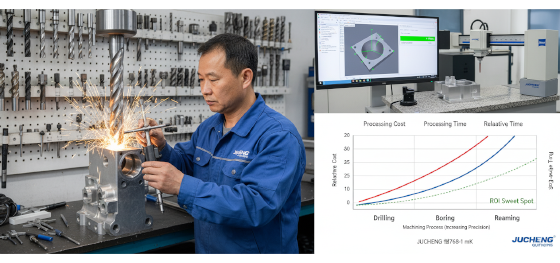
Im weiteren Kontext der CNC-Bearbeitungsprozesses, ist die Erzeugung eines Innendurchmessers eine mehrstufige Entwicklung. Sie können nicht direkt zu einer spiegelglatten H7-Bohrung gelangen, ohne einem disziplinierten Weg der Materialabtragung zu folgen. Jeder Schritt dieser Trilogie – Bohren, Ausdrehen und Reiben – dient einem spezifischen strukturellen Zweck: Der erste schafft Raum, der zweite definiert die Geometrie und der dritte fixiert die Abmessung. Dieser Leitfaden untersucht die mechanischen Nuancen dieser drei Säulen und hilft Ihnen zu verstehen, wann Sie die Wirtschaftlichkeit eines Bohrers akzeptieren und wann Sie die chirurgische Präzision eines Reibers fordern sollten.
Effizienz in der Produktion liegt im Gleichgewicht dieser Operationen. Überdimensionierung eines Lochs führt zu verschwendetem Budget, während Unterdimensionierung zu katastrophalem Montageversagen führt. Lassen Sie uns die technischen Grundlagen der Lochherstellung untersuchen und wie JUCHENG diese Prozesse in perfekte mechanische Passungen umsetzt.
Bohren: Die gewaltsame Geburt einer Öffnung
Ausdrehen: Korrektur des geometrischen Pfads
Reiben: Der chirurgische Feinschliff für enge Passungen
Das Genauigkeitsparadoxon: Balance zwischen Präzision und ROI
JUCHENGs Messtechnik: Verifikation mittels KMG
Bohren: Die gewaltsame Geburt einer Öffnung
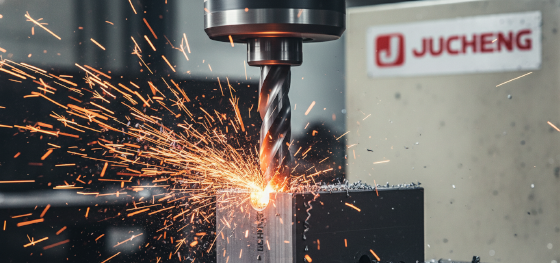
In der Abfolge von Bohren vs. Ausdrehen vs. Reiben, ist Bohren immer der erste Schritt. Es ist eine energieintensive, kraftvolle Operation, die für eines ausgelegt ist: schnellen Materialabtrag. Ein Standard-Spiralbohrer hat zwei Schneiden, die an einem Punkt zusammenlaufen. Während die Spindel dieses Werkzeug in das Metall treibt, erzeugt es ein Loch aus vollem Material. Allerdings ist Bohren von Natur aus ungenau. Da der Bohrer lang und relativ flexibel ist, neigt er zum "Verlaufen" oder Abwandern beim Eintritt in das Material. Das resultierende Loch ist selten perfekt gerade und aufgrund der Vibration der Schneidnuten oft leicht übermaßig.
Darüber hinaus ist die Oberflächengüte eines gebohrten Lochs rau, typischerweise im Bereich von Ra 3,2 bis 6,3 µm. Dies ist für ein Durchgangsloch für eine Schraube akzeptabel, aber eine Katastrophe für einen Lagersitz. Der Austritt eines gebohrten Lochs weist oft einen starken Grat auf, da das Werkzeug durch die letzte Metallschicht "stößt". Bei Jucheng Precision verwenden wir Hochleistungs-Hartmetallbohrer mit Spindelkühlung, um diese Probleme zu minimieren, aber wir verlassen uns nie auf einen Bohrer für eine Präzisionspassung. Wir betrachten Bohren als die "Schruppphase" – es schafft den Hohlraum, den wir später verfeinern. Wenn Ihr Teil nur ein einfaches Loch mit einer Toleranz von +/- 0,2 mm erfordert, ist Bohren der kostengünstigste Weg. Aber wenn die Physik Ihrer Baugruppe mehr verlangt, ist der Bohrer nur der Anfang der Reise.
Ausdrehen: Korrektur des geometrischen Pfads
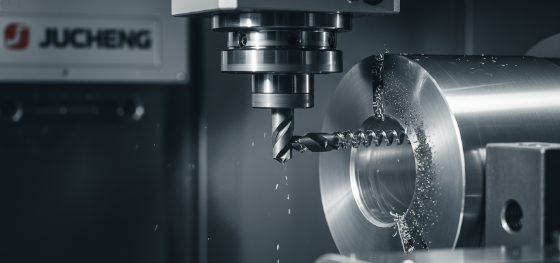
Wenn Bohren das stumpfe Instrument ist, ist Ausdrehen die korrigierende Linse. In der Bohren vs. Ausdrehen vs. Reiben hierarchy, boring is the process used to enlarge an existing hole while correcting its geometric center. Unlike a drill, which follows its own point, a boring bar is a single-point cutting tool that behaves like an internal lathe. Because the tool is offset from the spindle center, it carves a path that is perfectly concentric with the machine's axis of rotation. If a pre-drilled hole has wandered by 0.1mm, a boring operation will bring it back to the true position.
The primary value of boring is geometric truth. It ensures the hole is perfectly round and perfectly straight. This is vital for long internal bores in the CNC-Bearbeitungsprozesses, where any taper would cause a shaft to bind. At Jucheng Precision, we utilize digital boring heads that can be adjusted in increments of 0.002mm. This allow us to hit precise diameters that standard drills simply cannot achieve. Boring also improves the surface finish significantly over drilling, reaching an Ra 1.6 µm range. It is the mandatory step for any part that features a heavy press-fit or a complex internal step that must be perfectly aligned with an outer diameter. We treat boring as the bridge between raw creation and surgical refinement, ensuring that the "location" of your hole is as accurate as its size.
Reiben: Der chirurgische Feinschliff für enge Passungen
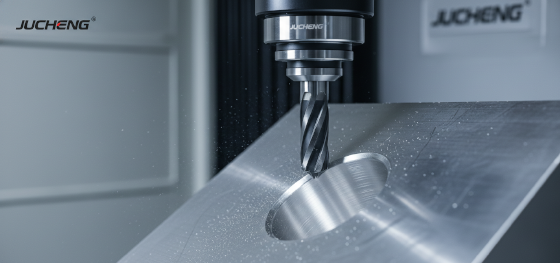
The final tier of the Bohren vs. Ausdrehen vs. Reiben trilogy is reaming. If boring defines the position, reaming defines the perfection. A reamer is a multi-edged finishing tool designed to remove a very small amount of material—typically between 0.1mm and 0.3mm from the diameter. Because it has multiple straight or helical flutes, it provides a highly stable cutting action that produces an incredibly smooth surface finish, often Ra 0.8 µm or better. This is the process JUCHENG uses to achieve H7 or H8 tolerances, where the allowable margin of error is thinner than a human hair.
However, reaming has a critical limitation: it cannot correct the position of a hole. A reamer will follow the path of the existing bore. This is why the sequence is so important. If you ream a hole that was poorly drilled without boring it first, you will end up with a smooth, perfectly sized hole that is in the wrong place. At Jucheng Precision, we combine these technologies into a seamless workflow. We drill to create the void, bore to ensure the location and straightness, and finally ream to lock in the final, mirror-finished diameter. This three-stage protocol is how we deliver medical-grade components that require an exact sliding fit. Reaming is the surgical strike of the machining world—it is fast, predictable, and delivers the consistent sizing needed for high-volume precision assembly.
Das Genauigkeitsparadoxon: Balance zwischen Präzision und ROI
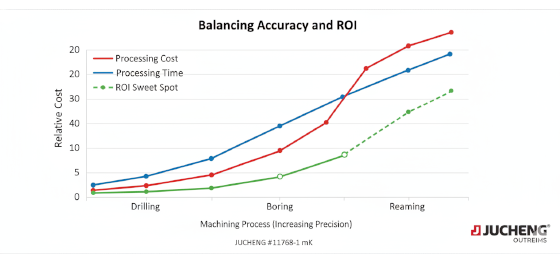
Die Wahl zwischen Bohren vs. Ausdrehen vs. Reiben is ultimately an economic decision based on the physics of your design. Every additional step in the hole-making process adds cycle time and tooling cost. A drilled hole is the cheapest; a reamed hole is the most expensive. The "Accuracy Paradox" in manufacturing is that 90% of a part's cost can be driven by the final 10% of its tolerance requirements.
During our DFM (Design for Manufacturing) reviews, JUCHENG engineers look for opportunities to optimize this balance. If a part is a simple structural bracket, we suggest staying with drilling to save you money. But if the part is a high-speed rotating housing, we mandate the boring and reaming sequence to ensure safety and performance. We also utilize modern "Interpolation Milling" as a flexible alternative to boring for large diameters, using our high-speed 5-axis machines to spiral a mill into a hole with extreme precision. This technical flexibility allows us to offer the most cost-effective path to your desired quality. By understanding the diminishing returns of precision, we help you invest your budget where it actually impacts the function of your product.
JUCHENGs Messtechnik: Verifikation mittels KMG
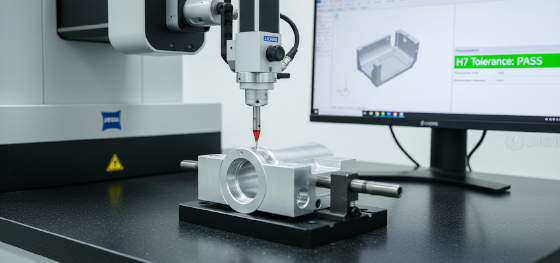
The final hallmark of a professional CNC-Bearbeitungsprozesses is the ability to prove that the hole meets the print. You cannot verify an H7 tolerance with a visual check. At Jucheng Precision, every precision bore we manufacture undergoes a rigorous inspection cycle. We utilize digitized inner-diameter micrometers for real-time shop floor checks, and for final validation, we use our Zeiss and Hexagon Coordinate Measuring Machines (CMM).
Our CMM probes take hundreds of points inside a hole to generate a 3D map of its circularity, cylindricity, and position. We provide our clients with detailed inspection reports that guarantee every Bohren vs. Ausdrehen vs. Reiben operation was executed to perfection. This transparency is vital for medical devices and aerospace assemblies where a single out-of-spec hole could lead to system failure. When you partner with JUCHENG, you aren't just buying a part; you are buying the engineering certainty that your components will assemble flawlessly every time. Don't leave your critical fits to a shop that only knows how to drill. Trust the specialists who understand the entire precision hierarchy. Contact Jucheng Precision today for a technical review of your next precision project.

