


Betreten Sie eine beliebige Präzisionswerkstatt, und Sie werden wahrscheinlich Reihen von weißen, zylindrischen Kunststoffstäben sehen. Für das ungeübte Auge sehen sie identisch aus. Sie teilen dieselbe "industrielle Vanille"-Ästhetik. Aber fragen Sie einen erfahrenen Maschinisten, sie auf eine Drehbank zu legen, und die Wahrheit kommt sofort ans Licht. Ein Material erzeugt knusprige, schneeartige Flocken, die leicht nach Formaldehyd riechen. Das andere produziert lange, gefährliche Bänder, die sich wie ein Vogelnest um die Spindel wickeln und nach verbranntem Haar riechen. Dies ist der klassische technische Showdown: Delrin vs. Nylon.
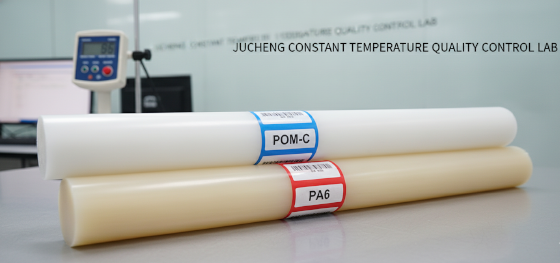
In der Welt der Nylon CNC-Bearbeitung, die Wahl des falschen Polymers ist ein Fehler, der sich oft erst zeigt, wenn das Teil im Einsatz ist. Sie könnten perfekte Toleranzen in einem klimatisierten Raum erreichen, nur um dann festzustellen, dass das Teil in einer feuchten Umgebung aufquillt und blockiert. Bei Jucheng Precision agieren wir nicht nur als Werkstatt, die Kunststoff schneidet; wir dienen als Materialberater. Wir wissen, dass die Wahl zwischen Acetal (Delrin) und Polyamid (Nylon) nicht darum geht, welches "besser" ist – sondern darum, mit welcher Physik Sie leben wollen.
Dieser Leitfaden taucht in die strukturelle DNA dieser beiden technischen Giganten ein. Wir werden über die oberflächlichen Datenblätter hinausblicken, um zu erkunden, wie sie sich unter einem Schneidwerkzeug verhalten, wie sie auf Wasser reagieren und wo sie letztendlich in Ihrer Baugruppe hingehören. Wenn Sie Schwierigkeiten haben, sich für das richtige weiße Kunststoffmaterial für Ihr nächstes Projekt zu entscheiden, wird diese technische Aufschlüsselung den Weg nach vorne klären.
Hygroskopie: Der Feuchtigkeitskrieg
Mechanische Seele: Schlagzähigkeit vs. Steifigkeit
Bearbeitungsverhalten: Späne und Oberflächen
Reibung und Verschleiß: Gleitfähigkeit
Kritische Anwendungen: Präzision vs. Widerstandsfähigkeit
JUCHENGs Auswahlmatrix: Die endgültige Entscheidung
Hygroskopie: Der Feuchtigkeitskrieg
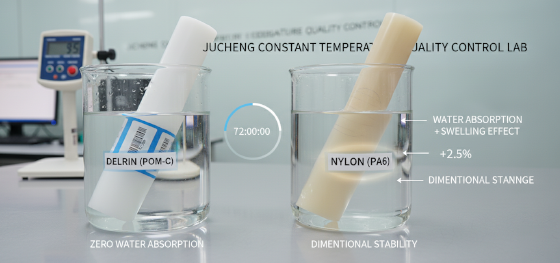
Wenn es einen einzigen Grund gibt, warum Nylon in hochpräzisen Anwendungen versagt, dann ist es der Durst. Nylon ist hygroskopisch, das heißt, es nimmt aktiv Wasser aus der Luft auf. In einer feuchten Küstenfabrik kann ein Nylon-6-Teil um bis zu 2% bis 3% an Volumen aufquellen. Dies ist nicht nur eine Oberflächenveränderung; die Wassermoleküle dringen tatsächlich in die Polymerketten ein und drücken sie auseinander. Dies führt zur Ausdehnung des Materials, was aus einer präzisionsgefertigten Lagerbuchse eine blockierte Katastrophe machen kann.
In der Delrin vs. Nylon comparison, Delrin is the undisputed champion of stability. Acetal (Delrin) has a moisture absorption rate that is nearly ten times lower than Nylon. It remains almost entirely indifferent to humidity. This makes Delrin the mandatory choice for parts that must maintain tight tolerances regardless of the weather—think of fuel system components, medical dosing pumps, or precision gears. At Jucheng Precision, we often tell our clients: if the part needs to fit exactly the same in London as it does in Dubai, specify Delrin. If you specify Nylon, you are essentially designing a moving target.
Mechanische Seele: Schlagzähigkeit vs. Steifigkeit
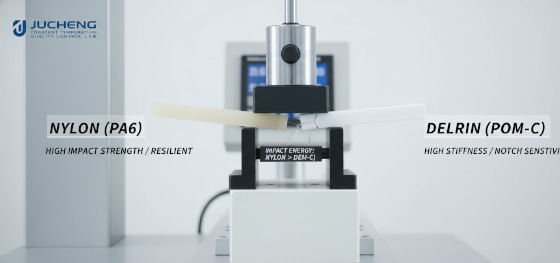
While Delrin wins on stability, Nylon is the heavyweight when it comes to raw toughness. Nylon has a higher "elongation at break" and superior impact strength. It is a material that yields and bounces back where others snap. If you drop a Delrin part on a concrete floor, it might chip or crack due to its notch sensitivity. If you drop a Nylon part, it usually just bounces. This resilience makes Nylon the superior candidate for impact-prone components like hammer faces, conveyor wear pads, and structural bumpers.
However, stiffness is a different story. Delrin has a higher flexural modulus, meaning it is more rigid. It doesn't "creep" or deform under a constant load as much as Nylon does. When you are designing a snap-fit clip, Delrin provides that satisfying, crisp "click" because of its spring-like stiffness. Nylon tends to feel "mushier." At Jucheng Precision, we analyze the load profile of your part during our DFM review. If your part needs to stay rigid under a heavy load, we push you toward Delrin. If it needs to survive being slammed or vibrated, Nylon is your best insurance policy.
Bearbeitungsverhalten: Späne und Oberflächen
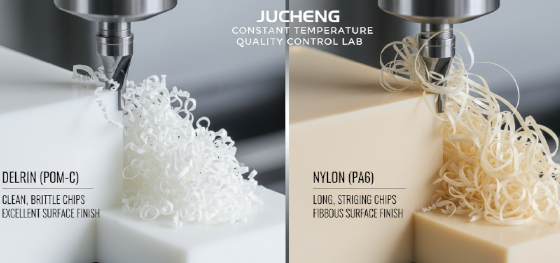
From the machinist's perspective, Delrin vs. Nylon is a battle between a dream and a chore. Delrin is arguably the best-machining plastic in existence. It is free-cutting, produces small, brittle chips that fly away from the tool, and leaves a beautiful, matte-finish surface without any extra effort. Because it doesn't melt easily, we can run our CNC machines at high speeds, which translates to lower part costs for our clients.
Nylon is a gummy material. It doesn't want to break; it wants to tear. This leads to the infamous "stringy chips" that wrap around the tool spindle, creating heat and potentially ruining the part’s surface. Achieving a high-quality finish on Nylon requires exceptionally sharp, high-rake tooling and a lot of air-cooling. It is a slower process that requires more operator attention. At Jucheng Precision, we have mastered the nuances of Nylon tool paths to prevent the "fuzz" or burrs that typically plague cheaper shops. We manage the heat to ensure that the material's internal stress isn't triggered, preventing the part from warping after it leaves the machine.
Reibung und Verschleiß: Gleitfähigkeit

Both of these materials are "self-lubricating," but they handle wear in different ways. Delrin has a lower coefficient of friction against metals, which makes it feel "slicker" to the touch. This is why it is used for almost every precision plastic gear in the world. It starts moving with less force (lower breakaway torque) and runs quiet. However, Delrin is somewhat sensitive to abrasive wear—if grit or sand gets into the system, it will grind the Acetal down quickly.
Nylon, particularly when filled with molybdenum disulfide (MoS2) or oil, is a beast when it comes to abrasive wear resistance. It has a "tougher" surface that can absorb small particles of debris without failing. In a dirty, industrial environment—like a mining conveyor or an outdoor tractor—a Nylon bushing will likely outlast a Delrin one. It is less about "slickness" and more about "durability." Our engineering team at JUCHENG evaluates the cleanliness of your part's operating environment to help make this call. We don't want you to have a gear that is slick but wears out in a week because of dust exposure.
Kritische Anwendungen: Präzision vs. Widerstandsfähigkeit
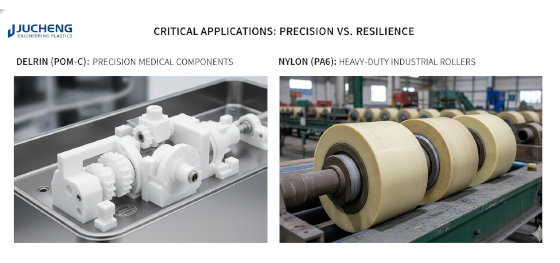
Let’s look at where the lines are drawn in the industry. Delrin is the king of the "small and precise." You will find it in high-end consumer electronics, medical valves, and precision instrumentation. If a part has a complex internal thread or a tiny aperture that must stay round, it belongs in Delrin. The material's rigidity and lack of moisture absorption make it a predictable partner for designers who live in the world of +/- 0.02mm.
Nylon is the king of the "large and load-bearing." It is found in crane sheaves, heavy-duty rollers, and engine-room components. Because it can be cast into massive shapes with low internal stress, it handles the macro-world better than Delrin. Its ability to survive high temperatures (especially Nylon 66) gives it a permanent home in automotive engine bays. When we ship large-format Nylon parts from Jucheng Precision, we are usually shipping components intended for some of the world's most brutal mechanical assemblies.
JUCHENGs Auswahlmatrix: Die endgültige Entscheidung

To help you navigate the Delrin vs. Nylon choice, Jucheng Precision follows a strict decision matrix. We ask three primary questions about your part's destiny.
1. Does it touch water? If yes, choose Delrin. The dimensional shift of Nylon in wet environments is almost impossible to manage.
2. Does it take a beating? If the part experiences sudden impacts or shock loads, Nylon is the only safe choice.
3. Is it a precision fit? For sliding fits, tight-tolerance bores, and high-speed gears, Delrin’s superior machinability and stability make it the winner.
Our facility is equipped with specialized high-speed spindles and climate-controlled production zones to manage both materials effectively. Whether you need the rigid precision of Acetal or the rugged resilience of Polyamide, Jucheng Precision has the technical rigor and the manufacturing capacity to deliver. We don't just cut plastic; we ensure your engineering vision survives the real world. Contact our engineering team today for a free DFM review and see how our plastic manufacturing expertise can clarify your design process.

