


Die Wahl des falschen Rohmaterials ist wie der Bau eines Wolkenkratzers auf einem Fundament aus losem Sand. In der Welt der transparenten Polymere ist dieser Fehler subtil, aber katastrophal. Sie erhalten möglicherweise zwei Platten aus klarem Kunststoff, die identisch aussehen, sich identisch anfühlen und sogar denselben Markennamen tragen. Wenn Sie sich jedoch für die günstigere Option für ein hochpräzises Projekt entscheiden, wird die "genetische Ausstattung" des Materials irgendwann gegen Ihr Design arbeiten. Dies ist die unsichtbare, aber folgenreiche Auseinandersetzung zwischen Guss- und extrudiertem Acryl.

Für einen Ingenieur bestimmt das Walz- oder Gussverfahren von PMMA mehr als nur den Preis pro Quadratfuß. Es bestimmt, wie das Material auf die Hitze einer Spindel reagiert, wie es auf chemische Reinigungsmittel anspricht und ob es seine strukturelle Integrität über einen Lebenszyklus von fünf Jahren bewahrt. Bei Jucheng Precision betrachten wir die Materialauswahl als ersten Schritt des Fertigungsprozesses. Wir haben unzählige Projekte scheitern sehen, weil ein Konstrukteur "Acryl" spezifizierte, ohne zu verstehen, dass Acryl-CNC-Bearbeitung sich je nach Herstellungsweise des Kunststoffs völlig unterschiedlich verhält.
Wenn Ihre Teile für medizinische Verteiler, Automobilbeleuchtung oder hochwertige Einzelhandelsdisplays bestimmt sind, können Sie es sich nicht leisten, die metallurgischen – oder vielmehr die makromolekularen – Unterschiede zwischen diesen beiden Qualitäten zu ignorieren. Dieser Leitfaden entschlüsselt die Physik der inneren Spannungen, des Molekulargewichts und der Bearbeitungsleistung, um sicherzustellen, dass Ihre klaren Designs für immer kristallklar bleiben.
Fertigungsunterschied: Zellen vs. Maschinen
Innere Spannungen: Der stille Präzisionskiller
Dickentoleranz vs. Oberflächengleichmäßigkeit
Bearbeitungsbegegnung: Schmelzen und Spanbildung
Polierpotenzial: Erzielung optischer Klarheit
JUCHENGs Urteil: Warum wir Guss vertrauen
Fertigungsunterschied: Zellen vs. Maschinen

Der Unterschied in Guss- und extrudiertem Acryl beginnt ganz am Anfang des Lebenszyklus des Materials. Zellgegossenes Acryl wird hergestellt, indem ein flüssiges Monomer (MMA) zwischen zwei hochwertige Glasplatten gegossen wird. Diese Platten werden zusammengeklemmt, und das Material kann polymerisieren – eine langsame, geduldige chemische Reaktion, die extrem lange Molekülketten aufbaut. Dieser "Batch"-Prozess ist zeitaufwändig und arbeitsintensiv, führt aber zu einem Material mit einem hohen Molekulargewicht und einer hochstabilen, ungeordneten Molekularstruktur. Es ist im Wesentlichen die "handwerklich hergestellte Kleinserien"-Version von Kunststoff.
Extruded Acrylic is the product of mass production. Pellets of acrylic resin are fed into a heated hopper, melted into a thick paste, and then forced through a high-pressure die by a massive screw. The plastic is pushed between rollers to achieve the final thickness. This process is incredibly efficient and produces miles of material per day. However, that intense physical pressure forces the polymer chains to align in the direction of the extrusion. These shorter, "stretched" chains are under constant tension, creating a material that is ready to fail the moment it encounters the heat of a CNC tool or the stress of a drill bit.
Innere Spannungen: Der stille Präzisionskiller
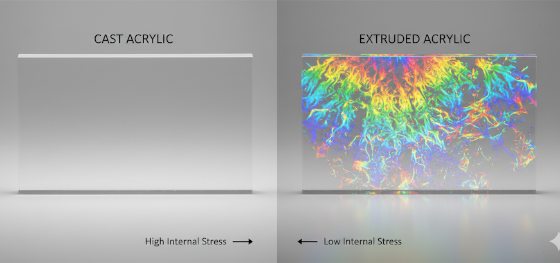
If you look at both materials under normal light, they look identical. But at Jucheng Precision, we use polarized filters to inspect raw stock. Under polarized light, extruded acrylic reveals a chaotic rainbow of "frozen stress" patterns. Because the material was forced through a die, those polymer chains are like thousands of tiny, coiled springs. When we remove material from an extruded sheet during Acryl-CNC-Bearbeitung, we are cutting those springs. The result is almost always warping. A flat panel made of extruded acrylic will often bow or cup within hours of being removed from the machine.
Even more dangerous is a phenomenon called "crazing." Those internal stresses are constantly trying to pull the material apart. If an extruded acrylic part is exposed to any solvent—even standard window cleaner or Isopropyl alcohol—those microscopic stress lines will suddenly erupt into thousands of tiny white cracks. Cast acrylic has virtually no internal stress because it was allowed to form naturally in a mold. In the Guss- und extrudiertem Acryl comparison, cast is the clear winner for any part that must remain structurally stable and aesthetically perfect for years of service in varied environments.
Dickentoleranz vs. Oberflächengleichmäßigkeit
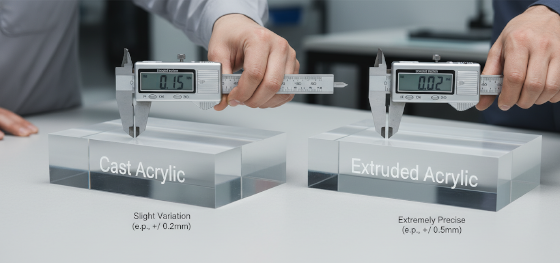
There is one area where extruded acrylic actually wins: thickness consistency. Because it is pushed between precision metal rollers, a 10mm extruded sheet will measure almost exactly 10mm across its entire surface, usually with a tolerance of +/- 0.1mm. This makes it popular for simple laser cutting or signage where the material must fit into a standardized track. If your design relies on the raw thickness of the sheet as a critical dimension, extrusion offers the easiest path.
Cast acrylic is much sloppier. Because it is poured between glass plates that can bow slightly under the weight of the liquid, the thickness can vary significantly across a single sheet. A "10mm" cast sheet might be 9.5mm at the edge and 10.5mm in the center. However, for precision CNC machining, this doesn't matter to us at JUCHENG. Our first step for critical parts is often a "skimming" pass, where we mill the material to a perfectly uniform thickness ourselves. We trade the initial thickness tolerance of extrusion for the superior chemical stability of cast, knowing that we can fix the dimensions but we cannot fix the chemistry.
Bearbeitungsbegegnung: Schmelzen und Spanbildung
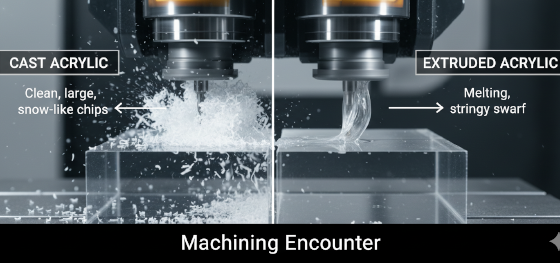
The most dramatic evidence of the Guss- und extrudiertem Acryl divide appears the moment the tool hits the plastic. Cast acrylic has a higher molecular weight, which translates to a higher melting point. When we cut cast acrylic, it produces crisp, cold flakes that fly away from the tool. The material has enough structural integrity to resist the heat generated by the friction of the cut. It feels much more like machining a soft metal than a plastic.
Extruded acrylic is "gummy." Because the molecular chains are shorter, the material softens at a much lower temperature. If the tool path dwells in one spot for even a fraction of a second, the chips will begin to melt and weld themselves back onto the part or, worse, fuse to the tool flutes. Machining extruded acrylic requires much slower speeds and aggressive air cooling to prevent a "plastic meltdown." For Jucheng Precision’s high-speed 5-axis centers, cast acrylic is the only material that can keep up with our production pace without risking a ruined part.
Polierpotenzial: Erzielung optischer Klarheit

If your goal is optical clarity—the kind needed for luxury automotive lenses or medical diagnostics—there is no contest. Cast acrylic is the gold standard for polishing. Because it is harder and more stable, it accepts mechanical buffing and vapor polishing with incredible results. The surface remains clear and brilliant. Because it has no grain direction, the polish is uniform regardless of which angle you are looking from.
Extruded acrylic reacts poorly to high-end polishing. During vapor polishing, the chemical gas attacks the aligned polymer chains and can cause the material to "frost" or become cloudy. Even with hand polishing, the heat from the buffing wheel often causes the surface to "roll" or smear rather than cut, leaving a hazy finish that looks unprofessional. At JUCHENG, we refuse to use extruded acrylic for any part requiring a high-gloss or vapor-polished finish. We believe that if you are paying for precision Acryl-CNC-Bearbeitung, you should receive a part that is truly transparent, not just "mostly clear."
JUCHENGs Urteil: Warum wir Guss vertrauen

The final decision in the Guss- und extrudiertem Acryl debate is a balance between initial material cost and the total cost of quality. Extruded acrylic is cheaper per sheet, but it carries a high hidden cost in scrap rates, warping, and delayed cracking. It is perfectly suitable for simple retail signage or protective covers that don't require tight tolerances. But for anything involving high-value engineering, it is a liability.
At Jucheng Precision, we have made a strategic choice. We exclusively use high-quality cell cast acrylic for all our precision CNC machining and prototyping projects. This decision allows us to offer our clients a 100% guarantee against stress-cracking and material warping. We believe that the slight premium in raw material cost is a small price to pay for the peace of mind that comes with superior performance. Whether you are building a complex prototype for a light pipe or a structural medical manifold, let our engineers guide you to the right material. Upload your CAD file today and experience the clarity that only high-end cast acrylic and expert machining can provide.

