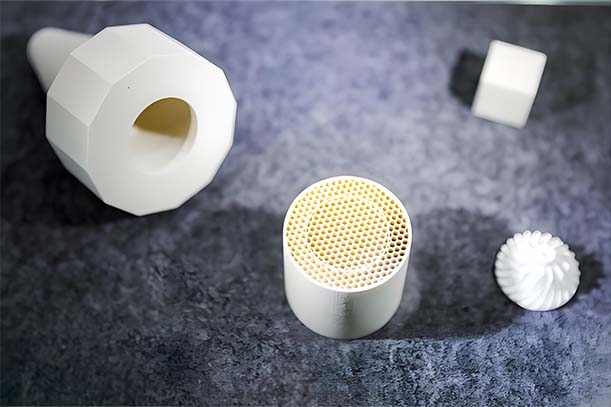
- Funktionsprototypen, langlebige Teile mit komplexen Geometrien.⦁ Maximale Baugröße bis zu 600*450*350 mm
⦁ Bereits in 2 Tagen
⦁ Maßgenauigkeit ± 0,3% mit einer unteren Grenze von ± 0,3 mm (± 0,012”)
⦁ Schichtdicke 80 μm
- Erscheinungsbild-Prototypen, vergleichbar mit Spritzgussteilen.
⦁ Maximale Baugröße bis zu 1370*670*498 mm
⦁ Bereits in 1 Tag
⦁ Maßgenauigkeit ± 0,5% mit einer unteren Grenze von ± 0,15 mm
⦁ Schichthöhe 50-100 μm
-
Günstig und einfach zu bedienen
⦁ Maximale Baugröße bis zu 1380 × 680 × 480 mm
⦁ Bereits in 1 Tag
⦁ Maßgenauigkeit ± 0,5% mit einer unteren Grenze von ± 0,15 mm
⦁ Schichthöhe 50-100 μm
-
⦁ Hochwertige, funktionale Teile mit feinen Details. Beliebt für Kleinserienproduktionen.
⦁ Maximale Baugröße 600 x 650 x 380 mm (14,9” x 11,2” x 14,9”)
Standarddurchlaufzeit 2 Tage
⦁ Maßgenauigkeit ± 0,3 % mit einer unteren Grenze von ± 0,3 mm (0,012 Zoll) Schicht
⦁ Schichtdicke 80 μm
- Material SS316L, AlSi10Mg, Ti64 verfügbar
⦁ Maximale Baugröße
280*280*350 mm
⦁ Standardlieferzeit 7 Werktage
⦁ Maßgenauigkeit ± 0,2 % mit einer unteren Grenze von ± 0,2 mm
⦁ Schichthöhe 30 μm
Fordern Sie Ihr DFM & Angebot an – Laden Sie Ihre Zeichnungen hoch
ㆍGeben Sie Ihre Anforderungen ein und laden Sie Ihre 2D- und 3D-Dateien hoch. Wir senden Ihnen innerhalb von 24 Stunden Ihr Projektangebot und DFM zurück.ㆍDateitypen: STEP, STP, IGES, IGS, SLDPRT, 3DM, SAT, X_T, DWG, DXF, STL, PDF, ZIP und mehr. Dateigröße: < 128 MB Teilegröße: < 1500*1500*1500 mm
ㆍDatenschutz: Wir respektieren Ihre Privatsphäre. Hier finden Sie ein Beispiel einer Geheimhaltungsvereinbarung. Mit dem Absenden dieses Formulars stimmen Sie unseren AGB und der Datenschutzerklärung zu.
ㆍDatenschutz: Wir respektieren Ihre Privatsphäre. Hier finden Sie ein Beispiel einer Geheimhaltungsvereinbarung. Mit dem Absenden dieses Formulars stimmen Sie unseren AGB und der Datenschutzerklärung zu.