

Vacuum casting VS Reaction injection molding process differences.
Aufrufe: 21 Author: Site Editor Publish Time: 2023-12-04 Origin: Seite


Vacuum casting and reaction injection molding (RIM) are both processes used for the production of plastic or polyurethane parts, but they have distinct differences. Here are the key differences between vacuum casting and reaction injection molding:
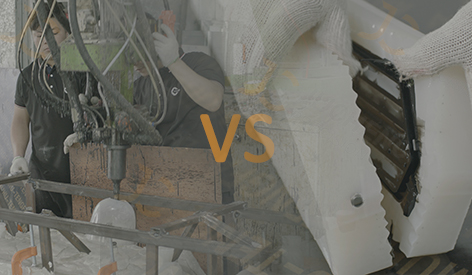
Process Principle:
Vakuumguss: Involves creating a silicone mold from a master pattern and then using a vacuum to draw liquid resin into the mold. This process is suitable for small to medium-sized production runs of high-quality prototypes and end-use parts.
Reaction Injection Molding (RIM): Utilizes a chemical reaction between two liquid components (polyol and isocyanate) to create a polymer. The reaction occurs in the mold, where the mixture expands to fill the cavity. RIM is typically used for larger parts with lower production volumes.
Material Used:
Vacuum Casting: Typically uses polyurethane or epoxy resins, providing a wide range of material properties, including flexibility, hardness, and transparency.
Reaction Injection Molding (RIM): Uses liquid polymers, often polyurethane, resulting in parts with high strength, impact resistance, and surface finish.
Production Volume:
Vacuum Casting: Well-suited for low to medium production volumes. It is often used for prototyping and small-scale production.
Reaction Injection Molding (RIM): Suitable for low to medium volumes, but it can be more economical for larger parts compared to vacuum casting.
Tooling and Mold Design:
Vacuum Casting: The process involves first creating a master pattern, then pouring liquid silicone over it. As the silicone solidifies, it forms a detailed mold capable of replicating complex shapes.
Reaction Injection Molding (RIM): Requires a mold that can withstand the chemical reaction and the pressure of the expanding polymer. Typically, molds are made from metals.
Cycle Time:
Vacuum Casting: Generally has a shorter cycle time compared to RIM, making it suitable for rapid prototyping and faster production runs.
Reaction Injection Molding (RIM): Typically has a longer cycle time due to the chemical reaction and the time required for the polymer to cure and solidify.
Part Size:
Vacuum Casting: Well-suited for small to medium-sized parts.
Reaction Injection Molding (RIM): Particularly suitable for larger parts due to the nature of the molding process.
In summary, vacuum casting and reaction injection molding serve different purposes in terms of production volume, part size, material properties, and tooling requirements. The choice between them depends on specific project needs and requirements.

ㆍDatenschutz: Wir respektieren Ihre Privatsphäre. Hier finden Sie ein Beispiel einer Geheimhaltungsvereinbarung. Mit dem Absenden dieses Formulars stimmen Sie unseren AGB und der Datenschutzerklärung zu.
